

Your brain can’t start focused work when it knows an interruption is coming.
A region of the prefrontal cortex is responsible for tracking future obligations, and the moment it detects something coming, it keeps your brain in a low-grade state of readiness that blocks the neurological shift required for flow.
You feel it as resistance. A subtle pull away from the hard stuff. You write it off as a rough morning.
Your calendar did that to you.
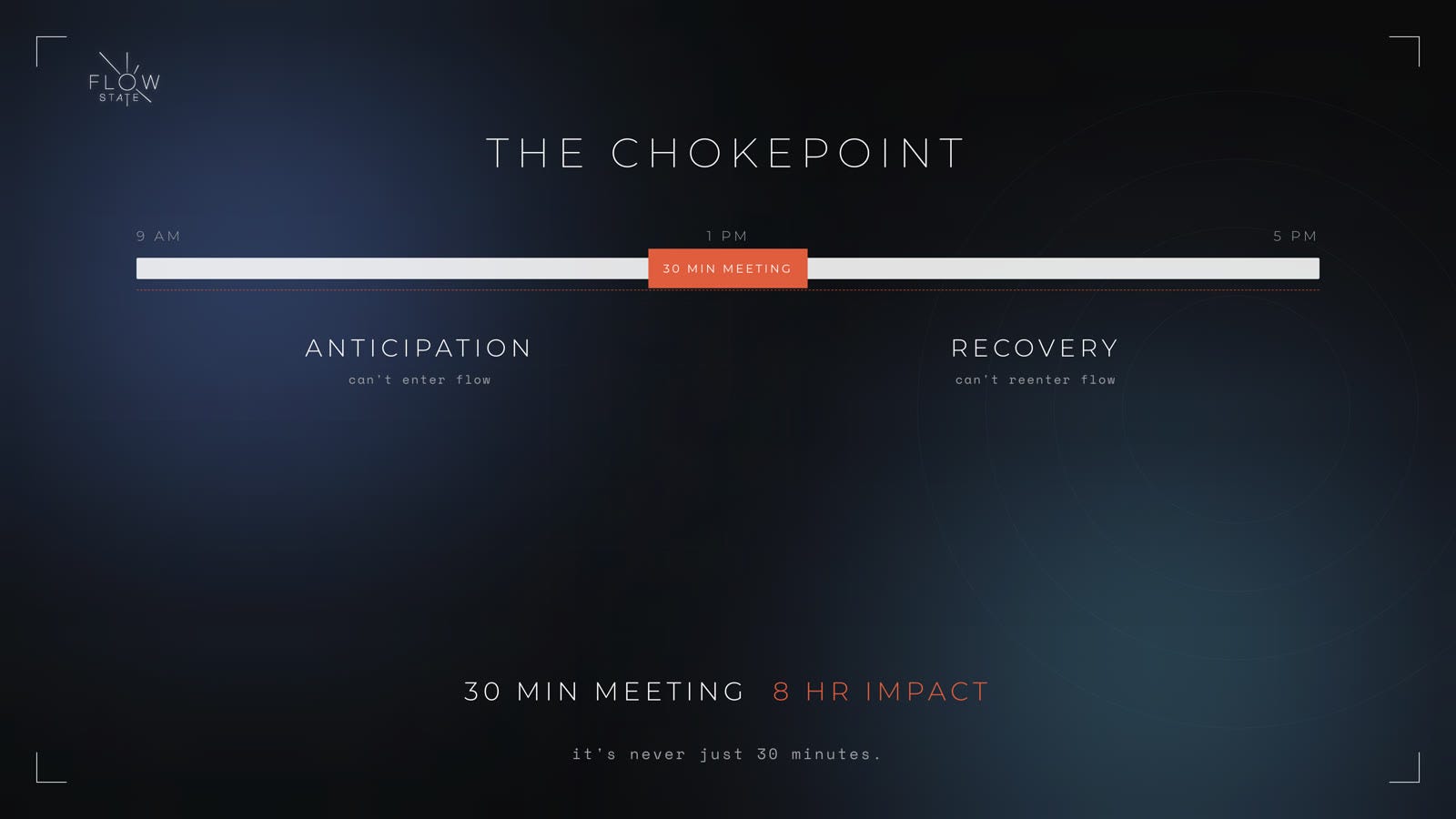
The meeting on your calendar at 2 PM reduced your capacity to access flow state at 9 AM.
I. THE TRAP I COULDN’T NAME
The first time I built a proper team of employees, I thought my schedule would finally open up.
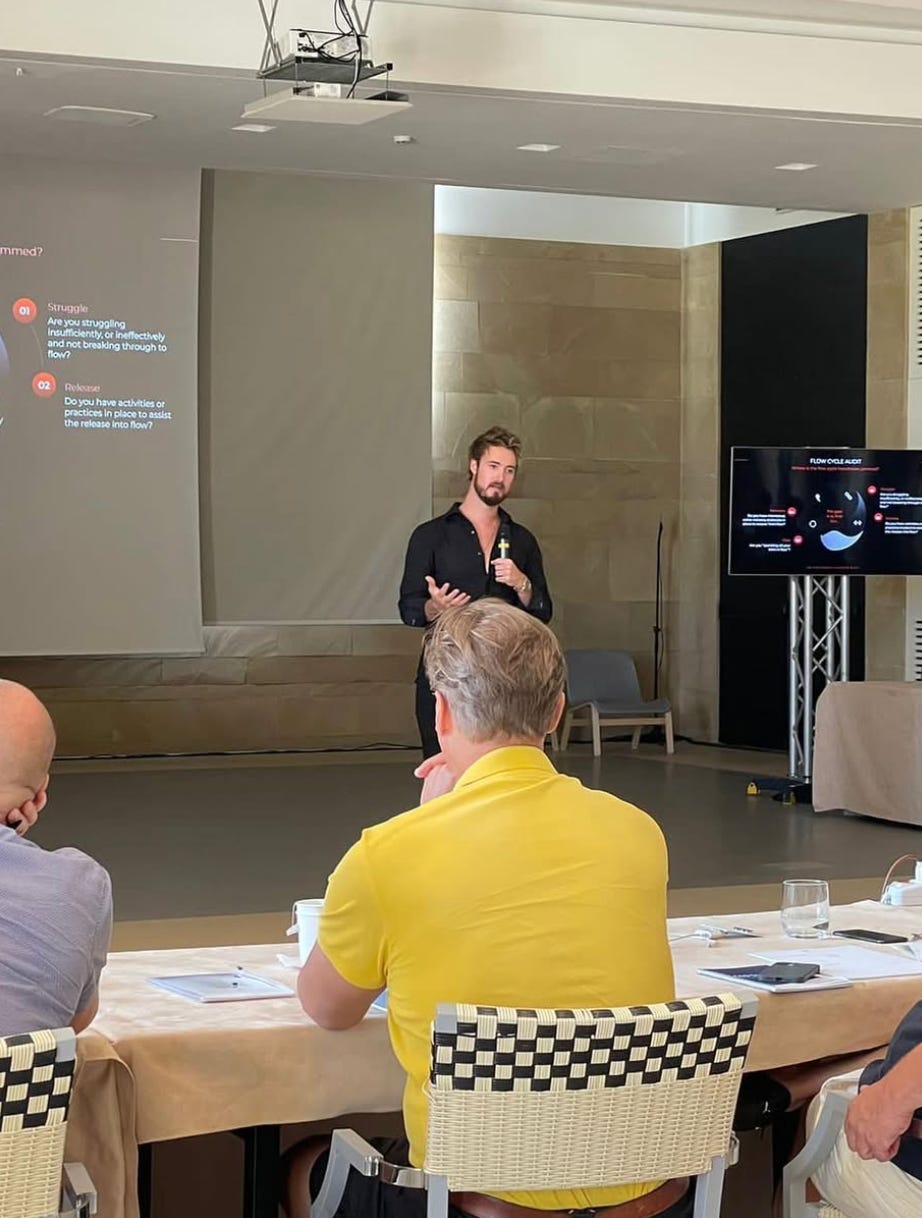
More people meant more delegation, which meant more time for the ultra-focused, high-impact work that actually moves a business forward...right?
Instead, I found myself stuck in a trap I couldn’t name.
I’d wake up ready for challenging work - the kind that’s easy to resist, but matters most.
And then I’d glance at my calendar...
9:30 AM meeting.
Something subtle would shift.
It felt like a whisper in the back of my mind saying, “Is it even worth starting something deep right now?”
I’d try to fight it. I’d open the project anyway, ready to dive into the complexity.
But somewhere under the surface, my brain was already pulling back.
So I’d burn the hour before the meeting on shallow stuff. Emails, Slack, busy work.
Then the meeting would come, take 30 minutes, maybe stretch to an hour.
I’d try to reset afterward.
But the next obligation was already there: 12:00 PM team all-hands meeting.
And the pattern just repeated. All day.
The meetings weren’t the leak. The leak was the mental math my brain was running in the background, quietly recalculating whether the effort to focus was even worth it.
I had built this team to increase my productivity.
Instead, I had destroyed it.
I was now the least productive person on the team and the biggest bottleneck.
I had the overhead of salaries, and I couldn’t even find the uninterrupted space to lead, strategize, or even review their work properly.
I was blocking them, blocking myself, and burning through time and energy without making meaningful progress.
It was only later that I realized what was really happening.
II. WHY STRUGGLE NEEDS A PAYOFF
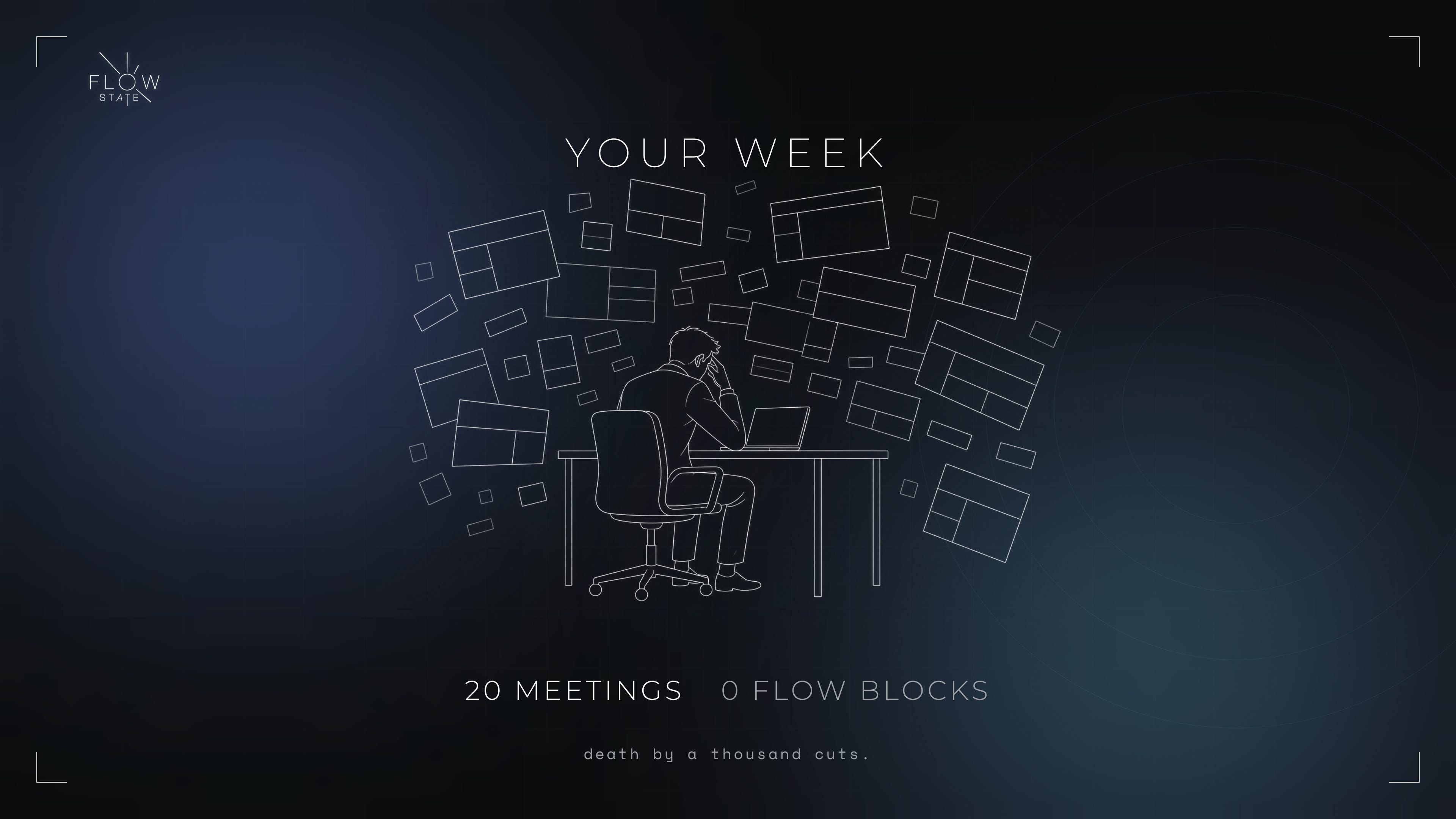
Flow, that peak state of focus and execution where productivity soars, is one stage in a four-phase cycle:
Struggle: Your brain wrestles with the challenge at hand. There’s a surge of norepinephrine, which makes this phase hugely uncomfortable and effortful.
Release: To transition into flow, you need a moment where the brain lets go of conscious control. You step back from the problem, and the processing shifts from conscious to subconscious.
Flow: The peak performance state where everything clicks - immersion, deep focus, and effortless action.
Recovery: Once flow is over, your brain needs active recovery to consolidate learning, replenish neurotransmitters, and prepare for the next cycle.
Once I understood the cycle, I could see the real damage. My focus was held hostage by what was coming next.
I was losing the willingness to struggle in the first place.
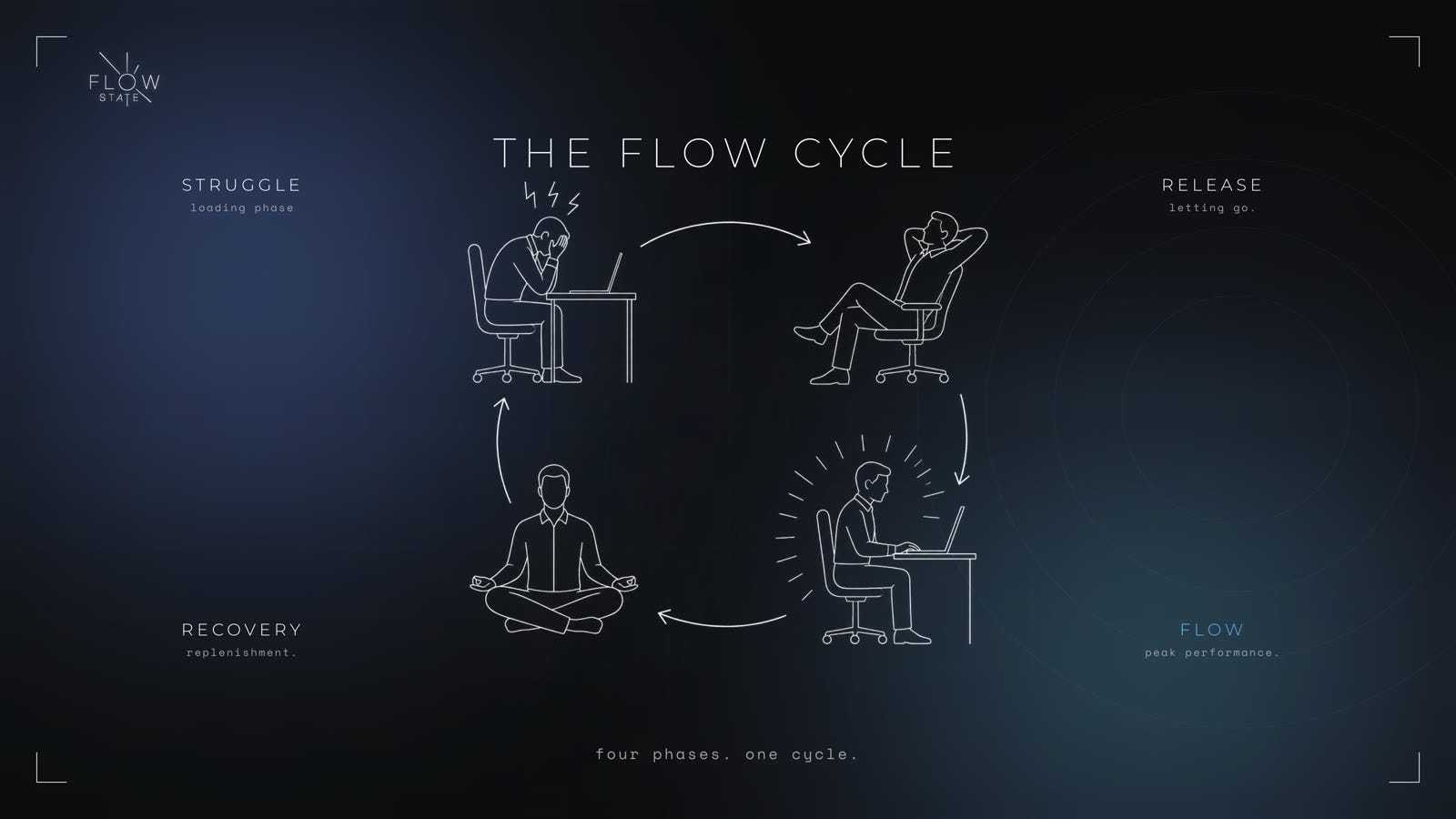
And that’s the core problem: If you know in advance that your work will be interrupted, you subconsciously resist the struggle phase that’s required for flow - because your brain calculates that the effort won’t be worth the reward.
Building a sandcastle on the beach feels pointless if the tide can wipe it out at any moment.
Same with work: If you know you’ll be interrupted, struggle becomes harder to endure. You resist the task.
The struggle is mentally taxing. So to justify it, flow alone isn’t enough. You need the promise of prolonged, uninterrupted immersion.
Think of surfing.
Would you wake at dawn, wax your board, and battle cold waves if the ocean went flat after one or two rides?
I know I wouldn’t - there just wouldn’t be enough of a struggle payoff.
It’s the same with persisting through struggle at work.
You rally your focus, block distractions, push through discomfort - only to get interrupted after 15 minutes. Without an uninterrupted flow session, struggle feels pointless. No waves to catch.
III. THE INVISIBLE ENEMY: CALENDAR CHOKEPOINTS
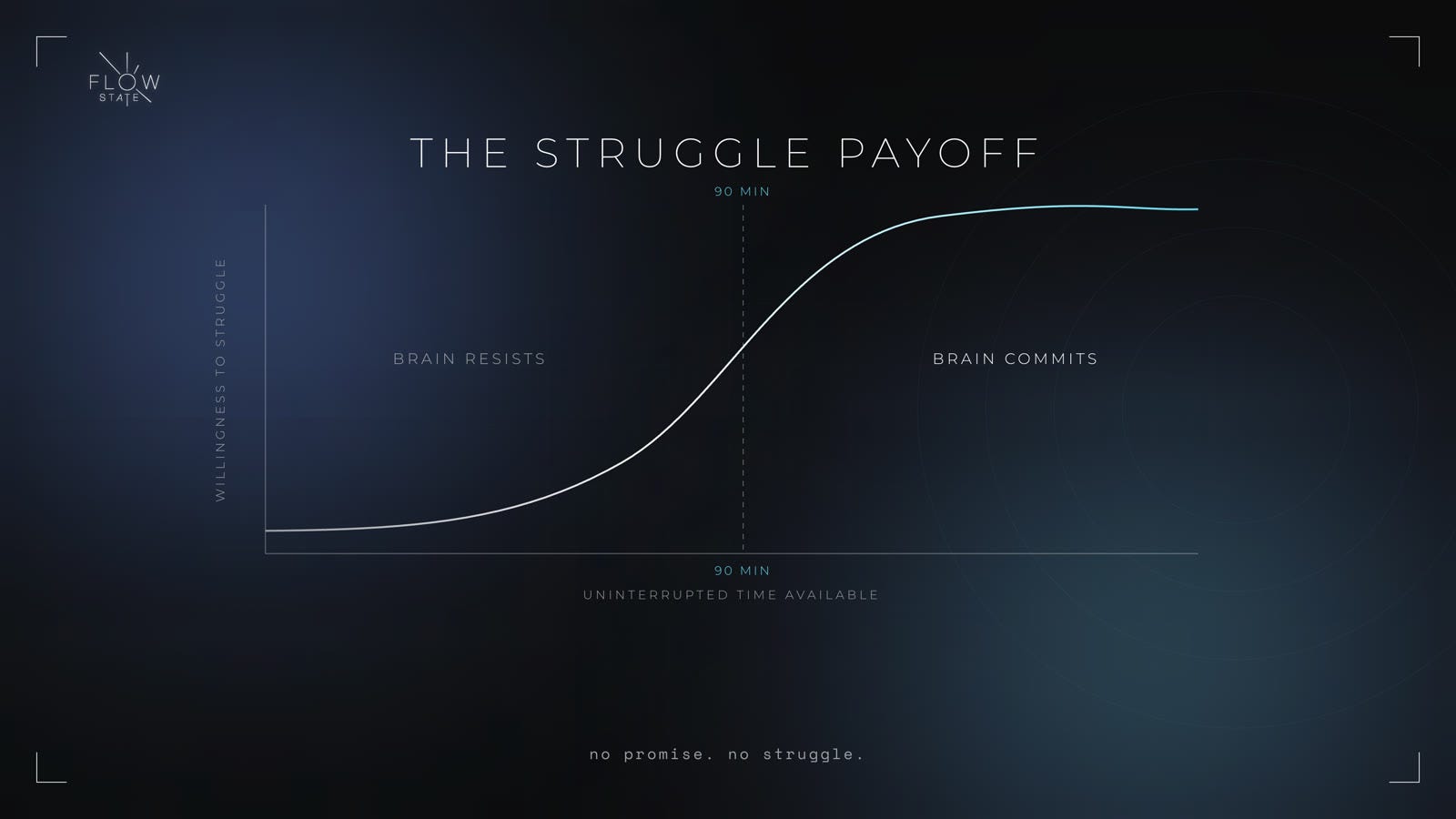
The thing that kills the payoff is a calendar chokepoint.
Calendar chokepoints are seemingly minor obligations - meetings or appointments - that fragment your day and leave you with insufficient time to get into flow.
A calendar chokepoint is like a crack in a dam. It doesn’t have to be large to cause a massive leak.
You know how this goes:
It’s Monday morning. You look at your calendar. A 10 AM meeting. A 12:30 check-in. A 4 PM sync.
Your day is sliced up like Swiss cheese.
You don’t have a single block long enough to get into a flow state deep enough to justify the struggle to the part of you that is resisting the effort required to do the work you know you need to do.
Building on the surfing analogy: Imagine you’re paddling out into the ocean, ready to catch some waves.
You’ve braved the early morning cold, waxed your board, and fought through the choppy water.
Just as you’re about to catch the perfect wave, someone else drops in on the wave you’re about to surf, killing your momentum.
A calendar chokepoint is that other surfer.
It’s that single unwelcome but planned disruption in your day that kills your momentum and ruins your flow.
IV. THE NEUROSCIENCE: WHY YOUR BRAIN CAN’T LET GO
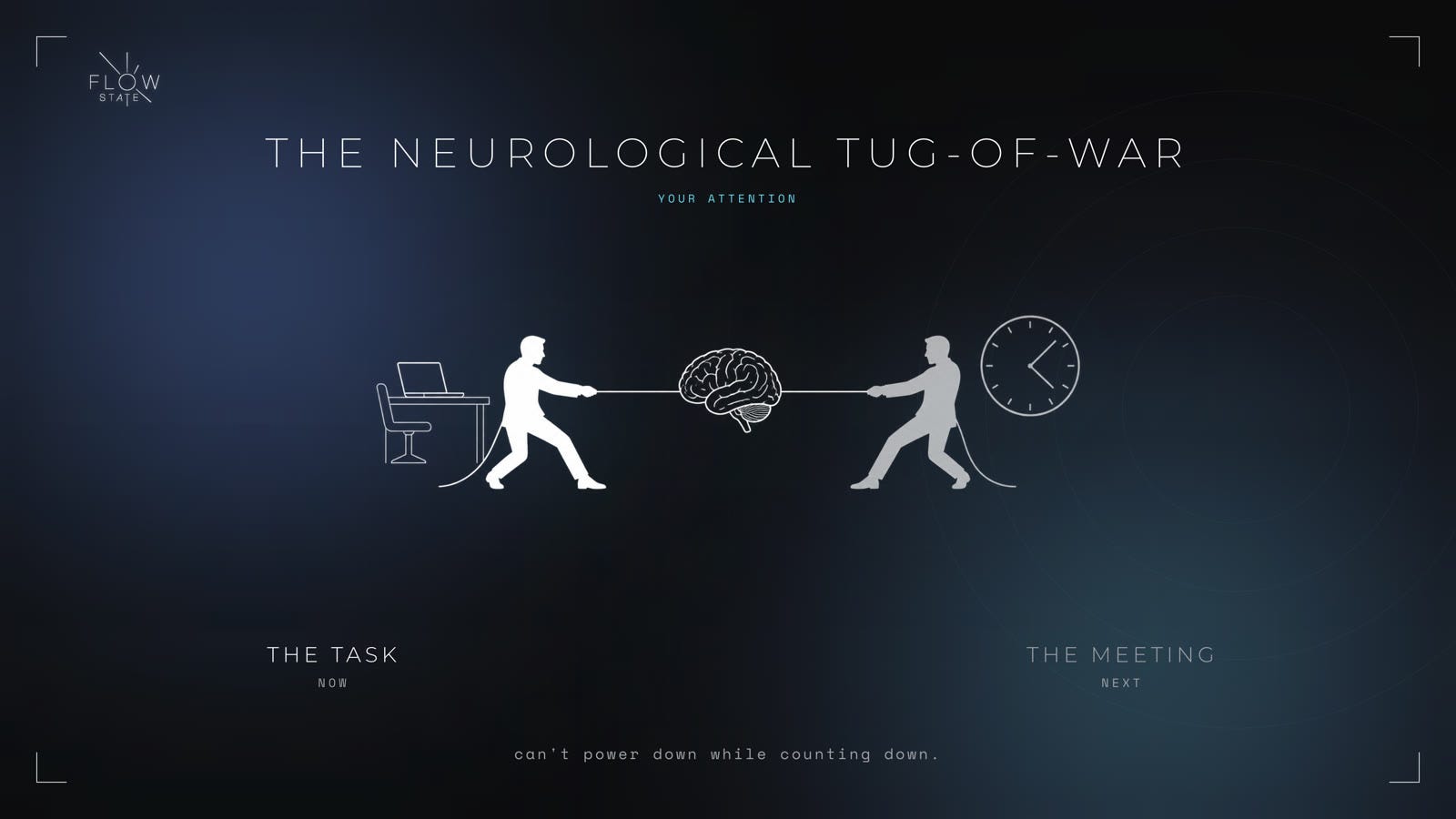
We think this traces to the dorsolateral prefrontal cortex (dlPFC).
Flow state happens when all of your attention is fully locked into the present.
But a calendar chokepoint creates a neurological tug-of-war between now and next.
Among other things, your dlPFC is responsible for prospective time monitoring - tracking future obligations, ensuring you don’t forget what’s coming up. The moment a meeting appears on your calendar, your dlPFC locks onto it, keeping a mental timestamp, running background processes, and subtly anchoring your attention to the upcoming event.
This creates sustained activation in the dlPFC.
And that’s the problem.
Flow happens when the dlPFC downregulates - a state called transient hypofrontality.
This is what allows deep immersion and effortless execution. It’s what lets you lose yourself in your work.
This prefrontal quieting is what allows for some of the key characteristics of flow:
The loss of self-consciousness - you stop thinking about yourself and just act instead
The merging of action and awareness - effortless, fluid execution
Time dilation - losing track of time, minutes turning into hours
In flow, you’re surrendering.
The “you” that grips, holds on, steers, and tries to control every aspect of your life begins to fade as the dlPFC quietens.
That vigilant, ever-present narrator of your existence - the voice constantly reminding you of who you are, what you’re doing, and where you stand - falls silent.
You are temporarily surrendering your sense of self, suspending your conscious control over your own existence.
Your brain shifts from effortful, top-down control to more efficient, bottom-up processing.
Regions like the basal ganglia and cerebellum take over, allowing practiced skills and intuition to flow without interference from self-doubt.
But it’s extremely hard to let go and surrender into flow when the brain has to maintain high prefrontal activity.
There’s an inherent contradiction:
You’re trying to quiet the dlPFC, and yet you’ve given it something to chew on and stay activated around.
Your brain struggles with doing both at the same time.
It’s like trying to flex and relax the same muscle at once.
Your dlPFC can’t power down while it’s counting down.
And because the dlPFC stays engaged - tracking the time gap, constantly recalibrating effort - you never fully let go.
And letting go is the price of admission to flow.
V. THE TRUE COST
Flow doesn’t just need time - it needs trust that time won’t run out.
This is why even a single calendar commitment fundamentally alters your ability to access flow.
A 30-minute call at 2 PM derails the day because it alters your consciousness. You become less susceptible to flow for the rest of the day.
VI. THE 5-STEP PROTOCOL FOR CLEARING CALENDAR CHOKEPOINTS & MAXIMIZING FLOW
First, the basics: To avoid calendar chokepoints, collapse meetings where possible - from in-person to Zoom, Zoom to phone, phone to email, email to text, text to nothing.
Research has found that up to 70% of meetings are potentially unnecessary.
Any meetings you still have to have? Shrink them by at least 25% in terms of length (at least the ones you control).
And when that’s not possible, batch your communication outside of your peak productive hours, and bookend your meetings - either knock them all out at the beginning of the day or right up against your hard stop for the day, after your flow blocks.
Bonus tip: Rather than trying to end your meetings five minutes before the hour, start them 5 minutes after the hour or the half hour.
A meeting that runs from 2 to 2:25 will run over to 2:30, since that’s the natural time people expect.
But if you end it at 2:30 - which is when other people have calls - but the next one starts at 2:35, your likelihood of having a 5-minute break is much higher.
Now, with these basics handled, let’s get strategic about clearing your calendar chokepoints and protecting your flow.
Step 1: Implement Policy Bans
For each identified chokepoint source, create a policy ban. This is where your policy for saying no comes into play.
This kind of no is a tactic for setting boundaries without guilt or awkwardness.
You say no to a category of activity, not to the person. By framing your refusal as a clear, pre-set policy, you protect your priorities while maintaining relationships.
For example:
“I don’t do social meetups during the workweek.”
“I’m off boozing for November.”
“I’m on a ‘no coffee and meetups’ diet for the month.”
The no is an external rule. It isn’t personal.
In separating the decision from the relationship, you can make a clear decision and communicate it with kindness.
The no in action:
My friend Scott lives nearby in LA.
He invites me to a party in Hollywood on Friday night. But I’m not available because I’m writing a book. So how do I say no to a good friend with an appealing invitation?
“Scott. What a great idea. That would be a blast. I’ve wanted to do that for a while, and it’d be a good chance to catch up.
Unfortunately, I’ve done it again. I’ve misplanned the timeline for a book I’m working on and need the full weekend to work on it.
I want you to know - spending time with you is a priority for me, but given the time-sensitive nature of this project, I have to put it ahead here.
This book is tied to a publishing deadline, so I have to nail it. I know you’ve been in similar situations and understand.”
Of course, the explanation can be simpler and shorter, too:
“I’d love to, but I’m writing a book and have a tight deadline. I’ll be able to join you once I pop out of the writing cave. I’m excited to see you.”
The four parts of a no:
Politeness & Personal Acknowledgement: Acknowledge and compliment them on the value of whatever they’re asking.
Admit Your Shortcomings: Demonstrate humility by showing them what you can’t handle.
State Your Priorities with Specificity: Be detailed so they can empathize with your situation. If you don’t give enough information, they will fill in the gaps with less favorable assumptions (for example, that you don’t care).
Never Backtrack: This makes your “no” seem disingenuous and can cause anger or irritation. The “no” must be a legitimate, unmovable decision.
Step 2: Stack consecutive empty days
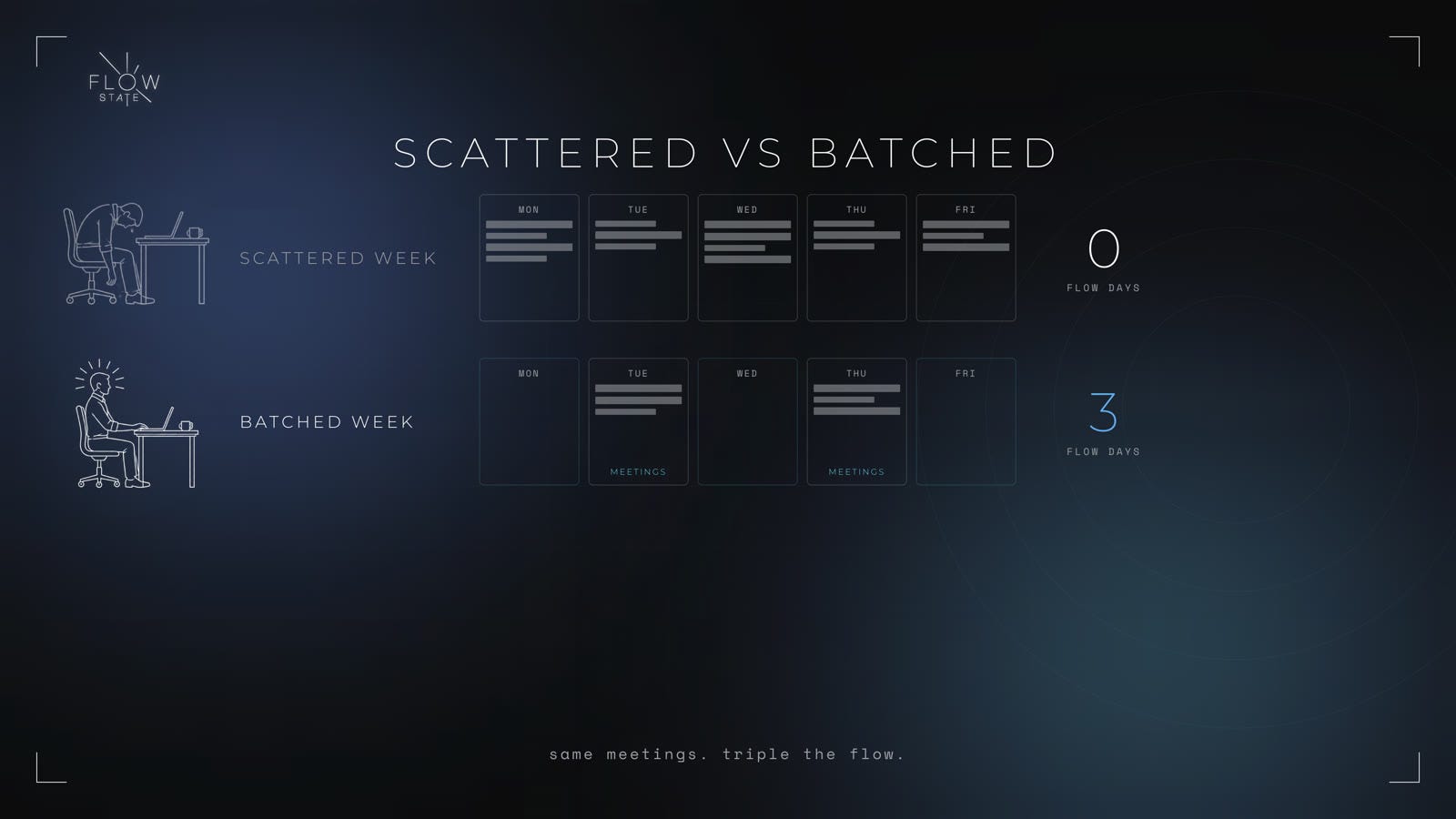
The same way a single meeting can fragment your focus within a day, a scattered week does the same thing at scale.
Each time you allow a meeting to slice up your workday, you not only lose flow today - you make it harder to access flow tomorrow.
Why?
Because your brain treats flow as an investment. If your dlPFC predicts that tomorrow will be another fragmented day, it subconsciously resists entering struggle today.
This is why high-flow individuals don’t just protect individual days.
They aim to protect entire weeks.
Back-to-back chokepoint-free days give you consecutive days with nothing on the calendar, a sequence of uninterrupted, high-output workdays where deep immersion compounds.
And just like with single-day flow, the more runway you have, the easier it is to persist through struggle, let go, and enter flow faster each time.
It’s like the runway of a plane.
For the plane to take off, you need a long runway. Similarly, for immersion to occur, you need runway. The longer the runway is, the deeper the immersion can go.
With consecutive empty days, you don’t even have to think about setting priorities or what you’ll do the next day.
There’s just the one big priority you’re tackling, and you can tackle it continuously day over day over day.
A solid way to measure your life’s creative output is to add up your total consecutive days with nothing on the calendar, singularly focused on whatever your highest priority thing is.
To create consecutive empty days, maximize the total amount of chokepoint-free days in your week. Be ruthless.
Reduce all the meeting lengths, cut all the meetings you don’t need, and batch everything back to back.
One-Week Meeting Day:
One client I was working with had enough space roughly to do all of his calls on a Monday, but he had them peppered throughout the week.
So I had him implement a One-Week Meeting Day.
If you control your own schedules, an advanced flow strategy is instead of scattering meetings throughout the week, batch all calls into a single day per week (8-10 hours of calls in a single day, ideally Monday).
This creates maximum flow potential on all other days, allowing for deep, sustained work.
Remain incredibly vigilant about incoming call requests that will chokepoint any of the free days you have after this.
And become comfortable with not doing a call until the following Monday.
Even if they ask for a call on Tuesday or Wednesday, say, “Hey, I’ve got a spot on Monday” and allow yourself to wait for that call.
If you have some calls spill over, spill them into the next day (Tuesday), not into another day like Wednesday.
You want consecutive chokepoint-free days because the same effect that occurs within a day occurs across days.
Remember: Switching the category of activity is what breaks flow. A day of back-to-back calls can still be a flow day. A day that flips from writing to calls to writing cannot.
A benefit of a one-day meeting approach is that you’ll build up social flow - which is a subtype of flow state that can only happen when interacting with others.
And this social flow can carry meeting over meeting, specializing in that mode of cognition for that day and bifurcating from that mode of cognition for the other days.
Step 3: Clear Your Next Ten Days
Look at your calendar for the next ten days. Apply your new policies and clear out any existing chokepoints. This might involve:
Rescheduling meetings
Delegating tasks
Politely declining invitations using your policy responses
Aim to create at least 3-4 chokepoint-free days within this period.
Step 4: Protect tomorrow’s long uninterrupted block
Choose a goal-directed action for tomorrow that requires deep focus. Now, examine your calendar to protect the promise of a long uninterrupted block:
Identify the ideal time block for this action.
Look for ways to create more uninterrupted space around this time:
Can you move any meetings earlier or later?
Are there tasks you can delegate or reschedule?
Can you extend your focus block by starting earlier or ending later?
Apply your policy no to any requests that might intrude on this time.
Example: Let’s say you need to write a crucial report tomorrow. You’ve blocked 10 AM - 12 PM for this task. To protect the promise of a long uninterrupted block:
Move your 9:30 AM check-in call to 9 AM
Cancel your 12:30 PM lunch meeting
Set your status to “Do Not Disturb” from 9:30 AM - 1 PM
Inform your team you’re unavailable during this extended block
Step 5: Catch interruptions that aren’t on the calendar
Identify any “un-calendared flow blockers” - actions or commitments that aren’t on your calendar but could interrupt your flow state. Examples:
School pick-up times
Regular household chores
Anticipated client calls
Upcoming deadlines not yet scheduled
For each uncalendared action:
Decide if it needs to be on your calendar
If yes, schedule it
If no, create a reminder or system to manage it without interrupting your flow blocks
By following these steps, you’ll clear your calendar chokepoints, protect the promise of a long uninterrupted block, and create a more accurate representation of your time commitments.
This will allow you to enter the struggle phase of the flow cycle with confidence, knowing that the payoff of flow is on the other side.
VII. THE CHOKEPOINT-FREE LIFE
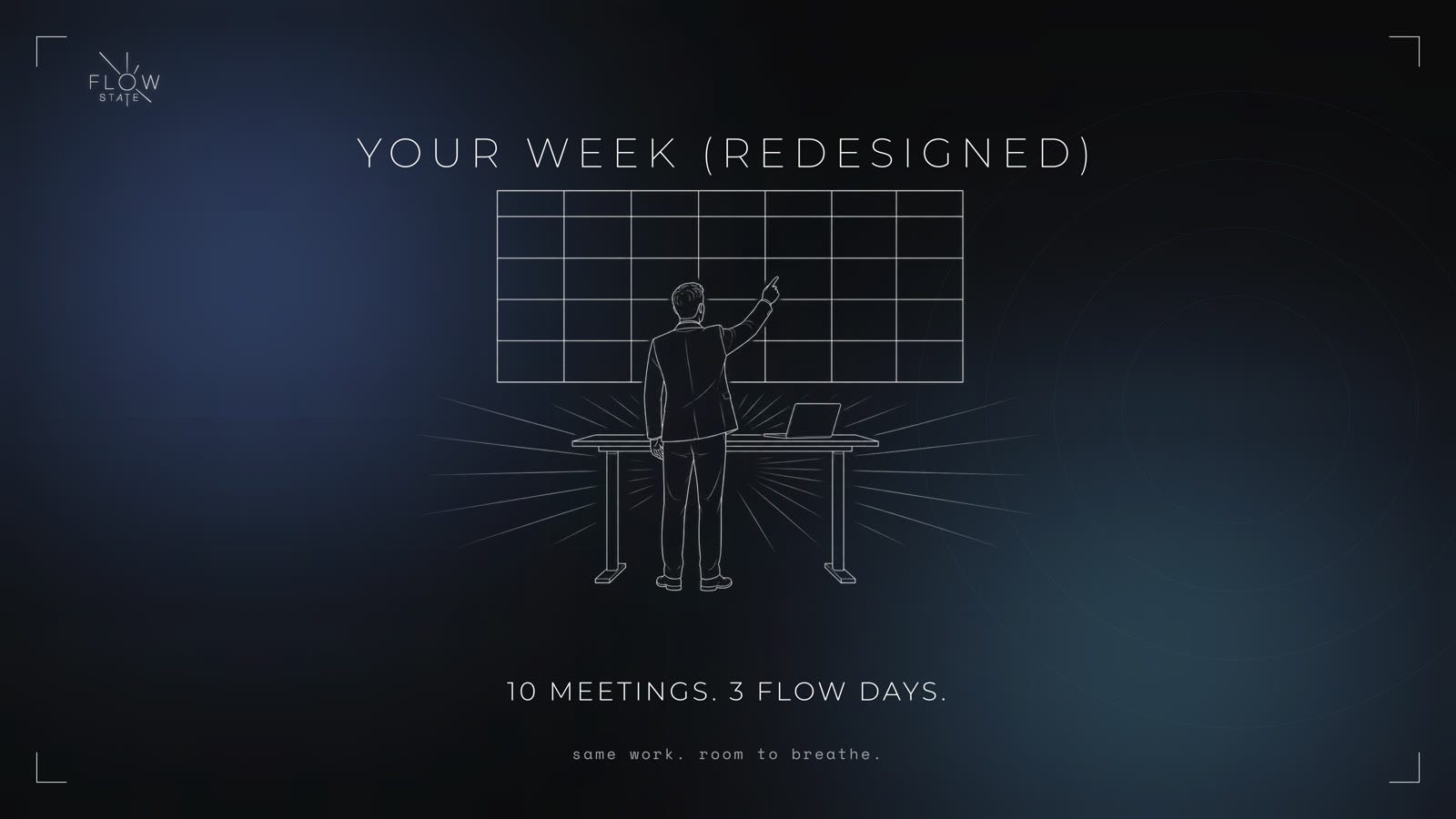
Over time, you want as many chokepoint-free days in your calendar as possible, where your day doesn’t have a single calendar chokepoint.
You want days where there’s nothing or only one thing - the absolute most important thing - for hours on end. And that most important thing could be recovery (which is the fourth phase of the flow cycle).
When you clear calendar chokepoints from work days, you get more flow. When you clear calendar chokepoints from leisure days, you get more recovery (which is required for more flow).
Aim for chokepoint-free days at least a couple times a week.
Obviously, on a lot of days, you’ll have to have things scheduled. So try and “batch schedule” as many spacious, chokepoint-free days in your calendar as you can.
And the benefits of a chokepoint-free day compound across time.
One open day is powerful. But three, four, five days in a row? That’s when the real depth happens.
Because you can follow flow freely.
You can surrender, let go, and find the deepest form of immersion. You can just sit down, jamming, enjoying work, and just do it until midnight.
There’s no “Oh, I gotta get ready for something that’s coming up and get ready for bed or have this or that meeting, etc.”
There’s a different level of insight, creativity, productivity, ideas, and output when you follow flow. It will bring you to places that you otherwise would not reach.
It’s as if you loosen the reducing valve of consciousness and access what Aldous Huxley, the author of Brave New World, called “Mind at Large.”
It’s the place where ideas come from, or where the muse lives. Deep immersion allows you to drop down to the depths of wherever insight occurs.
And the things that you produce during this chokepoint-free space end up paying off and compounding for decades.
VIII. WHAT CHANGES NOW
Every yes to a calendar chokepoint spends the attention your goals need. Every scattered meeting, every thoughtless “yes” to a calendar request depletes your brain’s capacity for flow.
By clearing calendar chokepoints and protecting large blocks of uninterrupted time, you create the conditions your brain needs to persist through struggle and drop into flow day after day.
The 5 steps again:
Implement policy bans. Say no to the category, not the person.
Stack consecutive empty days with One-Week Meeting Days
Clear Your Next Ten Days of existing chokepoints
Protect tomorrow’s long uninterrupted block by extending focus blocks
Catch interruptions that aren’t on the calendar by capturing hidden obligations
Start with tomorrow. Look at your calendar. Find the chokepoints. And clear them.
This makes a lot of sense to me. One issue I struggle with, though. I am trying to develop a daily exercise habit. Doing that first thing in the morning makes it more likely that I'll do it, but it is in contradiction to going into flow right after waking. On the other hand, scheduling exercise for later in the day is like the 'interruption' I know is coming that you write about here. And, of course, it's harder to develop that as a habit when I don't do it immediately. I guess the solution is to prioritise whatever is most important, but it would be great to do both!
i kinda think this is more of a tolerance or skill issue, honestly. have been doing flow block bookends to meeting and session days for years. it's not my preference, and it's neurologically expensive AF, but needs must.