
Why Ambitious People Self-Destruct (The Neuroscience)
Why your brain runs a million-year-old program that scatters your focus the moment things start going well

“Focus on one thing.” You’ve heard it from every business book, every podcast, and every successful entrepreneur.
And you’ve tried. You know it’s the right move. But somehow you’re still spread across three or four things, none of them where they should be.
You’d assume it’s a discipline thing. That if you just buckled down and said no to more stuff, you’d stay on track. But your brain is running a million-year-old program that scatters your focus the moment things start going well.
There’s a name for it: dispersion. And your dopamine system fights you every time you try to follow that “just focus” advice.
I. HOW I BECAME A VICTIM OF DISPERSION
I built my training company into an 8-figure business through three years of singular focus. Whenever people asked how we did it, I said the same thing: say no to everything else.
But with success came opportunities. Within six months, I went from total focus to being spread across five major projects: the original company, acquiring a new business, pursuing a PhD, writing a book, and building a content ecosystem.
Despite being hyper-vigilant about shiny objects, an invisible enemy had crept in and split my attention without me noticing.
Each new project was like adding a brick to the backpack of my mind. The excess cognitive load blocked my access to flow — the state in which I was most creative and effective.
Instead, I got sloppy. I changed the sales script without testing it. Our close rate dropped. The team was confused. Advertising started bleeding money.
All of a sudden, a once enjoyable, well-structured business turned into a complete mess.
Then came decision fatigue. I was trying to juggle five full-time jobs simultaneously.
Focused work felt like jumping between time zones. One task in Japan, then flying to Croatia for another, then California for a third. The attention residue from constant switching meant I spent more time acclimating to each project than actually working on it.
I realized I’d fallen into a common trap: assuming that opportunity lives in breadth, not depth. In trying to grab it all, I’d lost my grip on what truly matters.
So I slashed everything down and refocused on the single most important thing.
Within a month, I progressed more on that one pursuit than I would have on all five combined in a year. Priorities became clearer, stress dropped, and I fell into flow state way more often.
(I post daily about flow state — the state of peak performance where you feel and perform your best. Follow
if you want to see more of it)
II. DISTRACTION VS. DISPERSION
You’ve probably heard the standard advice: eliminate distractions. Turn off notifications. Block your calendar.
That’s fine for distraction. But dispersion is a different animal.
Distraction is getting pulled off-task. Dispersion is getting pulled off-pursuit.
One costs you minutes or hours. The other costs you months or years.
Distraction is obvious — you stop one task to check your phone. Dispersion sneaks up on you. You don’t notice it until the damage is done, because each individual pursuit feels productive.
Here’s why you experience it in the first place:
III. THE NEUROSCIENCE: EXPLORE-EXPLOIT DYNAMICS
Picture yourself as a prehistoric human foraging in the wilderness.
You find a bush bursting with ripe blueberries. You’re picking and eating, but then your eyes catch another bush in the distance. Slightly darker berries. You can’t help but be attracted.

This is the fundamental tradeoff all organisms face: exploitation (pursuing a known reward) versus exploration (sampling lesser-known options in search of something better). And your brain has a built-in bias toward exploration.
Eyeing that other bush, you get a rush of anticipatory dopamine from the nucleus accumbens (NAc) — a subcortical brain structure that serves as a key player in the brain’s reward and motivation system. Under this dopamine spell, you drop your berries and run over to the other bush.
This is why success specifically triggers the urge to scatter: once your brain learns to expect a reward, dopamine shifts from firing at the reward itself to firing at the cue that predicts it. The better things are going, the louder the pull toward something new tends to be. That’s the mechanism behind dispersion.
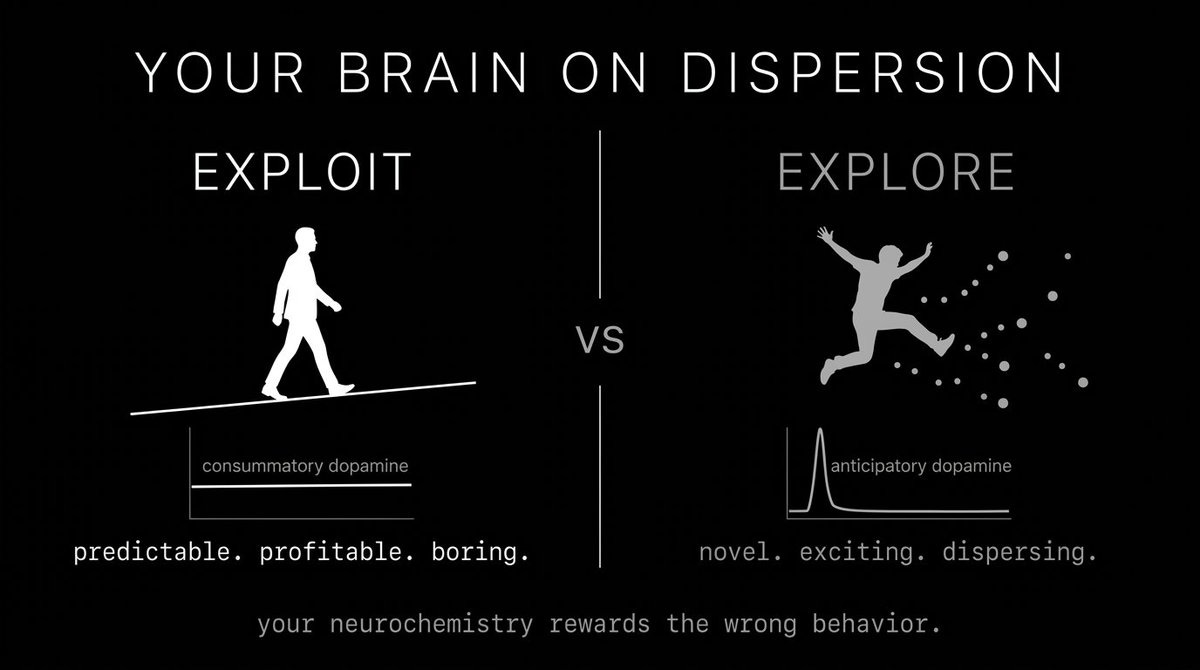
And if you’re entrepreneurial, you’re even more at risk. Based on the Big Five personality traits, entrepreneurs tend to score high in Openness to Experience — the very trait that makes you good at starting things can make you bad at sticking with them. Your brain is more sensitive to novelty, which means the anticipatory dopamine hit from a new pursuit is even stronger for you than for the average person.
Three cognitive biases stack on top of this: novelty bias (chasing new pursuits before mastering current ones), scarcity bias (anxiety about missing limited opportunities), and present bias (overvaluing immediate wins over long-term compounding). Together with the dopamine mechanics, they keep you locked in explore mode when you should be exploiting.
IV. THE PROTOCOL
Now that you understand the mechanism, the question is how to bypass it. You can’t rewire millions of years of evolution. But you can build a system around it. Here’s a proven 3-step process.
(After training over 15,000 entrepreneurs, including execs from Audi, Meta & Google, I also put together a 30-day email sequence breaking down the science of peak performance and flow state in a bit more detail. Access it through the link in my bio)
PHASE 1: PICK ONE PURSUIT
In the early nineties, Bill Gates’ father sat at dinner with both Gates and Warren Buffett and asked them what they considered the single most important factor in their success. They gave the same one-word answer:
“Focus.”
When I was dispersed across five projects, I had the same hours, the same skills, and the same ambition as when I’d built an 8-figure business on one thing. The only difference was where the attention went. Within a month of refocusing, I made more progress than the previous year of scattered effort combined.
Since you can’t steer multiple boats at once, the first step is picking one. The more pursuits, the less progress.
This seems obvious, but you still need to start there.
List your current pursuits and the pursuits you wish you were doing. Then stretch the timeline to 30 years. Which one would you look back on and say, “Thank God I decided to focus on that instead of the other stuff”?
When you stretch the timeline, priorities that seemed equally important become wildly different in weight. The side project that felt urgent last week barely registers against a thirty-year horizon. The one pursuit that keeps surfacing — that’s your answer.
Don’t be fooled by how exciting a new pursuit looks from the outside. When you’re not yet involved in something, you’re biased toward optimism because you can’t see the full complexity.
Every new venture looks like a straight line from a distance. Up close, it fractures into an exponential web of subtasks you never could have imagined.
PHASE 2: CUT THE CARGO
You’ve picked your pursuit. Now strip out everything within it that doesn’t directly make the boat go faster. Every new hire, partnership, routine, project — if it doesn’t advance the primary pursuit, drop it.
Steve Jobs did this when he returned to Apple in 1997. The company was 90 days from insolvency with a dozen versions of the Macintosh. He asked his team, “Which one do I tell my friends to buy?” Jumbled answers. So he cut the product line by 70%. A year later, Apple turned a $309 million profit.
Deciding what not to do is as important as deciding what to do.
PHASE 3: PERSIST THROUGH THE PLATEAU
You’ve picked one boat and cut the cargo. Now keep sailing. This is where it gets hard.
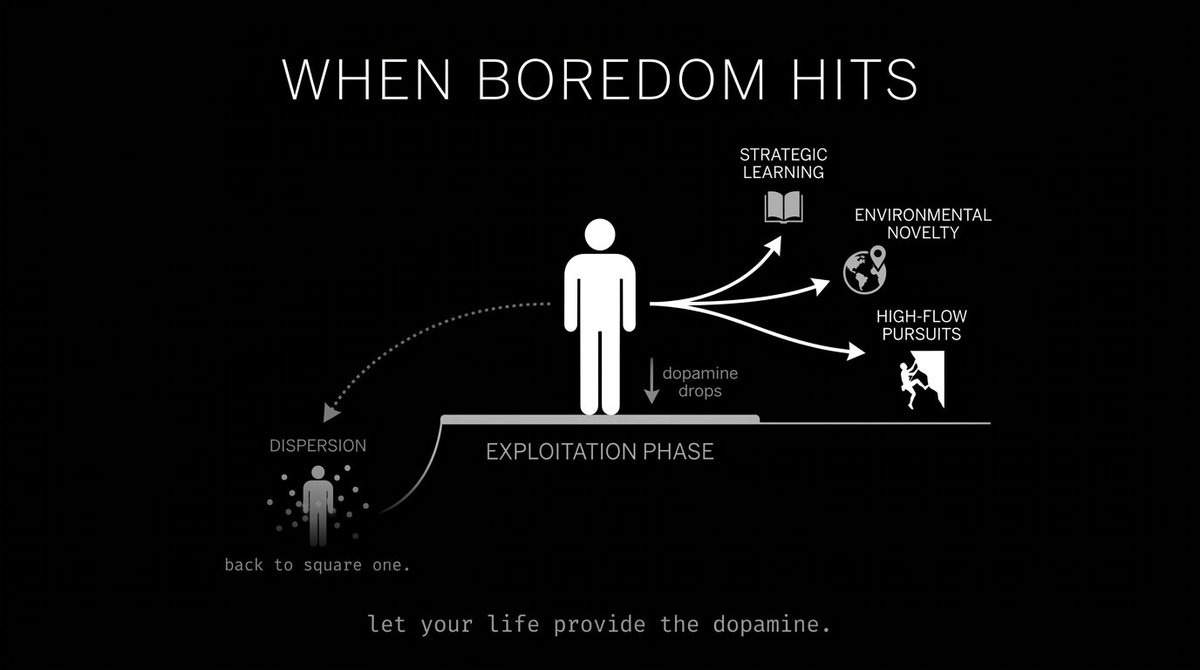
With your primary pursuit, you’ll have bursts of flow when challenge and skill are aligned. But over time, outcomes become predictable. And when that happens, dopamine drops significantly.
Your brain doesn’t care that the business is working. It cares that there’s no novelty.
So it starts scanning. You notice a competitor doing something different. You read about a new market opportunity. Suddenly, you’re drafting business plans in your head.
Starting something new offers a fast way back into the flow channel — not because it’s a better opportunity, but because novelty is easier. The skill demand drops, uncertainty spikes, and flow temporarily returns. That relief is what makes dispersion feel so logical in the moment.
But you’d be starting over at square one.
When in doubt, choose the more focused option.
Now, most advice stops here. Tell yourself to focus and push through. But your dopamine system doesn’t take orders. Your nucleus accumbens is going to keep hunting for novelty, whether you like it or not. So instead of fighting it, feed it — just not through your business ventures. Satisfy your exploration drive outside your work so you can maintain focus inside it.
Let your business stay methodical, predictable, even boring. Let it compound.
Then redirect the exploration drive into three areas:
1. Strategic learning. Read two to three books per week in domains adjacent to your work. Network with people operating at the level you’re targeting. Learning generates dopamine through intellectual novelty — new information, new connections, new skills — without dispersing your professional focus. One founder I know spent eighteen months reading financial engineering literature while his operations ran on autopilot. When his business hit the next growth phase, he raised $40 million. He’d built the capacity during exploitation.
2. Environmental novelty. If your work is location-independent and you’ve been in the same city for years, move. Or book month-long stays in unfamiliar places. Take on a physical project you’ve been avoiding — a workshop renovation, a vehicle restoration. New environments provide the novelty your nervous system craves without touching your business.
3. High-flow pursuits with real failure risk. Pick one pursuit that triggers flow outside your business. Three times per week, ninety minutes per session. The activity needs immediate feedback, clear goals, and escalating challenge. Brazilian jiu-jitsu. Rock climbing. Competitive tennis. Learning piano. Here’s the filter: can you fail at it? If there’s no meaningful risk of failure, it won’t be engaging enough to satisfy the drive. Disc golf works better than walks. Climbing works better than the gym.
In our experience, flow also has a carryover effect. When you access flow in one domain, it becomes easier to access in other domains. A high-flow lifestyle protects a low-flow business phase.
The rule: when work stops being exciting, make your life exciting instead.
When financial reward comes from your business, protect it by staying focused. Let your life provide the dopamine.
WHAT CHANGES NOW
Phase 1: Pick One Pursuit. Run a temporal audit. List your current and fantasy pursuits, then stretch the timeline to 30 years. The difference in importance becomes obvious.
Phase 2: Cut the Cargo. Apply the “does it make the boat go faster?” filter. Remove everything that doesn’t directly advance your primary pursuit. Do less, better.
Phase 3: Persist. When dopamine drops and boredom hits, don’t disperse. Redirect exploration into strategic learning, environmental novelty, and high-flow pursuits outside your business. Let your life provide the dopamine so your business can compound.
Ten years of focus turns ordinary talent into something no one can compete with. Ten years of dispersion turns extraordinary talent into a long list of things that almost worked.
-Rian