
This Workspace Setup Will Change Your Life
Flow can be amplified or blocked by where we work. The trouble is, very few knowledge workers have intentionally designed their workspace for it.

Charles Darwin. William Shakespeare. Emily Dickinson. Thomas Edison.
What did all of these people have in common?
They all had a place. A specific location in time and space from which they changed the world. And the nature of that place affected the degree of change they were able to make.
From Edison’s laboratory in Menlo Park to Darwin’s family Down House in Kent, these creators had a workspace in which they lost themselves in a state of flow.
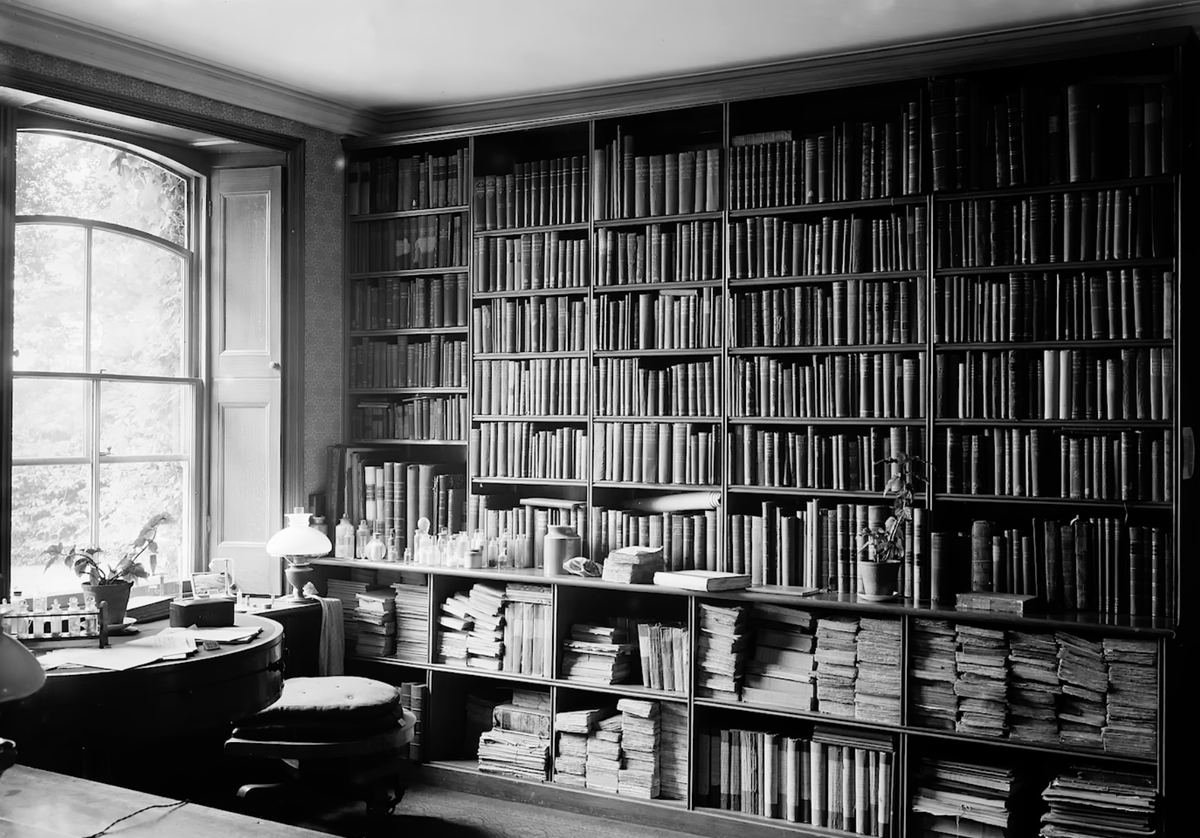
Flow can be amplified or blocked by where we work. The trouble is, very few knowledge workers have intentionally designed their workspace for it.
They tend to fall into one of three camps. Which of these sounds like you?
I. THE THREE ARCHETYPES
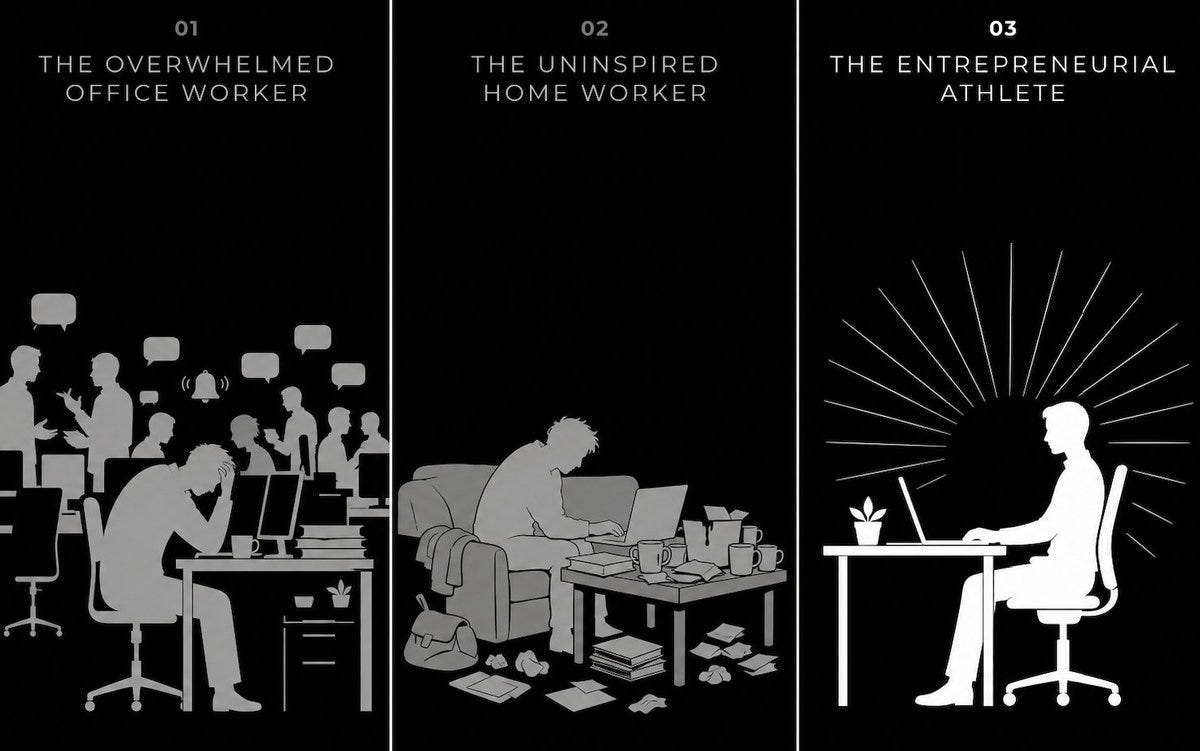
1. The Overwhelmed Office Worker
You work in an open office plan plagued by constant disruptions. Between tap-on-the-shoulder meetings and chatter, you can’t focus for more than a few minutes at a time. You dream of a private office, but feel powerless to change your environment.
2. The Uninspired Home Worker
Yesterday’s dirty mugs still clutter your makeshift desk. Maybe you work on the couch, hunched over, so the ergonomics are terrible. The cluttered space is associated more with distraction than meaningful work. You know you could have a lovely office, but lack the motivation to set it up.
3. The Entrepreneurial Athlete
The Entrepreneurial Athlete engineers their workspace for flawless focus and flow. It’s treated as a sacred and cherished space, so all sources of distraction are banned. Everything is set up for complete immersion and accelerated progress.
The Entrepreneurial Athlete understands their environment must facilitate focus before focus can facilitate greatness.
Whichever camp you fall into, it’s only after you optimize your workspace that you realize the magnitude of difference it can make to your focus, productivity, and access to flow.
Your workspace is one of several specific blockers that quietly prevent access to flow state, the state of consciousness where you feel your best and perform your best.
The workspace is where I start with almost everyone, because it’s the lever they’re most certain doesn’t matter, and it’s usually the one holding them back the most.
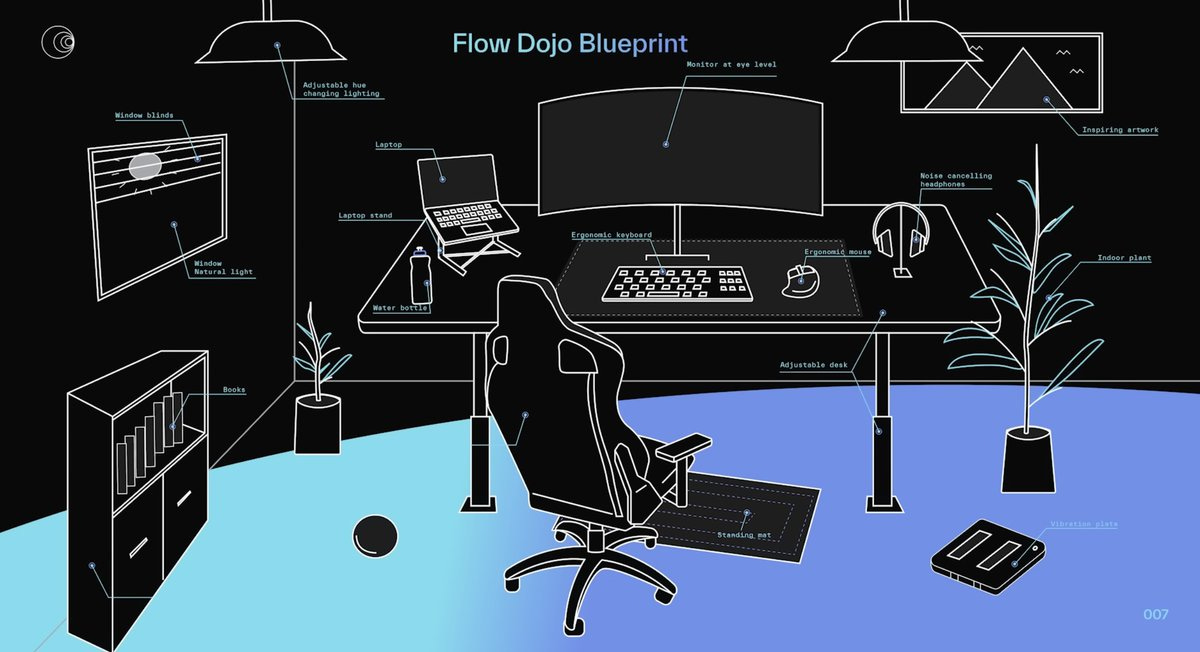
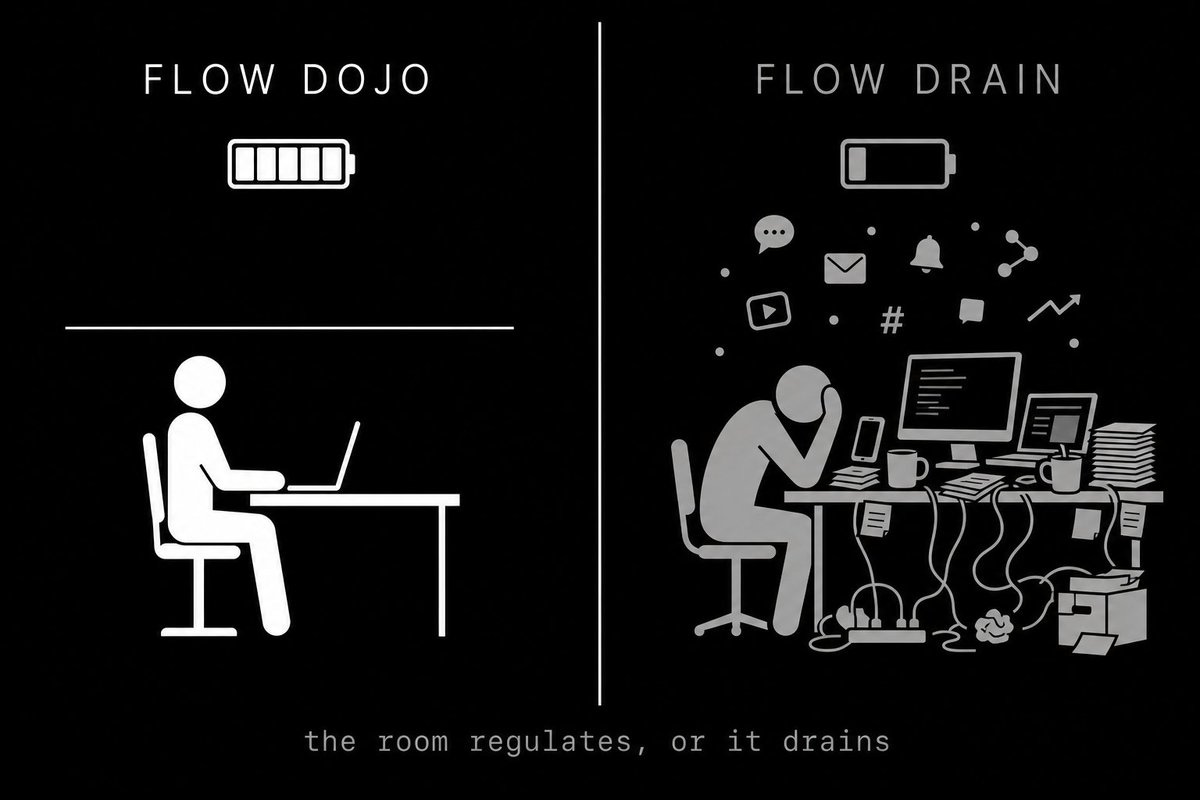
II. THE FLOW DOJO
I once rented an oppressively bleak office space. 50th floor of a drab Mexico City high-rise.
Frigid temperatures, harsh fluorescent lighting, plus a tedious commute up. The musty carpet and sterile drywall sapped motivation. I could barely stand being there.

Then I moved to a gorgeous co-working space, with floor-to-ceiling windows overlooking tree-lined Amsterdam Avenue. Soft natural light, lively colors and textures.
I ended up spending over three times more hours working at Haab compared to the previous office space. And I accomplished way more in those hours too. Happier, immersed, in flow.
Never underestimate a workspace’s magnetic pull. A depressing space repels you. An incredible environment draws you to stay longer, achieve more in each session, and return eagerly.
And this translates to increased flow and more productivity.
III. DESIGNING FOR YOUR FUTURE SELF

To create a flow dojo, we need to design an environment that will maximize your output when you’re at your best and protect your lesser self from sabotaging your work when you’re at your worst.
But it starts with answering the question:
What are the core elements of a flow dojo, and how do you set one up?
IV. SUPPRESSION IS AN ACTIVE PROCESS
Neuroscientist Adam Gazzaley, an advisor to the org I co-founded, Flow Research Collective, says distractions are “goal-irrelevant information that we either encounter in our external surroundings or generate internally within our minds.”
The key word here is “information.”
We’re wired to crave it.
The brain responds to new information the way it responds to food. With a pleasurable dopamine hit. This served our ancestors because new information was a matter of life or death.
But it cripples the productivity of modern entrepreneurs.
Sources of dopamine-inducing “information” are everywhere, all the time.
This isn’t just about overt forms of distraction, like your phone, coworkers, or social media.
Anything that the brain has to filter out that’s not directly relevant to the task at hand is considered “information” that has to be filtered.
And the key part:
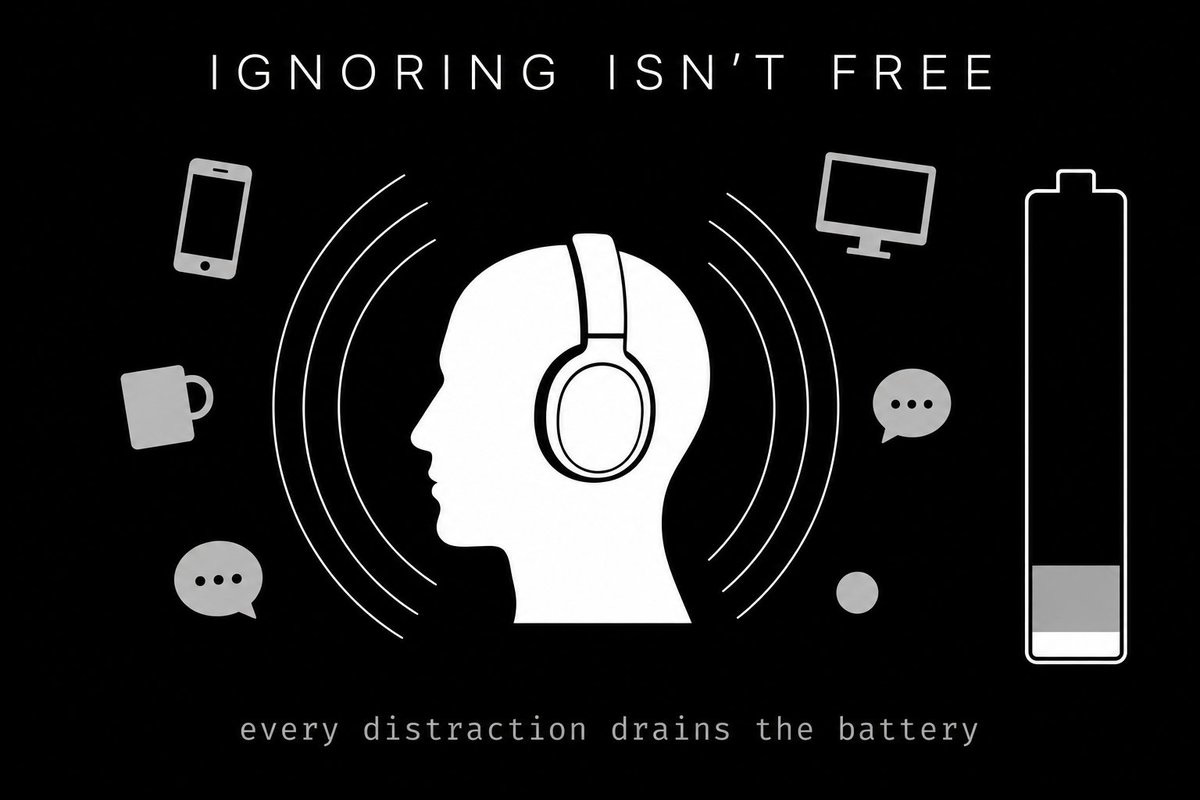
Your brain suffers from distraction because it’s bombarded by irrelevant information that it has to ignore.
Ignoring is not a passive process. Like noise-canceling headphones, the more noise the brain has to filter out, the more battery it drains.
Though it seems to happen automatically, filtering out irrelevant stimuli is a highly effortful and active process for the brain. It taxes our gray matter and attention. It hinders memory. And this brain fatigue increases self-distraction. The impulse to divert attention away from the task and do something else that’s easier, more stimulating, and more dopamine-rich.
Think of it this way:
The option to distract is itself a distraction. And all information is a distraction.
The more you reduce irrelevant input, the more neurochemical and cognitive resources you have for focus. The essential precursor to flow.
That means winning the war for your attention is about what you ignore.
The Entrepreneurial Athlete engineers their flow dojo to minimize what their brain has to filter out.
How to Implement This:
First, keep your phone out of reach (and off).
The phone is obviously a source of distraction. But what’s less obvious is that the mere presence of a phone is a distraction that impairs cognitive functioning.
Even when it’s not being used.
Even if you have all sounds and notifications disabled.
Even if it’s turned off and face down on the desk.
Research from the University of Texas found that people performed worse on attention tasks when their phone was simply visible, even powered off.
Keep the phone in a cupboard, the other room, or the car. That way, it won’t gnaw at your attention.
Second, minimize other gadgets.
Don’t have a TV or tablet in sight. Don’t have access to video games at your desk.
For almost all kinds of work, you actually only need one monitor or laptop.
All the other gadgets tend to drive distraction more than productivity. They expand the scope within which we can be distracted.
Simplify instead. Just get rid of them.
The heuristic:
Have less to ignore so you can focus more.

V. MIND YOUR ANCHORING BIAS
Legendary basketball coach John Wooden leveraged anchoring bias when coaching the UCLA Bruins in 1948. At the time, the team was known for sloppy practices and undisciplined play.

Wooden’s first lesson for his players was not about layups or defense. It was about how to pull up their socks, leaving no flaps inside their sneakers to avoid blisters, and how to tie their shoes perfectly to prevent sprained ankles.
These small details cascaded, and the anchored traits, diligence in pulling up their socks, ended up being embodied by the players and carrying over into their game.
Anchoring bias means you key off the standards and traits that define your current environment and then end up embodying those.

To use anchoring bias to your advantage in your flow dojo, start by clearing the clutter.
One of the things I often emphasized to our sales team is that messiness on their desk results in bad spelling and formatting in Slack messages. Which results in poorly written emails to prospects. Which results in decreased sales. Which results in reduced revenue for the company. Which results in us not fulfilling our mission.
Environment anchors traits. Traits shape behavior. Behavior determines outcomes.
Your environment’s orderliness will manifest as orderliness in your work.
VI. MAKE THE SPACE CONDUCIVE TO THE PHYSIOLOGY OF FOCUS
Make Your Office Alluring
This is what I did in Mexico City. The magnetic pull of the environment alone was enough to dramatically increase my output.
Your flow dojo is your place to create value, earn a living, and make an impact. Treat it as the investment that it is. Make working at your desk a treat.
And if possible, set things up so you have an expansive view. You want something broad but not distracting, like horizon lines, open fields, and mountains. This can help you think big, expand your perception and possibilities, and soothe your nervous system.
Positional Variance
The biggest lever you can pull to make your space conducive to focus is positional variance.
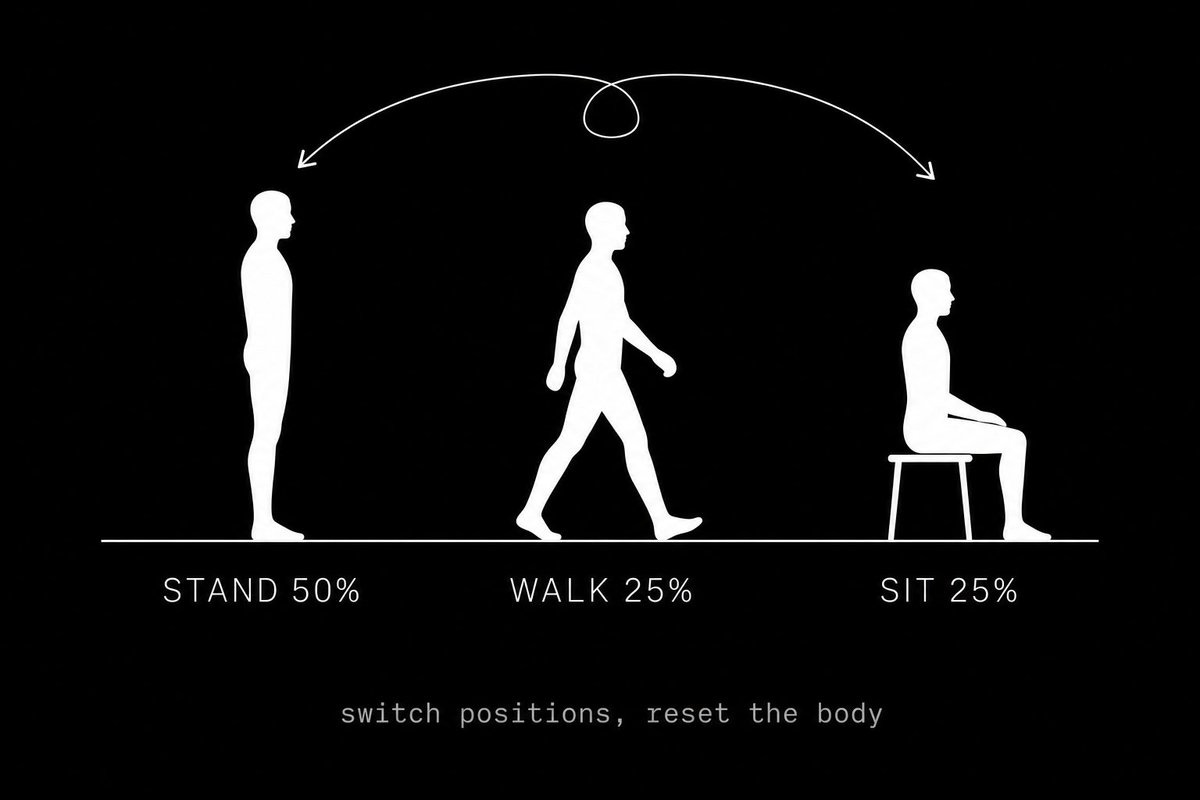
To light up your physiology, performance, endurance, and flow, set up your space to alternate between standing, sitting, and walking.
A ratio that works well for sustained focus:
Stand for 50% of the time. Walk for 25% of the time. Sit for 25% of the time.
Swapping positions like this reduces perceived exertion. This is how hard it feels like your body is working. Your body reaches fatigue in one position, and this fatigue affects your performance. When you switch, you get a reset.
So remember this rule:
To reset, change positions and places.
Get a standing desk. Standing enhances blood flow, delivering more oxygen to sharpen alertness. To sustain a standing position, use a motion board. This lets you subtly rock side to side so you can stand without cramping up. The standing desk doesn’t have to be fancy. Even a stack of books or boxes will do.
You can also use a stability ball or kneeling chair to swap seated positions. Sitting upright without a backrest strengthens your core and posture, and reduces lower back pain. Physical pain can be a formidable distraction, which can block flow. Being pain-free increases your flow proneness.
Then, for walking, get an inexpensive treadmill to put under your desk.
Walking triggers what researchers call exercise-induced transient hypofrontality. This shifts brain resources from the prefrontal cortex to the parts that control physical movements and automatic responses. The same shift happens in flow. It enables key facets of flow like reduced self-consciousness, time distortion, and heightened focus.
You can also take walking meetings. After the walk, because of the transient hypofrontality, you can drop into flow immediately when you sit back down to work.
VII. ELIMINATE THE INVISIBLE ENEMY - FRICTION
Friction is the invisible enemy of flow. It’s all of those micro moments of frustration where you have to waste cognitive resources on finding, untangling, tidying, and sorting.
It’s the annoying hassle of digging up old computer files. Or digging your phone charger out of your backpack, untangling it, and then having to hunch over to plug it into a spot that’s an awkward distance from your desk.
Each of these moments of friction is like being pinched. They’re tiny zaps of irritation that spike cortisol. The body’s stress response to friction is nearly identical to getting your arm pinched. And it chips away at your cognitive resources.
The solution is to clear every inch of friction from your workspace.
First, get organized so that everything is easily retrievable.
This means taming those big shelves full of wires, removing the pile of paper that your headphones are buried under, and keeping a pen handy so you no longer have to move a bookshelf around to find one.
For frictionless flow, make it easy to access everything without looking.
Another way to keep things organized is to minimize. Anything that’s not conducive to flow, get rid of it.
VIII. DETER DISRUPTIONS
Every disruption reroutes your dopamine.
Your flow dojo must account for the cost of these disruptions. We can do this in two ways:
1. Be Inaccessible or Invisible
A closed-door office with a note on the door works. They can’t see you, and they can’t access you.
If you can’t do this, simulate it. Get as close to that as possible as often as possible:
Keep your back facing others to minimize eye contact. Wear big, over-ear headphones.
2. Make it a Big Deal to Interrupt You
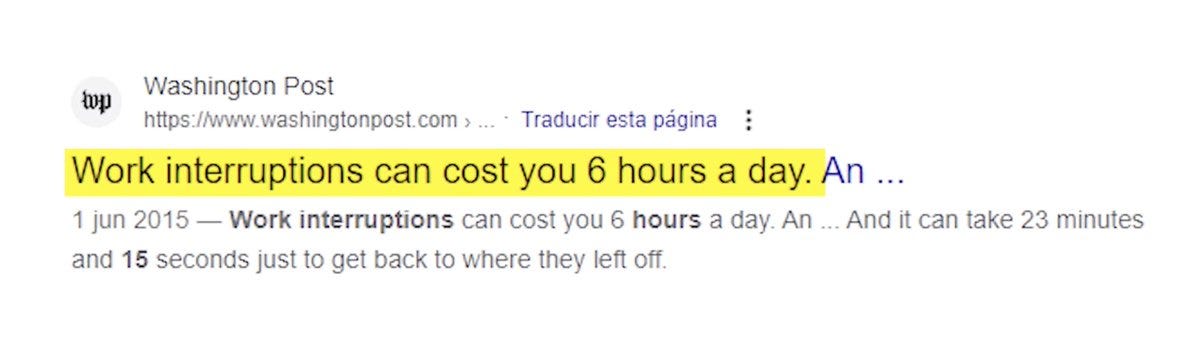
Make it feel burdensome for others to interrupt you. You have to move, turn around, and uncover your ears.
If it’s an obvious bother, you’ll be bothered less.
Based on Paul Ekman’s research on micro-expressions, our face reflects the state we’re in. And what we’ve seen with flow is that your gaze will often intensify in a way that causes others to be more averse to interrupting you.
So when you’re in flow, your face implicitly lets others know.
Same with work at home: have environmental boundaries to guard yourself from the distractions of others.
Remember that ignoring distractions or resisting impulses in our environment is not a passive act. It’s a highly active process.
Every distraction counts: food, people, noises, the ability to pick up a video game and play it. All of this actively saps your cognitive resources.
The golden rule: don’t let disruptions reroute your dopamine.
IX. CONDITION YOUR WORKSPACE FOR FLOW
Classical conditioning has long been used to create learned associations. The classic example is Ivan Pavlov’s experiments with dogs. By consistently pairing the neutral stimulus of a bell with feeding the dogs, Pavlov conditioned them to salivate at the sound of the bell alone.
A similar principle is applied in CBT-I sleep therapy for insomnia. Patients strictly keep their bed for sleep only, no screens or reading. This associates the bed with the sleep response rather than wakefulness. Over time, the bed becomes a cue for physiological sleep.
Just as CBT-I conditions the bed for sleep, you can condition your workspace for flow.
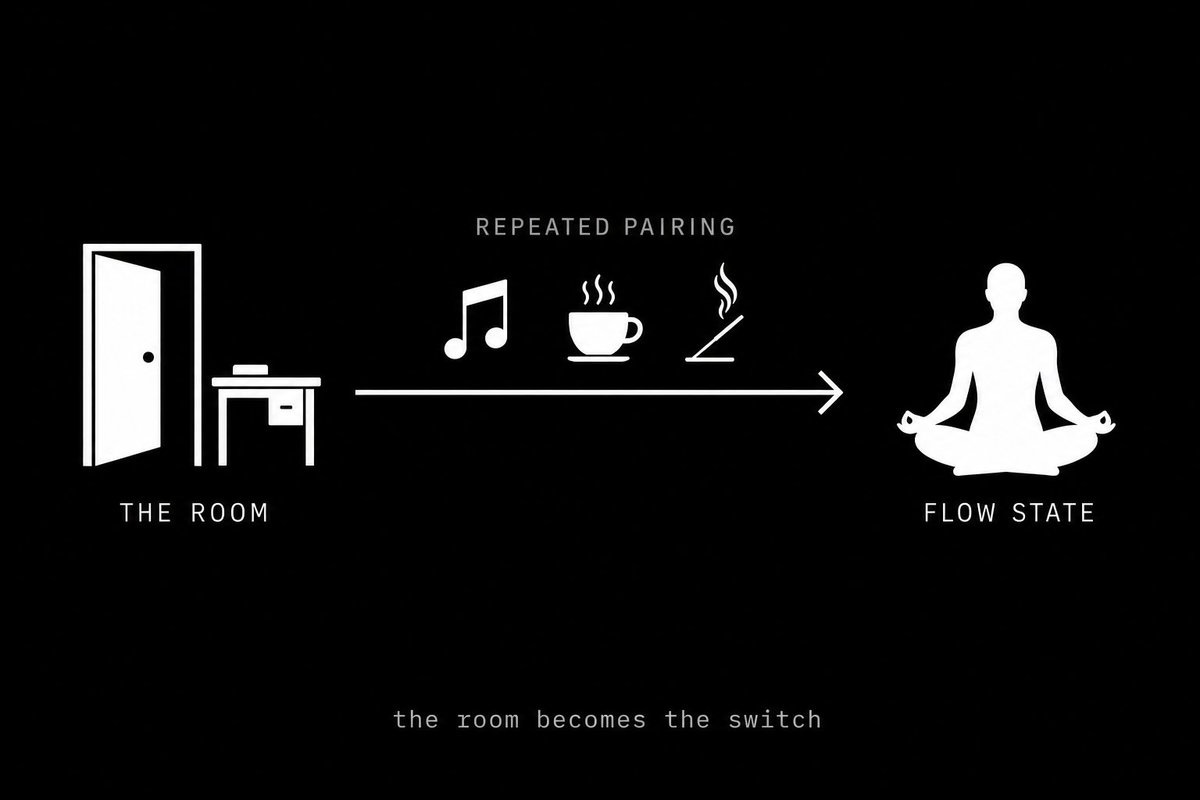
The neutral stimuli become the desk, chair, computer. Your office environment. Pair this repeatedly with focused work. You can trigger flow via proven triggers: a specific playlist, caffeine, light exercise. Then, while in this peak state, immerse yourself in focused work.
Over time, your office environment alone will trigger heightened focus and motivation.
The Key to Conditioning
For this classical conditioning to kick in, only use your flow dojo for focused work.
In the same way you don’t want to associate your bed with anything but sleep, you don’t want to associate your flow dojo with anything but focused work.
This means, don’t allow yourself to slip. If you find yourself starting to procrastinate in your office, or get distracted, checking your phone, scrolling social media, hopping on a call with a friend, then literally leave your office.
That way, your workspace becomes a cue for your brain to release dopamine and norepinephrine. With consistency, merely entering your office will put you in a state of mind that’s conducive to peak performance.
Sound and Scent
You can add stimuli to your office to increase the conditioning link that’s associated with your flow dojo, including sound and scent.
I play rhythmic instrumental music and binaural beats in my office, and I like to burn an incense stick. As I pull it out, spark the lighter, and start burning it, my brain knows it’s time to focus. It’s also relaxing. And scent is the only sense that bypasses the thalamus and goes straight to the brain’s emotional centers.
Sound and scent can create an invisible environment. A “flow cave” that you can escape into for work.
X. THE MINIMUM VIABLE FLOW DOJO
Even if you can’t set up the absolutely ideal flow dojo, you want to take it as far as you can with whatever you’ve got.
Make it a priority to create a “minimum viable flow dojo.”
Even when you’re traveling, you can use boxes or pillows or books for a standing desk, and set up your space for focus and flow.
For example, during the height of the COVID pandemic and lockdowns, I was stuck in a living situation that required me to use my bathroom as an office. It was not the best, but I made it work.
I could sit on the edge of the bathtub and prop my laptop neatly on the sink. There was plenty of natural light from the window, candles to soothe my amygdala, and most importantly, no one would bother me.
During that time, that bathroom was my flow dojo.
And even though this was a weird work environment, it was low in distraction. I made huge professional progress in that workspace.
WHAT CHANGES NOW
Make your workplace a cherished space. This is where you have creative breakthroughs, get into flow, and do what you love. Take pride in it and make it somewhere you love to be. Create positive associations so you’re excited to enter and stay in it.
If you work in an open office plan or suboptimal work environment, make structural changes within a week. Rent a better co-working space, get set up at home, and do whatever you must. This is a critical priority.
Consider the alternative:
If you have someone tapping on your shoulder every fifteen minutes, no matter what you’ve set up with your flow readiness and the flow triggers, flow will be difficult to enter and sustain. The room comes first. Focus follows.
A room you fight in costs you a little focus every hour, and over years that’s a career spent suppressing your surroundings instead of building. A room that pulls you in does the opposite. It compounds, quietly, into work no one can compete with.
Design the room, or fight it.