

Burnout is recognized by the World Health Organization as an occupational syndrome that alters your neural circuitry.
Taking a week off addresses one of its six known causes. The other five keep firing while you’re at the beach.
I learned this the hard way. Twice.
Over the next few minutes, I’ll show you the six triggers behind burnout, the five protocols to shut it down, and how the best performers I know work at full capacity without ever hitting the wall.
I. THE DISCOVERY OF BURNOUT
In the 1970s, psychologist Herbert Freudenberger noticed something strange at a free healthcare clinic in New York City.
The volunteers arrived early. Long hours didn’t faze them because the work was rewarding. They were passionate about helping the underserved.
But over time, these once lively volunteers started to slide into resentment. Their empathy evaporated, replaced by detachment. The trend spread through the understaffed clinic, threatening to deprive patients of much-needed care.
What puzzled Freudenberger was that these healthcare volunteers weren’t depressed, or exhausted, or stressed. Not in the conventional sense.
After years of observing this pattern, Freudenberger realized he was witnessing a profound motivational collapse and emotional void — something well beyond fatigue or a temporary morale dip.
For the first time in history, he coined a term to describe this phenomenon.
The term he used was burnout.
II. THE THREE HALLMARKS
You know that state where you feel lethargic yet agitated? Drained but restless, feeling cornered by life?
Tasks that once fired you up now feel like chores. Your self-belief tanks, especially your faith in what you can achieve. You’re worn out, not just tired, and it’s making you irritable and cynical. Six cups of coffee barely make a dent in the bone-deep exhaustion.
It’s not depression. It’s something different. But it’s messing with your life and choking your ambition.
Three things make burnout distinct from any other maladaptive issue:
1. Exhaustion. Not just physical tiredness, but a complete depletion of emotional and mental resources.
2. Cynicism. A growing detachment from your work and the people around you.
3. Low self-efficacy. A tanking belief in your own ability to perform and achieve.
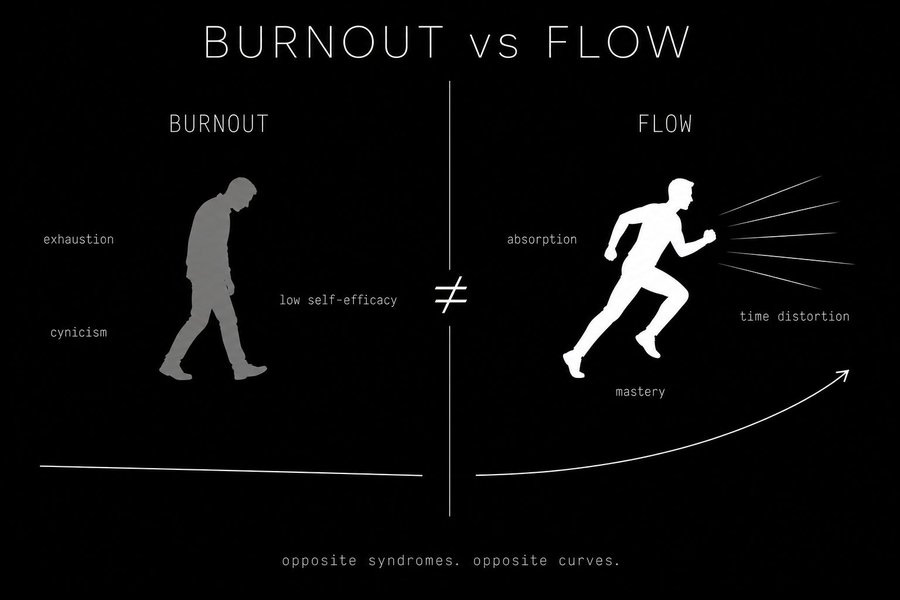
Think of burnout as the opposite of flow. Flow is that state of optimal consciousness where we feel our best and function our best. In flow, you’re deeply engrossed in your task. You lose track of time and feel a sense of mastery and control.

With burnout, you feel like you’re just going through the motions. Time drags on. Rather than mastery, you feel futility.
Flow compounds momentum. Burnout brings it to a screeching halt.
III. THE NEURAL DAMAGE
Despite what the hustle bros might tell you, the effects of burnout aren’t just subjective or psychological.
Burnout alters your neural circuitry, forcing a downward spiral of cognitive dysfunction.
Studies link it to an enlarged amygdala and weakened connections with the anterior cingulate and medial prefrontal cortex. People with burnout are more prone to attentional lapses. And it becomes harder for the brain to regulate negative emotions.
Burnout does to the mind what a bad cold does to the body. It leaves you feeling like a faded, ineffective version of yourself.
IV. MY FIRST BRUSH WITH BURNOUT
My first experience with burnout happened as a teenager.
I grew up in Ireland, dreaming of one day making it big in the United States. I just needed to get my foot in the door with an internship so I could land an American work visa.
During college, I applied widely. Out of hundreds of applicants, I lucked out and landed a gig at a company in California. This was my golden ticket to escape rainy Ireland and make it to LA.
The internship started out exciting. I was working alongside well-known professionals I had long admired.
But within weeks, the shine started to wear off. My pay was the equivalent of minimum wage, and I was spending half of what I earned on Uber rides to and from the office.
Making matters worse, the company culture turned out to be toxic. Leadership gossiped about clients and coworkers behind their backs. We weren’t practicing what we preached.
And most of the work I produced ended up getting scrapped, replaced with lower-quality work produced by others for political reasons.
Over time, I started to lose belief in my own ability to perform. That tanked my performance, which risked my ability to land a visa so I could finally move to the US and realize this childhood dream.
I was deep in the throes of burnout.
Once I realized it, I took a week off to relax by the beach and try to recover. I had to get back on my game and crush the rest of the internship.
But when I returned, although I felt good for a day or two, within a week I felt just as flat as before.
So what was happening? Why didn’t taking a week off reduce the burnout?
V. THE SIX TRIGGERS
Years later, I came across the research of pioneering psychologist Christina Maslach. She developed the Maslach Burnout Inventory, the most widely used instrument for assessing burnout in the scientific community.
Maslach discovered that, like flow state, burnout has validated preconditions — psychological triggers that cause it to emerge.
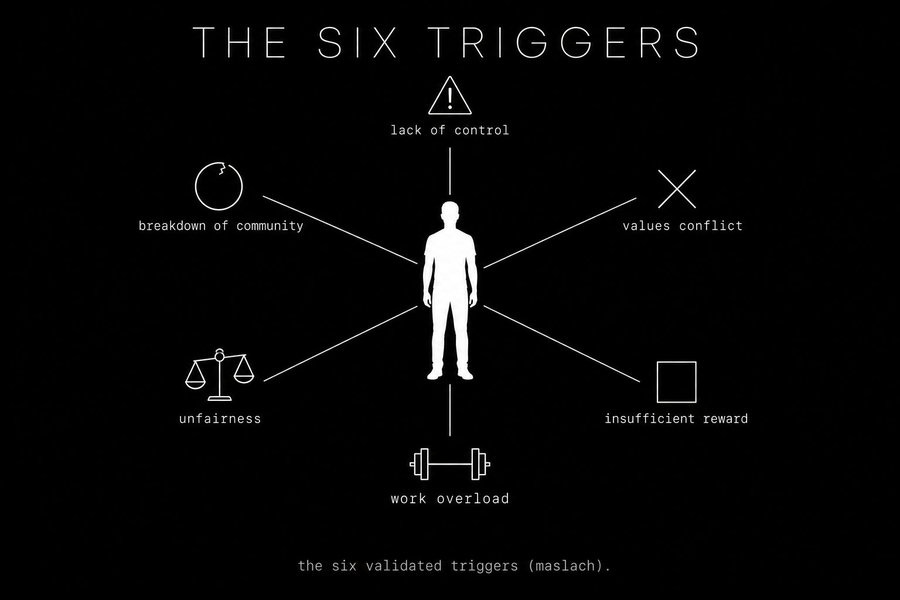
The six burnout triggers:
1. Lack of Control. You lack autonomy, ownership, or creative expression. Maybe you feel micro-managed. You can’t make decisions about how you work.
2. Values Conflict. There’s a disconnect between your core values and your organization. Maybe you care about the planet but your company doesn’t. Maybe they preach integrity but practice politics.
3. Insufficient Reward. You feel taken for granted, unrecognized, or under-compensated. The effort you put in doesn’t match what you get back.
4. Work Overload. Your workload is simply too high, too complex, or too urgent. There’s no relief valve.
5. Unfairness. A culture of favoritism. Nepotism, for instance, where your boss promotes their cousin even though you earned the role.
6. Breakdown of Community. You work with patronizing or low-performing colleagues and there’s no mechanism for healthy conflict resolution or feedback. There’s no sense of belonging.
After learning about these, the reason my LA internship burnout didn’t resolve finally clicked.
My burnout wasn’t because I was working too much. Taking time off had shown me that.
Rather, I was susceptible to the other triggers: lack of control, unfairness, and insufficient reward. Ironically, one of the ones I was least susceptible to was work overload.
You have to solve the root problem to solve the burnout problem. That means isolating the offending triggers in your workplace and fully addressing each of them.
You can’t fix one and hope it solves the rest. You have to address them all.
And this is why simply taking time off doesn’t fix burnout. It only addresses one trigger: work overload.
VI. PROTOCOL ONE: CHOOSE THE RIGHT KIND OF HARD
This is how you combat the trigger of insufficient reward.
After years of striving toward a PhD, I finally entered what I thought was my dream program.
Shortly after beginning, a nightmare unfolded.
Whenever I sat down to work, I was paralyzed, stuck in the struggle phase of flow. Even getting a basic outline for an essay took me weeks of painful, laborious work. And it wasn’t even good. At best, I strained to drag the essay from very bad to below average.
Every hour of studying this topic felt like five hours lost. It sapped my energy.
That created insufficient reward for the effort I was exerting.
The problem was, I was already a year into a three-year program. I was losing time fast. But no matter how hard I pushed, my output stayed flat.
Why?
I was simply studying the wrong domain. I was forcing myself into the “wrong kind of hard” — like somebody who isn’t naturally good at maths trying to do a master’s level math program.
The PhD research I’d started with was completely misaligned with my strengths. It required advanced quantitative skills, not my forte as a conceptual thinker.
So I redirected my research toward flow and moral philosophy.
Playing to my strengths flipped the effort-to-reward ratio.
Now I could work productively for hours on my PhD with less stress. I created the outline for a flow and meaning essay and got it to a 9 out of 10 level within mere hours.
The right kind of hard has four characteristics:
First, it comes with sufficient reward. You put a few hours in and get a big return. Think of it as good ROI on difficulty. When the effort-to-reward ratio is way off — huge effort, tiny return — you risk burning out.
Second, it’s fueled by intrinsic motivation instead of extrinsic. Potent intrinsic motivators include curiosity, mastery, purpose, autonomy, relatedness, and autotelicity - doing the work for its own sake. When these are present, you get more flow. Hard work feels easy, even effortless. And since you perform at a higher level in flow, it leads back to sufficient reward.
Third, it aligns with your strengths because you’re naturally good at it. You gain momentum and traction fast.
Fourth, most of the challenge sits at the upper end of the task. Good to great, or great to extremely great. Not zero to good. Pushing from good to great tests the upper limits of your abilities, which hooks your attention and drives flow via the challenge-skills balance.
Think of a pro athlete fine-tuning their form to shave milliseconds off a race time, as opposed to a novice trying to master the basic rules without making any progress.
Pick a hard that hooks you.
VII. PROTOCOL TWO: DON’T STAY TOO CLOSE TO THE LINE
This is how you combat the trigger of work overload.
Back in Ireland, I was convinced the key to success was redlining daily. White-knuckling, grinding at 100% intensity and speed. I’d guzzle coffee to power through 16-hour workdays, determined to squeeze out every last drop of productivity. The buzz kept me cruising, jacked up on the feeling of crushing tasks.
You know the state. You’re at your max, slightly too busy for slightly too long, redlining. Sometimes it even feels great. You’re cruising, crushing it, and you want to keep pushing.
But after a few months of this, the cracks emerged.
My mind grew foggy. Each task required more effort. Still, I clung to the red line, terrified that if I eased up, I’d lose my edge and my output would collapse.
Until late one night, spent and bleary, I hit the wall. My exhausted brain shut down, refusing to churn out more work. I collapsed into bed.
The next morning, I could barely get up. My energy had flatlined. I then struggled to work at all for weeks.
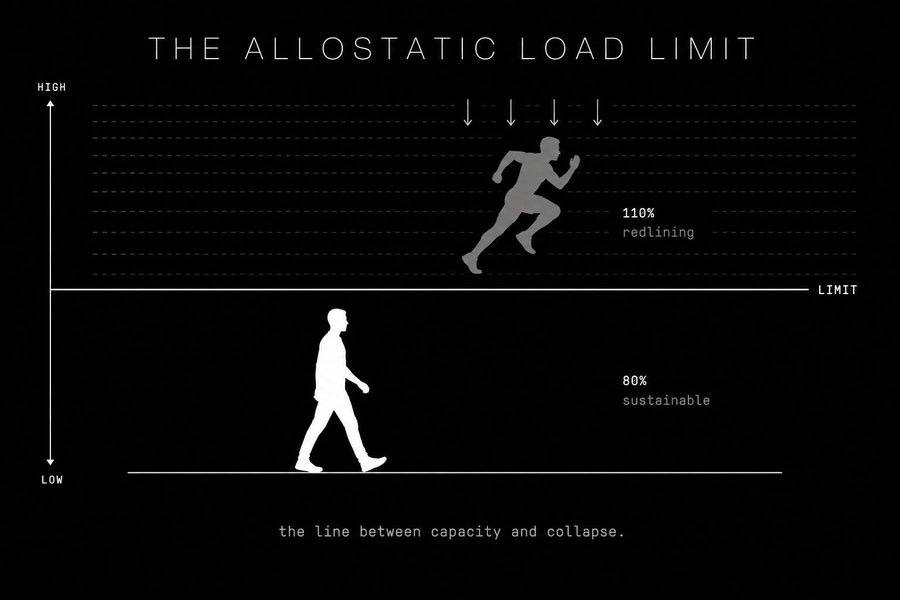
I lost way more momentum being forced out of the game than I would have lost by just dialing back proactively. Running at 80% instead of 110%.
Sustainable effort beats an endless sprint every time.
Burnout comes from operating too close to your capacity for too long. You cross an invisible line where motivation evaporates.
That line is called the allostatic load limit. Allostatic load refers to the wear and tear your body and brain incur from daily work and activity.
If you cross the allostatic load limit and stay there too long, cynicism creeps in. The simplest tasks turn exhausting.
Imagine your capacity is a 200lb squat. You rarely want to max it out. You want to train by squatting 80% of that — 160lb — routinely instead. Exceeding your max day after day guarantees injury and forces you out of the game, which decreases aggregate productivity.
After hitting severe burnout, a mentor suggested I start tracking my daily capacity on a scale of 1 to 10. 10 being right up against the allostatic load limit, 1 being the other end.
This simple hack prevents spillover. It also reveals when you’re near your limits, signaling the need to pull back in advance.
If you’re consistently hitting 8 or higher, dial it back.
Objective markers like heart rate variability also help you gauge capacity, but subjective ratings work well for most.
Don’t stay past the line for too long.
Going all out occasionally, pushing at a 10, can expand your capacity in the long run. But you can’t live there.
VIII. PROTOCOL THREE: WHEN YOU SEE A HILL, SPRINT
Sometimes you’re red-lining too long and you have to dial things back.
Other times, leaning in is actually the solution. You can strategically nudge past the allostatic load limit to cure the burnout.
In certain situations, you can work yourself out of burnout.
If you’re feeling overwhelmed by a fairly hefty workload but getting mediocre results, paradoxically, you can dial the workload up to an extreme level and get a disproportionate increase in results. Enough to combat the trigger of insufficient reward.
That will energize you and blunt the burnout even though you’ve dialed up the workload. Because one of the best buffers against burnout is winning. Getting results.
You rarely hear about founders like Mark Zuckerberg or Bill Gates building billion-dollar companies and getting burned out, even when working 100-hour weeks. Because when you’re winning, you can keep going. The success itself blunts the burnout.
Stacking wins generates dopamine. Dopamine drives focused attention, which drives access to flow state. Flow produces peak performance, which produces more wins. Ride that cycle and you build momentum.
Do it within a limited timeline. Remind yourself it’s only for a short while. A week, a month. Then dial back. Just don’t stay past the allostatic load limit for too long.
Dial work up in the short term, get disproportionately higher results within a constrained window, and the burnout will drop.
When you see a hill, sprint.
IX. PROTOCOL FOUR: DISARM THE BURNOUT TRIGGERS
To defuse burnout, detect and disarm each trigger.
Rank the six triggers based on whatever’s causing your existing burnout (or whichever poses the highest risk). Then tackle them in order, starting with the top-ranked one. Systematically address what’s causing each, and solve the root issue.
Address each trigger directly:
For lack of control: Focus your sense of control on the smallest part of your work that you can completely own. Speak with your boss or team about expanding the ownership you can take.
For work overload: Take real time off, not just weekends. And get active recovery during that time off. It’s not about hours off work. It’s about hours in active recovery.
For insufficient reward: Gain more by asking for more recognition, appreciation, or compensation. Sacrifice less by doing your work in less time.
For unfairness: Recognize it may stem from perceived, not actual, unfairness. We tend to compare our negatives to others’ positives, but rarely the reverse. This skews reality. Reset your perspective by considering the full context. And if there’s real objective unfairness, address it directly with whoever is causing it.
For values conflict: Pin down your company’s core values and contrast them with your own. If the clash is significant, consider leaving or moving to a fundamentally new role. If the disconnect is minor, negotiate a transfer to a team that aligns better with your values.
For breakdown of community: Rebuild your sense of belonging by investing regular quality time with your team. Synchronize frequently, ideally in person. Make space in meetings for members to share personal and professional victories and express genuine appreciation.
It can take time to address each trigger, but until these are handled, the burnout won’t let up.
The goal is to precisely diagnose your burnout and tackle each specific cause, rather than vaguely saying, “Hey, I’m burnt out, I need to take time off,” which is the default attempt at a fix.
X. PROTOCOL FIVE: BUILD YOUR BURNOUT BODY ARMOR
You can prevent burnout altogether by burnout-proofing your body and mind.
The way you do this is through a specific kind of recovery: active recovery.
Active recovery is the "on-off switch" for your nervous system. Almost nobody uses it. Once you do, burnout struggles to get a grip.
It's also the best way to address the work overload trigger. Time off only works when it's filled with active recovery.
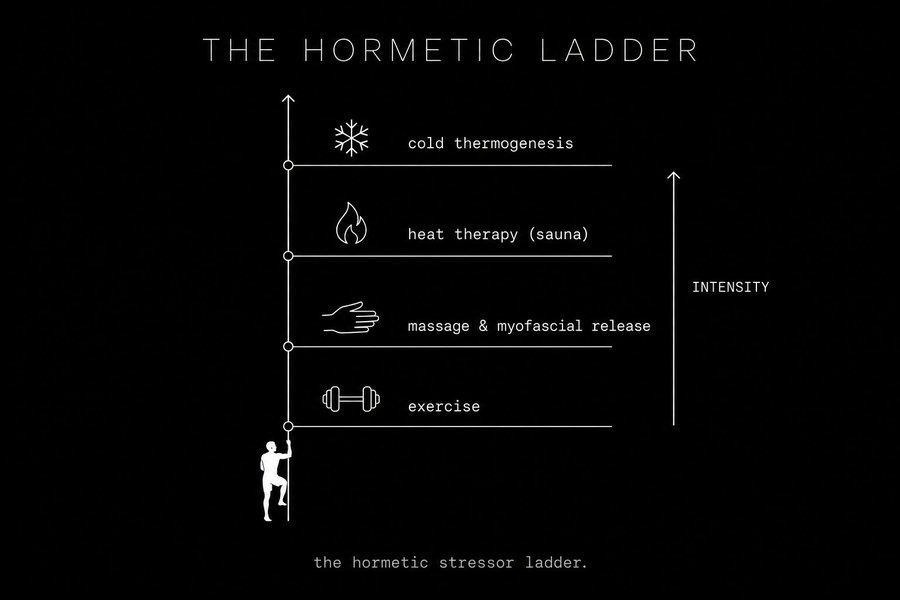
In particular, we want to use what are called hormetic stressors.
Hormetic stressors jack up your heart rate in the moment, then drop it and elevate your heart rate variability afterward. That’s a sign of your rest-and-digest, parasympathetic nervous system kicking in, which lowers long-term stress.
Think of it like an Iron Man suit. Hormetic stressors won’t make you invulnerable, but they’ll lessen the impact of burnout.
In burnout, your autonomic nervous system is stuck in overdrive, like a car revving in fifth gear. Hormetic stressors temporarily slam the shift from fifth to sixth. This jacks your autonomic nervous system to full sympathetic mode.
That causes a parasympathetic rebound. The gear shifts back down, and the stress now lands below the level of burnout. You’re in second gear instead of fifth.
Hormetic stressors work because when you’re battling burnout, your nervous system is too overtaxed to even respond to other forms of active recovery, like meditation or going for a walk. Those activities don’t hit your physiology hard enough.
They’re still good things to do, but they’re not hormetic stressors and won’t cause this parasympathetic rebound.
When you sweat it out in a sauna or jump into an ice bath, it’s all-consuming recovery. You no longer have room to pay attention to or be bothered by the burnout.
Yes, it sounds unappealing. Counterintuitive, even. But it works.
The interventions, in order of intensity:
Cold-induced thermogenesis. Ice baths, cold showers, cold plunges.
Heat therapy. Extreme heat through saunas, steam rooms, hot baths.
Exercise. For workplace Olympians, moderate exercise and strength training are non-negotiable.
Massage and myofascial release. Some of the world’s best athletes consider massage an indispensable part of their training regimen for a reason.
The more burnout you’re experiencing or at risk of, the more intensely you’ll want to intervene.
Use short bursts of hormetic stress to fight burnout.
XI. THE INFINITE STREAM
Work is endless. The tasks multiply. And often, the better you are at what you do, the more true that becomes. Your responsibilities reflect your capabilities.
So the real question becomes: how do we manage ourselves as finite beings in the face of the infinite stream?
That’s what burnout-proofing accomplishes.
When you understand the six triggers, you can diagnose the root cause with precision. When you apply the five protocols, you can work at full capacity without fear of hitting the wall.
Choose the right kind of hard.
Don’t stay too close to the line.
When you see a hill, sprint.
Disarm the triggers.
Build your body armor.
Do this, and burnout becomes a solved problem.
Rian, thank you for this piece. I've followed you for a long time, and I've learned a lot from you! I appreciate the clarity and structure with which you put this all together. When I think about the different hats I wear in my life - farmer, mother, homemaker, business owner, employee - there have been degrees of burnout in each. and definitely levels of burnout when looking at the whole life together. Your recent writings about allostatic load have been really useful for me. Working on active recovery has given me understanding, and allowed me to differentiate between nervous system state regulation throughout the day in small moments, here and there, from the LOAD that my nervous system is carrying. Thank you for the work you do.
Nothing has been more relatable to this for me at this moment. A few months ago I had a very similar experience at work and I eventually ended up getting so beaten up that I quit and came back to my hometown to pursue what people call the impossible dream. A few months of dedicated preparation and I'm back to feeling hardcore burnt out because what I am doing right now has no short term reward mechanism and it gets even harder to keep doing things when outcome lies after years of practice. Indeed helped me to realise that I was not alone in feeling all this.