

Have you ever felt like you’re constantly bouncing from one task to another, never quite sure if what you’re doing is actually moving you closer to your goals?
There’s a science-backed way to break free from this cycle and achieve laser-focus on what matters most.
Here’s how to train your brain to see your most ambitious goals as not just possible, but inevitable.
The Head Injury
When I was 13, I had a surprising amount of purpose and direction in life — for a 13-year-old.
I was training to be a world-class rugby player — like my younger brother, who later competed in the Rugby World Cup as Captain of the Irish Rugby team.
I was weight training with monk-like discipline six days a week and surfing with religious fervor.
These pursuits were a tunnel through which my attention and energy could be funneled. The world made sense because it all revolved around a destination — my future on the rugby field.
Then everything changed.
A head injury nearly killed me.

For a year, I couldn’t get out of bed. My brain barely functioned. I couldn’t remember the name of my best friend or favorite band. And the fatigue was crippling.
There would be no more rugby, no more surfing — even a 30-minute walk became a serious challenge. For seven years, all the way to age 20, I was chronically debilitated.
But here’s what I never would’ve expected:
Worse than the physical debilitation was this increasing experience of psychological disarray.
By the time I was 15, my mind started to subtly unravel.
There was no goal anymore, no future point to orient my consciousness around. My day-to-day was now unanchored to any aim, and it became meaningless.
The identity I had built disintegrated. I was unmoored, lost, and unclear on who I was, what I was here to do, and why it was worth waking up in the morning.
Some days, I couldn’t get out of bed in the morning. One day, on the way back up to school on the train, I had an overwhelming impulse.
An image flashed in my mind: hopping off the train, disappearing into the fields, and just walking until I couldn’t anymore. Sleep under a tree, wake up, start walking again, repeat. I wanted to break free of everything in a single, desperate act.
Somehow, it felt as if stripping life back to survival in the wilderness would ease the inner suffering.
There’s a name for this sort of aimless, psychological chaos:
It’s called psychic entropy.
Psychic Entropy: The Default State
Mihaly Csikszentmihalyi, the Psychologist who coined the term “flow state” called this psychic entropy — the natural tendency of our consciousness to drift into disorder and chaos when left unstructured.
Csikszentmihalyi argues that psychic entropy is not just a temporary state; it’s actually the human mind’s default setting.
Without direction, our minds unravel aimlessly. We ruminate on past mistakes, worry about the future, or get lost in unproductive daydreams.
It’s like being a leaf tossed by the wind — no direction, no goals that feel worthwhile enough to really pursue, and a nagging sense of wasted potential. The pain of knowing you have more to give, but not knowing how to unlock it, eats away at you.
With every misaligned action, confidence erodes, and you start to question your worth... especially as you see others who seem to have clarity and properly channeled ambition.

There are two main ways to address psychic entropy: internally, through mastering the mind with contemplative practices — such as meditation, mantra, and prayer... and externally, by finding a goal or focal point that brings order to consciousness.
For most, the external approach is much easier to implement.
Finding the Antidote
At the peak of my psychic entropy as a teen — lost, confused, identity-less, and angst-ridden — I read a musty old self-help book that had survived my mom’s last bookshelf purge.
For the first time in ages, something clicked.
The book was about goal setting and how setting goals can help you focus.
It seemed simple enough.
I thought, “Maybe, just maybe, it could work. I just need a different goal than becoming a professional rugby player, given my current physical debilitation.”
I decided to pick an arbitrary goal. One that seemed as distant as could be: becoming a doctor.
As I slowly began to commit to that goal, the chaos in my mind gradually began to recede.
It wasn’t easy. But as I studied and pushed myself forward, day by day, my actions began aligning with this grander purpose.
As this sense of purpose increased, my life started to feel more coherent. Things began feeling linked together. Like they made sense.
I studied harder, ate healthier to study better, became selective with who I spent time with, and slept more diligently — all so I could progress towards the Doctor goal.
Each chunk of previously disorganized experience started clicking into place. That old sense of direction I’d lost after the head injury began creeping back in.
As Mihaly Csikszentmihalyi put it decades ago:
“When an important goal is pursued with resolution, and all one’s varied activities fit together into a unified flow experience, the result is that harmony is brought to consciousness. Someone who knows his desires and works with purpose to achieve them is a person whose feelings, thoughts, and actions are congruent with one another.”
Interestingly, I didn’t end up becoming a doctor. But that’s the point — it doesn’t matter if the initial goal is “accurate.” What matters is having a goal so you can harmonize your experience.
This is what it means to be Goal-Directed.
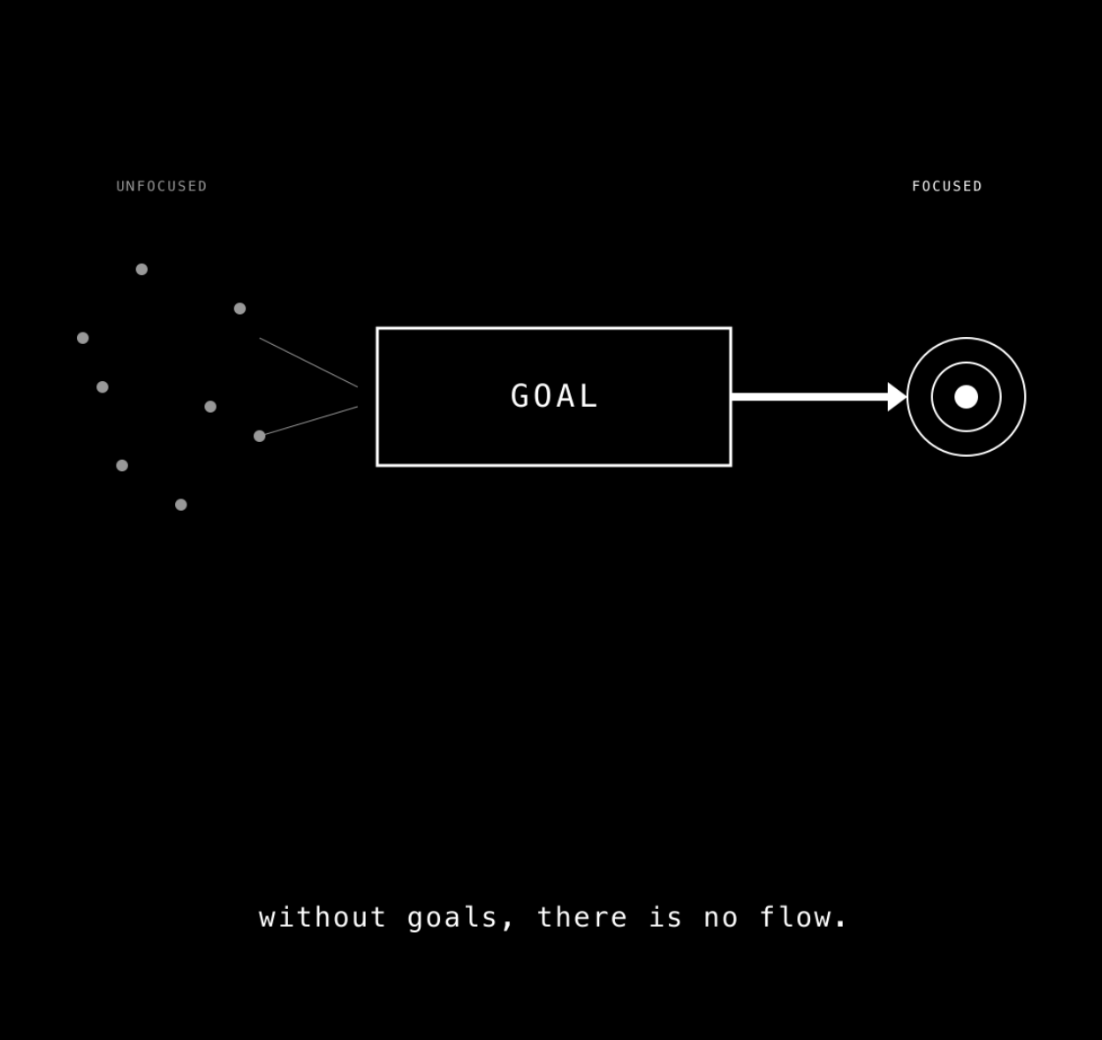
What It Means to Be Goal-Directed
Goals relieve your ill-at-ease consciousness from the burden of itself.
Beyond that, becoming goal-directed is a prerequisite for flow state.
Goal-directedness funnels attention, organizes experience, and imbues life with meaning — extinguishing the thrashing pain of psychic entropy.
And this goal-directedness isn’t just subjective — it’s rooted in your brain.
Goals activate your prefrontal cortex, enhancing decision-making and focus.
They reduce the negative chatter of your brain’s default mode network, combating worry and rumination. And most importantly, goals light up your brain’s reward centers, giving you a sense of purpose and fulfillment.
Being goal-directed makes life feel livable.
Now, you might have a decent idea of what your goals are already. But we’re about to dive far beyond goal-setting.
We’re about to build you a goal stack.
The goal stack involves building out direction and goals all the way from an unattainable infinite purpose down to goal-directed actions that you’ll execute on a weekly, daily, and hourly basis.
Think of your goal stack as a set of stairs you construct with the right structural integrity to lead to your end state. Each step has to actually lead to the place you want to go. If a single step is missing, you can’t get to your destination.
For most people, their ultimate goal remains a lofty idea in their head, with no staircase — or one that’s partially finished, leading nowhere.
Step 1: Build Your Goal Stack
The first time Michel Lotito swallowed glass, he was nine years old.
Thus began Lotito’s fondness for eating dangerous objects.
In 1959, gastroenterologists examined him.
His condition?
Pica: a taste for unusual, non-nutritive items.
This launched an incredible career: Monsieur Mangetout (Mr. Eat-all) was known to eat two pounds of metal every day.
How?
He would reduce metal objects into smaller pieces and keep his throat lubricated with mineral oil.
Throughout his career, his diet included 18 bicycles, 7 TV sets, 2 beds, 15 supermarket trolleys (one must wonder what was going through his mind as he munched through his 14th trolley), a computer, a coffin (handles and all), skis, and six chandeliers.
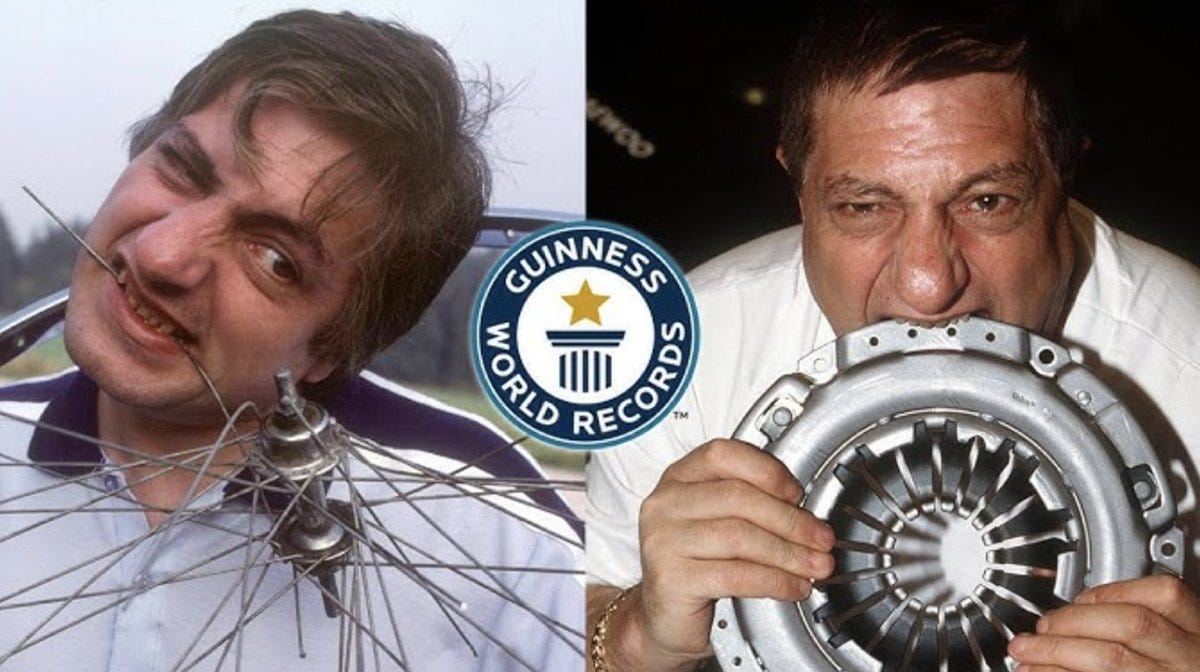
But the pinnacle?
In 1978, he ate an entire Cessna 150 airplane.
More precisely, he began eating it in 1978. It was a piece-by-piece process that took two years. In 1980, he emerged victorious from the battle of man versus flying machine.

How did Michel do all of this?
He used reverse engineering.
Reverse engineering turns large goals into small, achievable steps. It clarifies the tiny tasks involved in achieving a titanic goal and sets a timeline to get them done.
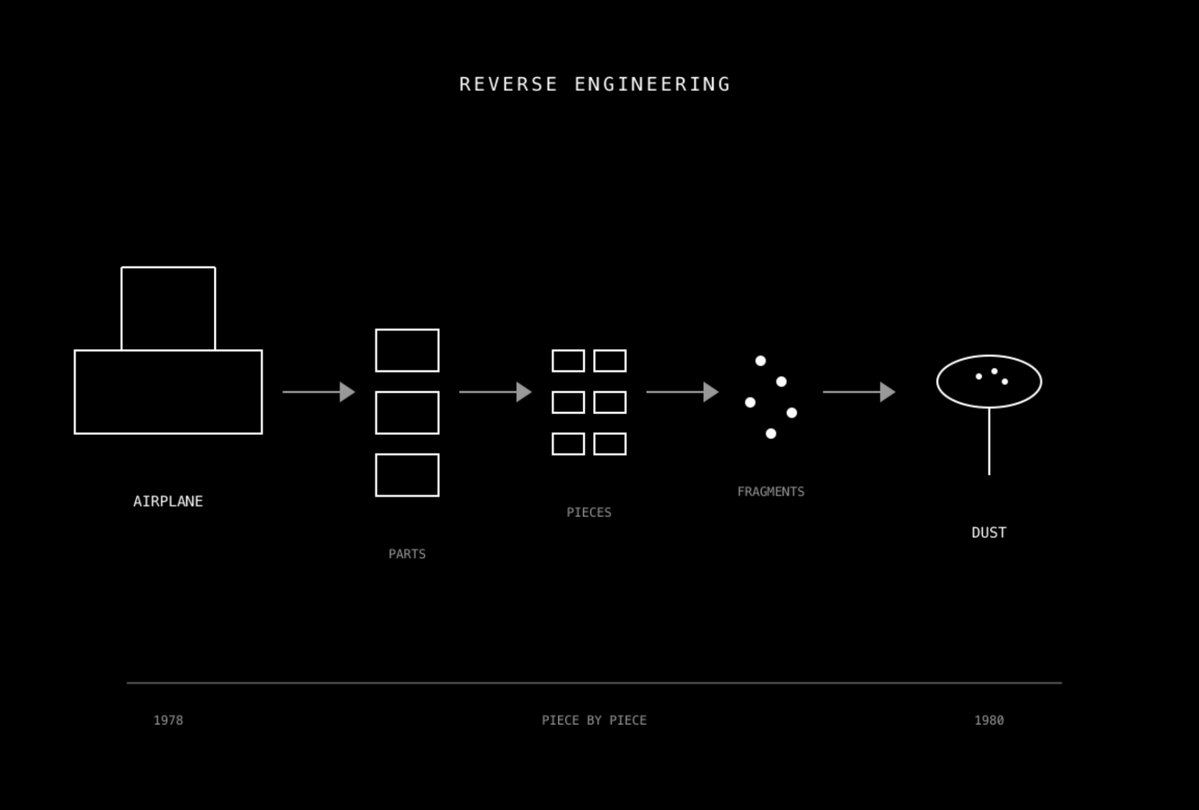
Your audacious long-term goals are the equivalent of your airplane. The first step needs to be to grind it down to an edible spoonful of dust.
The Layers of Your Goal Stack
In order to do that, we work through each layer in the goal stack, from an overarching purpose to multi-year high hard goals to yearly annual goals to quarterly goals to monthly goals to weekly goals and daily goal-directed actions.
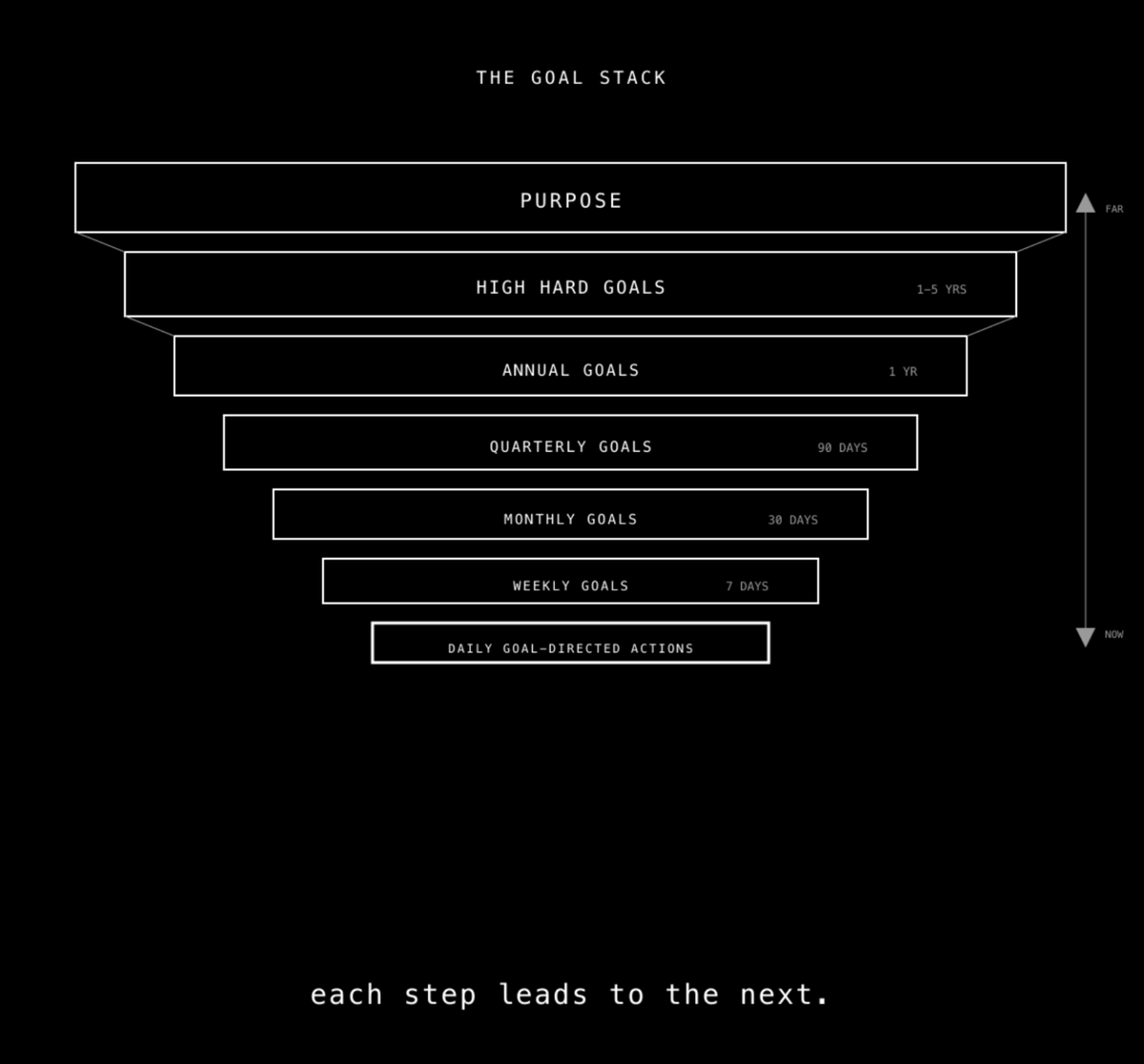
Layer 1: Purpose (Pick a Problem)
Earlier, I shared the story of how, at the age of 13, I experienced a head injury that had profound effects on my mental state. And how stumbling across that book on goal-setting gave my life direction.
Just before I stumbled upon that book, I was at the peak of my psychic entropy as a teen — lost, confused, and identity-less. I read books about life’s purpose.
These led me to believe that purpose was a static entity. Something that would be discovered if only I could do enough introspection.
Then, having struggled with my health so much, I decided I wanted to help others with theirs. So I chose to pursue becoming a doctor. In doing this, my understanding of purpose began to shift.
I realized that purpose isn’t necessarily something that finds you; rather, it’s something you discover and iterate upon as you engage with life.
In other words, I realized that purpose is something you do, not something you have.
Purpose is a verb, not a noun.
So, instead of finding my purpose, I realized I could just pick a problem. I asked myself, “What’s something messed up about the world that I wish wasn’t so messed up?” And the idea that anyone out there could struggle with their health like I had bothered me.
Finding your purpose is a bit like finding the position you’re best at on the rugby pitch. There’s no way to know until you get it to play, but once you’re in play, your role will self-correct fast and the path will become clear.
Conviction, certainty, and confidence in your goal are not pre-requisites to becoming the goal directed. Pick, move forward, things will clarify on route.
So here’s the rule: Pick a problem, not a purpose.
Picking a problem is often just a matter of paying attention to how you respond to things you see in the world that bother you. For example:
You’re walking along a beautiful beach, but instead of pristine sand, you find it littered with plastic bottles, bags, and other debris that has washed ashore.
The problem here is plastic pollution in the oceans.
Your potential purpose: To create a world where oceans and marine life thrive, free from the negative impact of human activities.
The key here is to realize that clarity about your direction in life is a choice.
It’s similar to ordering food off a dinner menu. Maybe you come to the restaurant and already know what you want. But chances are you don’t.
So you look at the menu, order something, and then you eat it.
Some people come to life knowing what they want to eat before looking at the menu.
But most have to look at the menu and pick.
Just pick so you don’t become starved with purpose. And over time, the problem you pick will evolve into a purpose.
The output of this exercise should be something specific enough to inspire but broad enough to allow flexibility.
This means the same purpose can be fulfilled in thousands of ways. For example, rather than having a purpose be to “become a singer-songwriter”, it’s probably more productive for it to be “enriching lives through music”.
Now, let’s turn your purpose into a plan through reverse engineering.
Layer 2: High Hard Goals (1-5 years)
A High Hard Goal is an ambitious, long-term objective that takes 1-5 years to achieve. It pushes you out of your comfort zone and requires significant effort, planning, and dedication.
In Michel’s story, eating the airplane was the high hard goal. He deconstructed the parts of the plane with its subcomponents.
Then he started with the most manageable part, ground it down, and took his first spoonful of lead.
Suppose you want to start a billion-dollar climate tech company.
Your high hard goal could be: “Build a climate tech company that reaches a valuation of $1 billion within five years, focusing on developing innovative solutions to reduce carbon emissions.”
Using this example, let’s break this down into annual goals.
Annual Goals
Year 1: Validate problem and solution, develop prototype, secure initial funding
Year 2: Build the team, refine product, establish partnerships
Year 3: Scale the business and secure significant funding
Year 4: You’ll achieve market leadership and expand your offerings
Year 5: Reach unicorn status and prepare for exit
You can see that each year builds upon the previous one.
Then, the next step is to take the Year 1 annual goal and break it down into quarterly goals. These should be significant milestones that move you closer to your annual goal.
Quarterly Goals
Using our example of building a billion-dollar climate tech company, here are examples of Quarterly Goals for Year 1:
Q1: Conduct market research, identify target market, and define the problem to be solved
Q2: Based on the defined problem, develop a prototype solution and gather user feedback
Q3: Refine the prototype based on user feedback and prepare a compelling pitch to start fundraising
Q4: Secure initial funding using the refined prototype and pitch, and prepare for product launch
Each quarter builds upon the achievements of the previous one, creating a logical progression towards the ultimate goal.
Monthly Goals
Now, continuing with our reverse engineering, let’s create monthly goals that directly support the Q1 goal:
Month 1: Identify target market and conduct 40 customer interviews to gather insights about their needs and pain points
Month 2: Analyze interview data to identify common themes and define a clear problem statement that resonates with the target market
Month 3: Ideate potential solutions to the defined problem and craft a unique value proposition that sets your solution apart
Each monthly objective contributes to the completion of the quarterly goal by providing the necessary information and groundwork.
Weekly Goals
Next, let’s plan weekly goals that directly lead to achieving the Month 1 goals:
Week 1: Create a comprehensive customer interview script and identify 50 potential interviewees who fit the target market criteria
Week 2: Conduct the first 10 customer interviews using the script and document insights, ensuring to capture key pain points and needs
Week 3: Conduct the next 10 customer interviews, building upon insights from the previous week, and start organizing data for analysis
Week 4: Complete the data analysis by identifying common patterns and summarize the key findings to inform the problem definition
Each weekly target plays a crucial role in gathering the necessary data and insights to achieve the monthly objective of identifying the target market and defining the problem.
By ensuring that each level of the goal stack directly supports and leads to the next, completing each goal sets the stage for the next, much like dominoes falling in a precisely planned sequence.
Now, bear in mind as you do this: don’t get too caught up in perfecting every detail upfront. Your reverse engineering doesn’t need to be flawless. Things will become clearer as you move forward.
Think of it less like waterfall project development, where you plan everything out in detail before starting and then follow that plan exactly, and more like the lean startup approach - you set direction but hold your plans lightly, refining as you go. The act of moving ahead will illuminate the path.
Note: Sometimes you won’t know what the next step is, but the skill is to approximate as close as possible to what the next is and as far as possible in the chain. You map out the cause-and-effect chain to the best of your ability. But to a thousand times more granular detail than 99% do.
Again: The goals, even if imperfect, give you a launching point. They orient you so you can start taking action with confidence. Then, as you make progress, you can course-correct and sharpen your targets.
So don’t put too much pressure on yourself to map out every step perfectly from the start. Sketch out your best estimation of the reverse-engineered sub-goals needed to reach your high hard goals.
With that in mind, at this point, you should have built out a goal stack consisting of a series steps that lead to your high hard goal.
With the goal stack, you’ve anchored yourself to a goal to structure your consciousness –– the first step in becoming goal-directed.
But now… how do we convert this goal stack into daily, hourly, and minute-by-minute actions that actually lead us up the staircase?
How do you actually live your goal stack on a week-to-week basis and attain that critical minute-to-decade alignment?
This brings us to the absolute core driver of peak performance and productivity…
Step 3: Commit to Goal-Directed Actions
Now that you’ve built your goal stack, you’ve given some longer-term structure to your consciousness. But you still have to deal with the moment that’s right in front of you.
How do you ensure that the actions you take will actually lead to reaching your goals?
To do that, think of your productivity as a car.
Elite performers spend nearly all of their time driving directly to their destination, taking the best route possible.
Most people spend 90% of their time driving in circles and cul-de-sacs, turning down wrong roads, or crashing into trees and reversing.
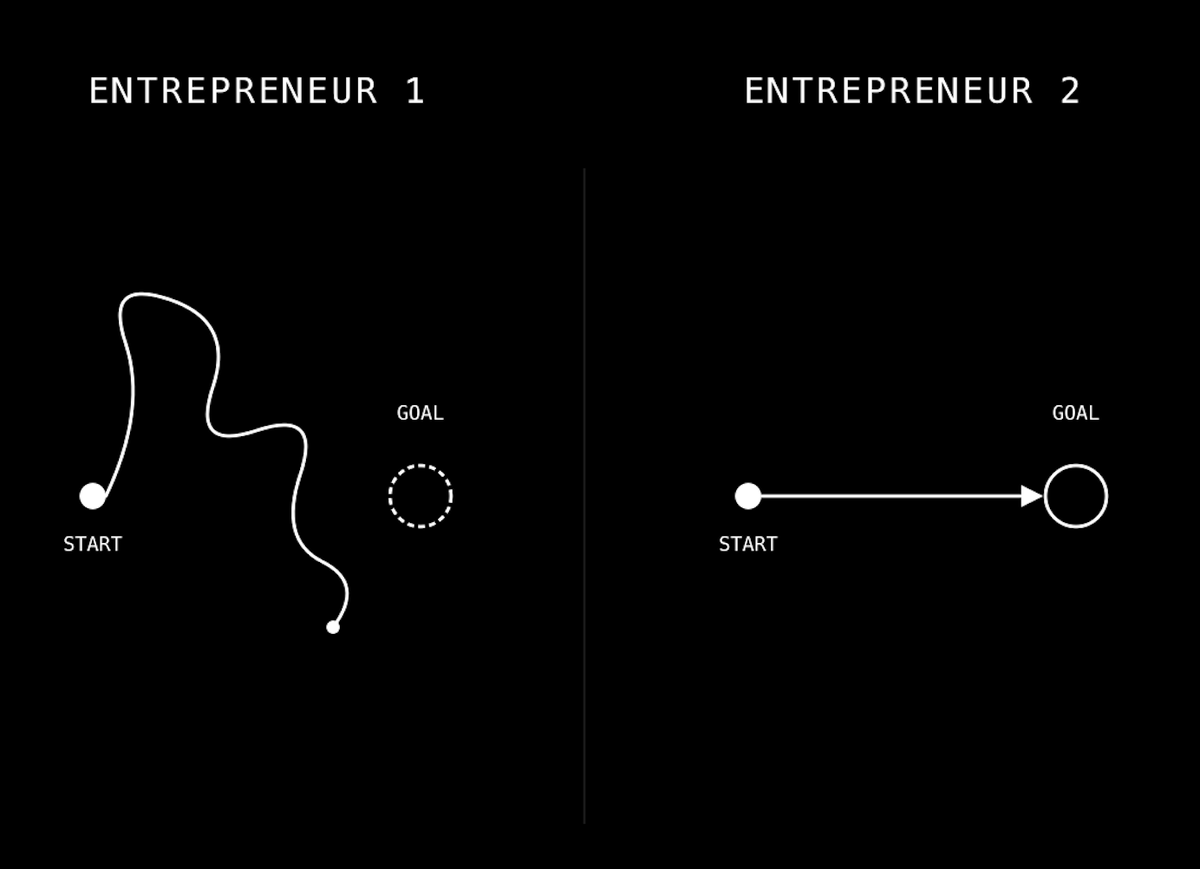
Two Entrepreneurs, Same Goal
I remember during my early years in business, I was at a business mastermind at Powder Mountain in Utah. I was observing two different entrepreneurs who had the same goal of building an 8-figure business, in the same industry chatting to one another about their day to day.
Entrepreneur A:
Wakes up and spends 15 minutes wondering what the most important thing might be to work on.
Then takes a break from wondering about it and answers all her email. Then has a hunch that it might be good to improve her branding because one of the emails she just responded to mentioned that branding has room for improvement. Spends 90 minutes on that.
Then she gets a call from her team and oversees what they’re doing. Then decides it could be good to explore expanding their social media presence, so she spends a few hours researching vendors and calling them up. And decides not to continue.
She’s floating through her day, a leaf in the wind, without a clear direction.
Entrepreneur B:
Knows from the day before that the single goal for the business right now is to increase lead generation.
She also knows that the single most important way to do that is to focus on the most effective marketing channel, which is Facebook ads. She also knows that the most important way to improve the Facebook ads is rewriting all the ads.
So she sits down for three hours, rewrites every ad, sends them to the team member to implement, and ties up the rest of the loose ends and finishes the day. The night before, she determined everything, and before checking anything, she attacks that one thing that she knows will drive her toward the 8-figure goal more than anything.
Once completed, she knows she’s attacked the correct thing for the day, does whatever maintenance stuff she needs to do, then finishes.
The Difference
The difference between these two entrepreneurs isn’t how much they work. They wake up with the same 24 hours.
But the actions they take are radically different.
The most important thing is not incrementally more important than everything else. It’s incomparably more important than everything else.
What Makes an Action Goal-Directed
Think of your goal stack as a towering stack of dominoes. To topple the whole structure, you need to identify the key domino that will trigger a cascading chain reaction.
These domino-toppling tasks are called goal-directed actions.
A goal-directed action has the highest level of progression toward goal attainment out of anything you can conceivably do. It’s an action that, when completed, directly brings you one step closer to your high hard goals. It’s the domino that knocks down the next domino in line.
Tasks that aren’t goal-directed are the equivalent of being a hamster on a wheel. There’s a lot of activity and movement, but ultimately, the hamster isn’t going anywhere. There’s the illusion of progress through motion but no true advancement.
Step 4: Separate Planning from Doing
Most professionals function like sprinklers. They spray a little bit of effort in multiple directions, hoping that somehow they’ll move forward.
When you become goal-directed, you become more like a power hose. One rapid stream of attention, burrowing into its target.
To move from reacting to deciding, we need to separate planning from doing.
Divergent thinking is creative: we link disparate and far-flung ideas to form something new.
Convergent thinking is when our attention narrows in on a single thing.
Both states are critical, but they don’t blend well together. We want to use one or the other:
Diverge when planning
Converge when doing
Separating these two brain states frees us to act without questioning whether what we’re about to do is the best thing we could do.
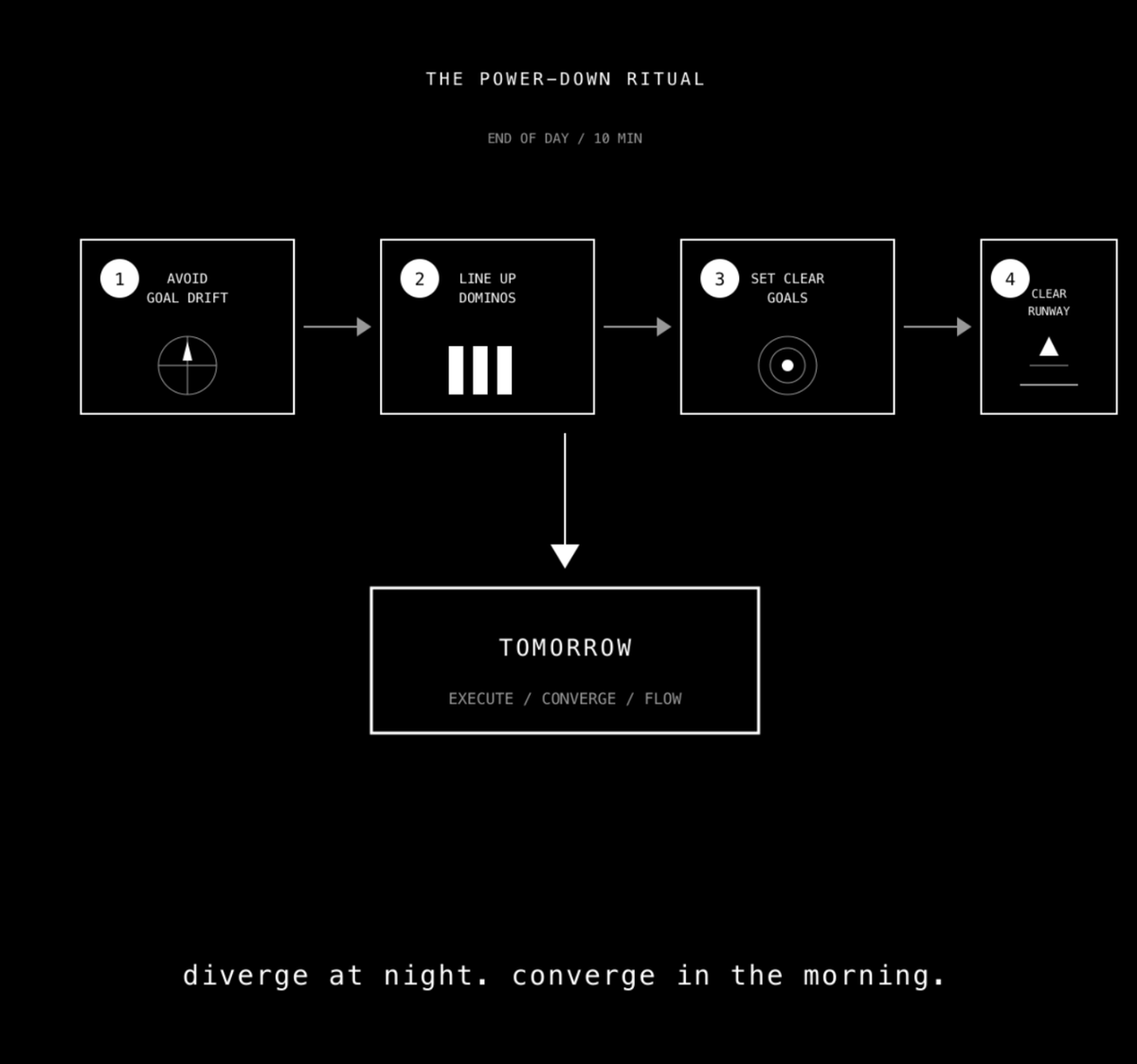
The Power-Down Ritual Is Your Tool For This
At the end of each workday, take 10 minutes to plan tomorrow’s goal-directed actions.
1. Avoid Goal Drift
Review your goal stack. Check your daily activities against your high hard goals to ensure alignment. This helps identify goal drift—deviations from your long-term objectives—so you can course-correct.
2. Line Up the Dominos
Identify the three most critical goal-directed actions for tomorrow. No more than three. These should be tasks that have the greatest impact on your long-term goals.
3. Set Clear Goals
For each goal-directed action, set wildly specific clear goals. Break the task into micro-goals.
Then, take the first step of the first step. Actually do it—open the document, title it, save it in the right folder.
When you map out your goal-directed actions with these wildly clear, minuscule goals and take the first step of the first step, you can dive right into work the next day and get into flow.
4. Clear the Runway
Tie down all loose ends so you have a free and clear runway for tomorrow.
The Goal-Directed Pyramid
To tie all of this together, visualize the Goal-Directed Pyramid:
The Base - Your Goal Stack (Aspiration)
The base is your purpose — a meaningful problem to solve that fuels your motivation.
Above this foundation is a staircase of progressively smaller blocks: your High Hard Goals, broken down into Annual, Quarterly, Monthly, and Weekly targets.
Each level supports the one above it, linking daily actions to long-term aspirations.
The Core - Your Goal-Directed Actions (Action)
At the pyramid’s heart, a glowing path of stepping stones ascends to the apex. Each stone is a Goal-Directed Action — a high-impact task that propels you forward and creates a domino effect of progress.
The Summit - Your Clear Goals (Attention)
At the pinnacle, a focused light beam illuminates the path, representing your Clear Goals — the specific, actionable sub-steps for each goal-directed action.
This light shows the immediate next action to take, providing exact directions to initiate flow.
The Deep Now and the Far Future
To get into the deep now through flow, you need a sense of what direction you’re moving into the far future.
And to build the far future, you need time in the deep now (through flow).
The deeper the flow state you experience now, and the more what you work on in that flow state ties to shaping the far future, the more Goal-Directed you are.
Time spent in flow states is highly productive and creative, contributing significantly to building the envisioned far future. And this vision of the far future provides direction and purpose, acting as a compass for your daily goal-directed actions.
It imbues your actions with meaning and responsibility.
A goal directed life provides an antidote to apathy, a cure for boredom and anxiety, and morphs directionlessness into clarity and fulfillment.