

By default, your brain is unproductive for 64% of your waking hours.
But what if you could harness the power of your “off” moments, making your idle brain time propel you toward your goals?
The science shows there’s a way.
The Rumination Landscape
The alarm goes off, and the question emerges: “To hit snooze or not?”
Strength prevails, and you get up, but then another question emerges: “Should I shower, or should I stretch?”
You decide to shower, and in the shower, you’re ruminating about whether your friend thinks you’re lame because you were wearing Crocs the other day. And you wonder whether your colleague thinks you’re incompetent because they glanced at you funny during yesterday’s meeting.
Then, after drying off, you think, “What should I have for breakfast... or should I skip breakfast?”
Before going to work, you wonder, “Should I walk to work instead of driving?” You glance down at your phone and see a message from your ex. You think, “Should I text back right away, or will that come across as needy?”
This is the rumination landscape most of us have.
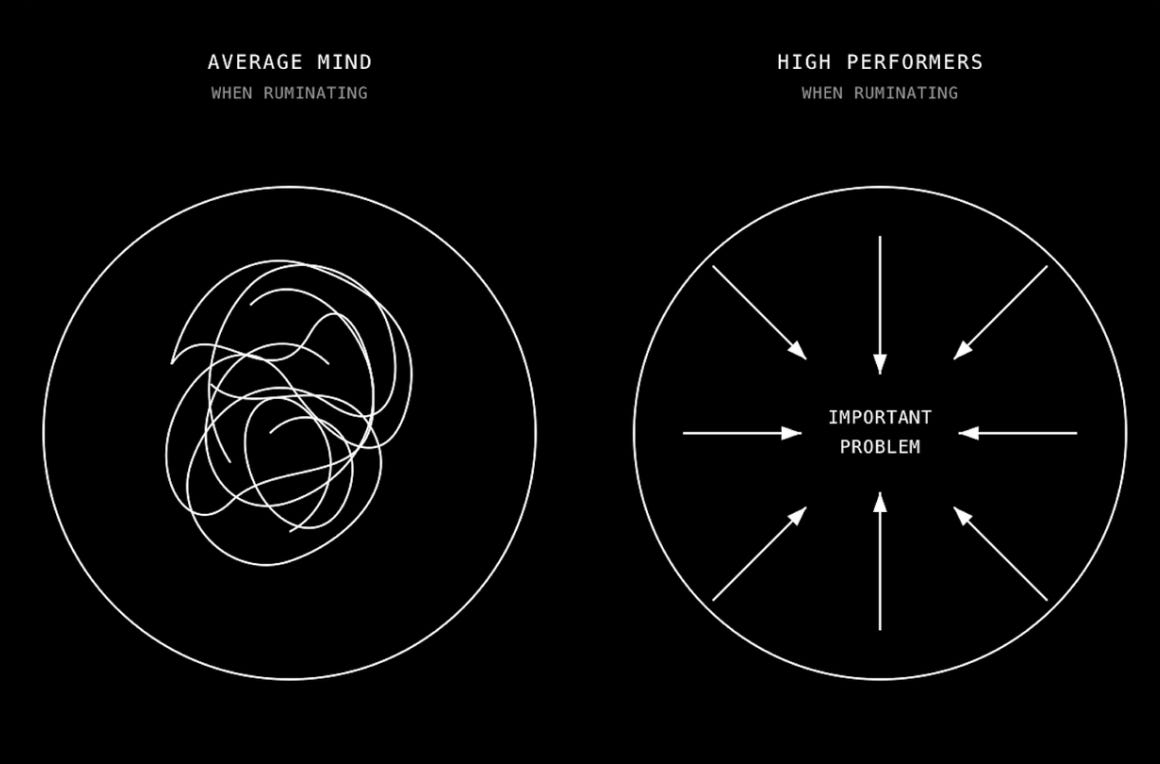
From the moment we wake up to the moment we go to bed, we’re trying to answer minor, irrelevant, trivial questions — our minds filled with clutter unrelated to our goals.
We fritter away our precious cognition on micro concerns. Ruminating on problems we don’t need to solve.
The Alternative
Now let’s replay that scenario:
The alarm goes off. On autopilot, you perform an optimal morning routine, having made every decision down to the trivial — like whether to shower before or after eating.
Courtesy of the Default Mode Network — the part of the brain that’s active during idle, non-focused moments — rumination still occurs, which means questions arise in the brain as you perform these actions.
But the questions are of a different quality this time:
While showering, you ruminate, “What’s our strategy to triple the business over the next five years?”
While brushing your teeth, you think, “Is rebranding a bigger priority right now, or is rebuilding our sales department?”
While stretching, you think, “How can I best support my daughter this month given her challenges navigating teenage life?”
These are the types of questions we want in our rumination landscape. Ruminating on problems that improve our lives if solved.
The Critical Shift
The highest performers cultivate the second kind of thinking
They take back control of their minds and transform their rumination into a 24/7 problem-solving supercomputer that works tirelessly on specific problems related to their goals — all on their behalf.
This transition from a clogged rumination landscape to a clear, creative, and constructive one has a name.
It’s called: Upgrading your rumination.
The Untapped Network
Most of us equate productivity to when the Task Positive Network (TPN) of the brain is fired up and we’re homed in on a task.
But what about the Default Mode Network (DMN), which is actively engaged when we’re idle — which comprises most of our waking life?
Societally, we bias and over-prioritize the productivity that comes from focused attention when the Task-Positive Network is engaged.
We undervalue and under-emphasize the productivity that comes from diffuse attention when the Default-Mode Network is engaged.
A sort of productivity discrimination.
But here’s the irony: The DMN-based productivity that governs our rumination accounts for far more total hours in our week.
We’re awake 112 hours per week. For roughly 40 of those hours, our TPN is engaged, and we are focused on something.
That means for 72 waking hours, your attention is dislodged, and the DMN is active, ruminating.
Literally, 64% of your waking life—20% more than the hours you work, assuming a normal work week — your productivity is at the mercy of your DMN while you’re ruminating.
It would be kind of like defining productivity in your company as only what happens in the boardroom: when the CEO is present, everyone is seated, the agenda is clear, and decisions are made deliberately.
This is Task-Positive Network productivity: focused, effortful, intentional work.
But the boardroom is only occupied a few hours a day.
Meanwhile, the company’s factory floor is running 24/7.
Machines are humming. Processes are looping. Systems are recalibrating.
Raw materials are being sorted, combined, discarded, or queued for future use.
This is Default-Mode Network productivity: diffuse, reflective, creative, insight-oriented.
Most make the mistake of trying to squeeze more performance out of the boardroom — longer meetings, better agendas, tighter focus — while leaving the factory running unsupervised, misconfigured, or actively wasting resources.
The board room view misses a whole mode of cognition (diffuse awareness) and a whole category of brain states (rumination and related states).
When we view productivity as being defined by both the task-positive network and the default mode network we end up with a holistic, whole-brain view of productivity.
We don’t think about our productivity as limited to being engaged in a task focused on producing work. We also view all of that disengaged time — when ruminating occurs—as a key lever that we can pull to further boost results.
Once we understand that beyond just maximizing time in the boardroom (task positive network, focus attention) we need to ensure the factory is running well (default mode network, diffuse awareness), the next question becomes: how do we do the latter?
The key move is to upgrade our rumination and train our default mode network to solve for our top priorities in all the moments that we are disengaged from focused attention and hanging out in diffuse awareness.
By transforming idle moments into productive rumination, you can solve problems faster, generate a constant flow of new ideas, and turn daydreaming into a strategic advantage.
Trivial thoughts become targeted thinking.
Instead of getting stuck in traffic and stressing about emails, your commute becomes a brainstorm for your next business breakthrough. Your morning routine becomes a precious time for reflection, where major insights for the day ahead emerge. Washing dishes and folding laundry lead to high-leverage moves you could never have thought of while working.
When you upgrade your rumination, you weaponize your idle cognition.
There are three phases we recommend for upgrading rumination:
Phase 1: Reclaim Your Rumination
You have your main business—the core engine that drives most of your results. But then you decide you also want to build an audience, so you start a Substack and YouTube channel — oh, and your coworker ropes you into their startup on the side. Then you and a friend dream up a podcast idea. Now you’re also a podcast host. Then you start dabbling in crypto trading.
Bit by bit, new shiny objects nibble your attention away. You’ve got a dozen mental tabs open that don’t build on each other at all.
That’s called dispersion.
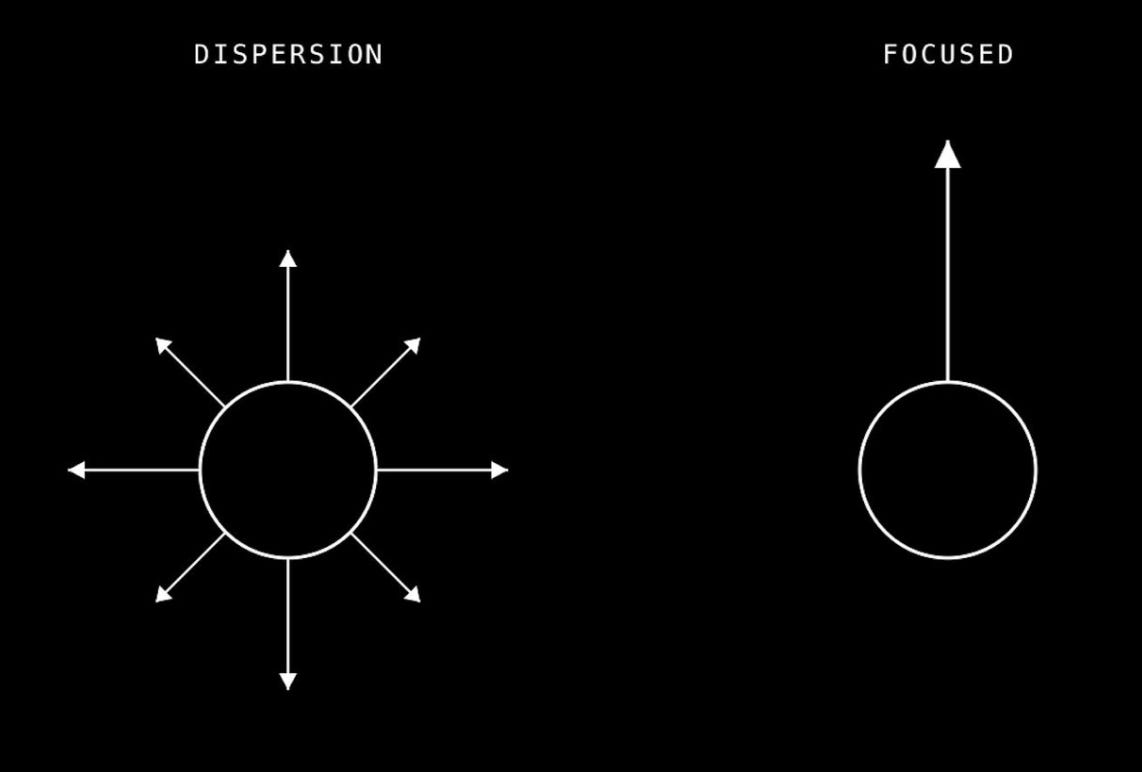
Dispersion is the process of continually decreasing focus on your main pursuit and diverting your limited resources—attention, effort, and time—across multiple non-complimentary pursuits.
Put simply. You’re a victim of dispersion when you’re going a mile wide and an inch deep.
Dispersion causes paralysis. Finding a clear goal so you can even begin work is difficult when you have a vast array of projects, each with its own vast array of sub tasks.
This creates inertia and every task becomes two tasks:
Decide which of your businesses to work on
Decide what to work on within that business
And this dramatically degrades your rumination.
It’s not just that your rumination ping-pongs between projects.
It’s worse: you often don’t ruminate on professional pursuits at all because your mind can’t hone in on anything.
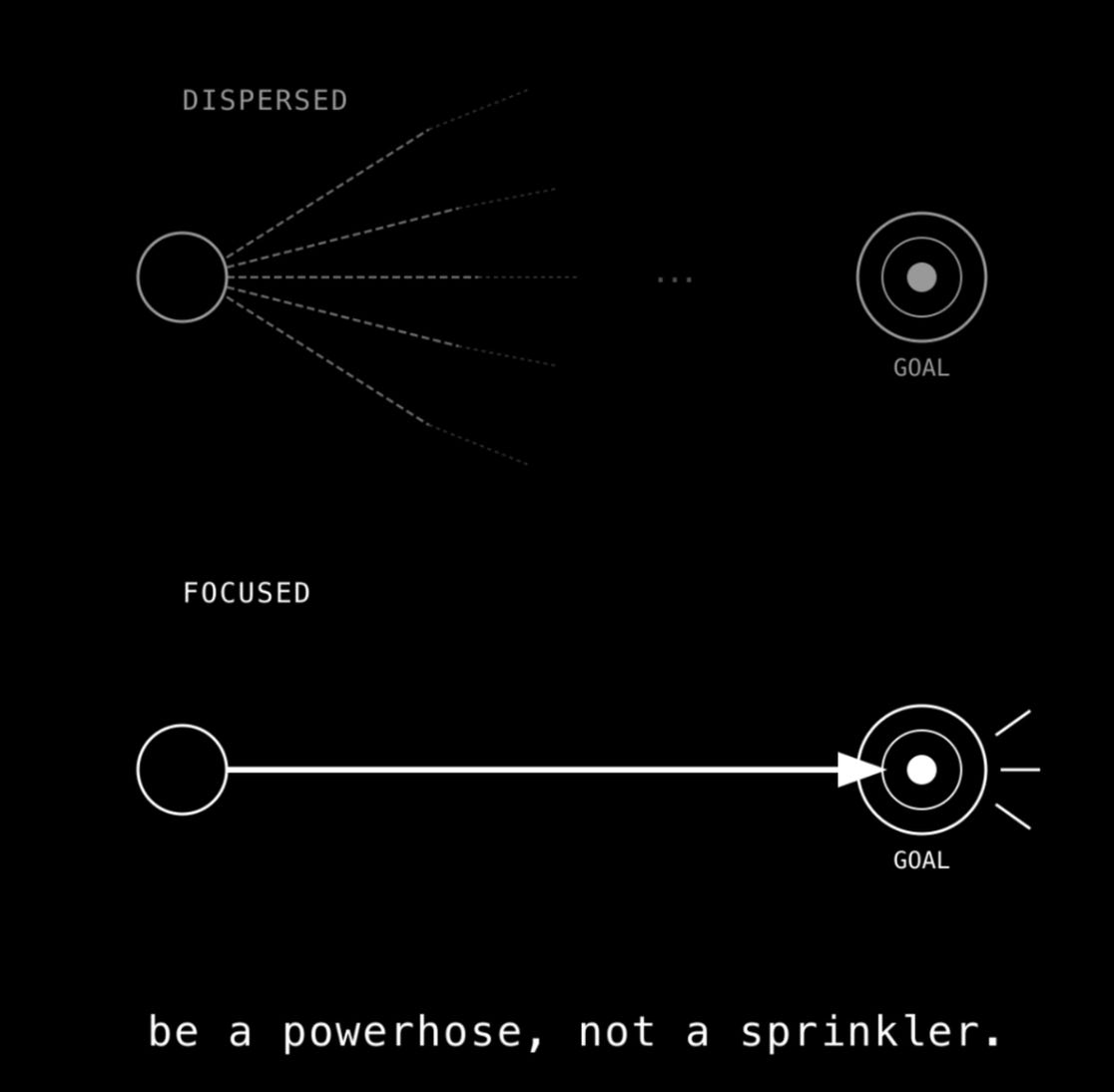
You can’t hit the bullseye of three dart boards at once.
In the same way, your mind has no single target for its rumination when you’ve got a dispersed smattering of projects.
Instead, the DMN latches onto the simplest and stickiest stuff it can: social media, pointless social interactions, the news, and other trivialities.
Once you understand this, it becomes clear there’s no such thing as “just a few hours spent here or there” on a project.
Every chunk of TPN-based focused work you do has a corresponding DMN “rumination consequence”.
In simpler terms, for every piece of work you do, there’s doing the work and then there’s thinking about the work you did later.
So, the first way to upgrade your rumination is to slash dispersion.
This will give your mind a single target to ruminate upon so that it doesn’t latch on to triviality.
Phase 2: Reboot Your Rumination
Now that you’ve reclaimed your rumination by eliminating dispersion, it’s time to clear out all the accumulated junk still rattling around.
Sometimes, to truly upgrade your rumination, you have to reboot it entirely.
This entails completely offloading the cognitive gunk that’s accumulated, sometimes over the course of decades.
Over time, half-baked thoughts and ideas, open loops, worries, the “need to dos” and “should dos” accumulate like junk. Occupying your working memory, boosting cognitive load and robbing you of precious and productive rumination.
The solution is to purge all of it. Externalize the clutter.
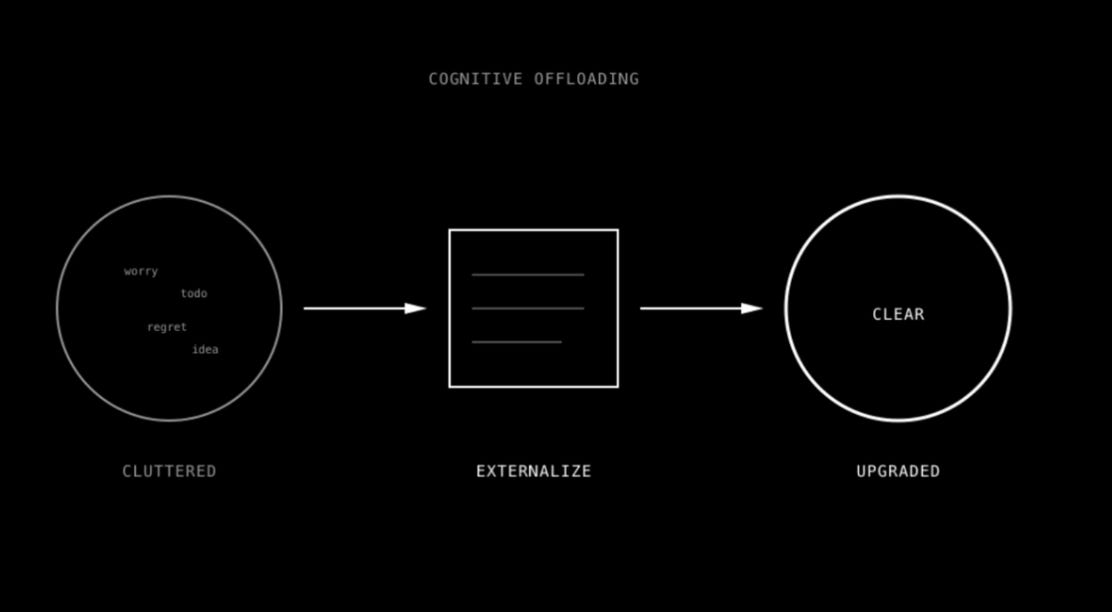
Sit down with a piece of paper and pen and write out every single thought that comes into your head.
Every nagging concern, every trivial notion, every major worry, dumb idea, soft and hard regret — all of it.
Write them out, and get them out of your head.
The act of articulating and capturing frees mental bandwidth enormously. This is known as cognitive offloading — freeing up mental resources, allowing for improved focus and upgraded rumination.
It’s like scavenging for intruders in your mind, much like antioxidants scavenge for free radicals in the body. You’re digging deep to uproot suppressed clutter. Carving out space for your best thinking.
If you want to maximize the impact of this intervention, do it in solitude.
Humans evolved to be inherently social. This makes social signals particularly salient and sticky—and likely to occupy a disproportionate amount of space in our rumination landscape.
This specific type of social rumination has a name: brooding.
Brooding is a subtype of rumination defined as a passive comparison of one’s current situation with some unachieved standard. It’s that mental loop where you replay social interactions, worry about what others think, or measure yourself against peers.
One way to ensure brooding doesn’t clog your rumination is to reduce your opportunities to compare yourself to others—less social media, for example.
Another way is to ensure honesty and candor in your interactions with others. If you aren’t straightforward and underdo candor in your communication, you risk social rumination—degrading the quality of your productive thinking.
For upgraded rumination, aim to live a life free of loose ends, social question marks, and open loops. It’ll mean you’ll have to reboot your rumination less often, as it’ll get less clogged in the first place.
Phase 3: Maintain Your Upgraded Rumination
The average adult makes about 35,000 remotely conscious decisions each day. Researchers at Cornell University estimate we make 226.7 decisions each day on food alone.
Decision-making depletes willpower, increases cognitive load, and tilts our attention from divergent and creative to convergent and jagged—which blocks upgraded rumination.
Visualize decisions as physical tasks—like bending down and picking up a heavy box.
Seen this way, it makes the negative impact of the decisions more pronounced.
To upgrade our rumination, the move is to set things up once and let them run indefinitely without exerting additional cognitive energy.
There are two tools for this: Decision Recycling and Decision Autopilot.
Tool 1: Decision Recycling
Eliminate as many micro- and medium-sized “should I or shouldn’t I?” decisions as possible.
Decision recycling: you decide once and reuse that decision endlessly.
Average minds tend to face repeat scenarios, tend to have predictable preferences, and tend to opt for the same outcome... yet they spend their energy and time making a unique decision to get to that same outcome, every time!
Deciding on whether to book direct or multi-step flights due to the pricing differences, wondering what to do after work on a Thursday, assessing what time to set their alarm each evening for the following morning.
Instead, you can make one decision and recycle it across all future outcomes. When you decide once and repeat forever, you set and forget optimal choices.
Examples:
If you always spend 5-10 minutes deciding whether to fly direct or have a stopover, recycle: always fly direct.
If you spend two minutes setting your alarm clock every night for a slightly different wake-up time, recycle: always wake at 7:30 AM.
If you go back and forth about whether to attend a social event during the week, recycle: only socialize on weekends.
Start with five scenarios you frequently encounter where you find yourself making a unique decision each time. Make the decision one more time, right now, and apply it thereafter.
Tool 2: Decision Autopilot
Decision recycling addresses “What should I do each time?” while decision autopilot handles “What’s next in this routine?”
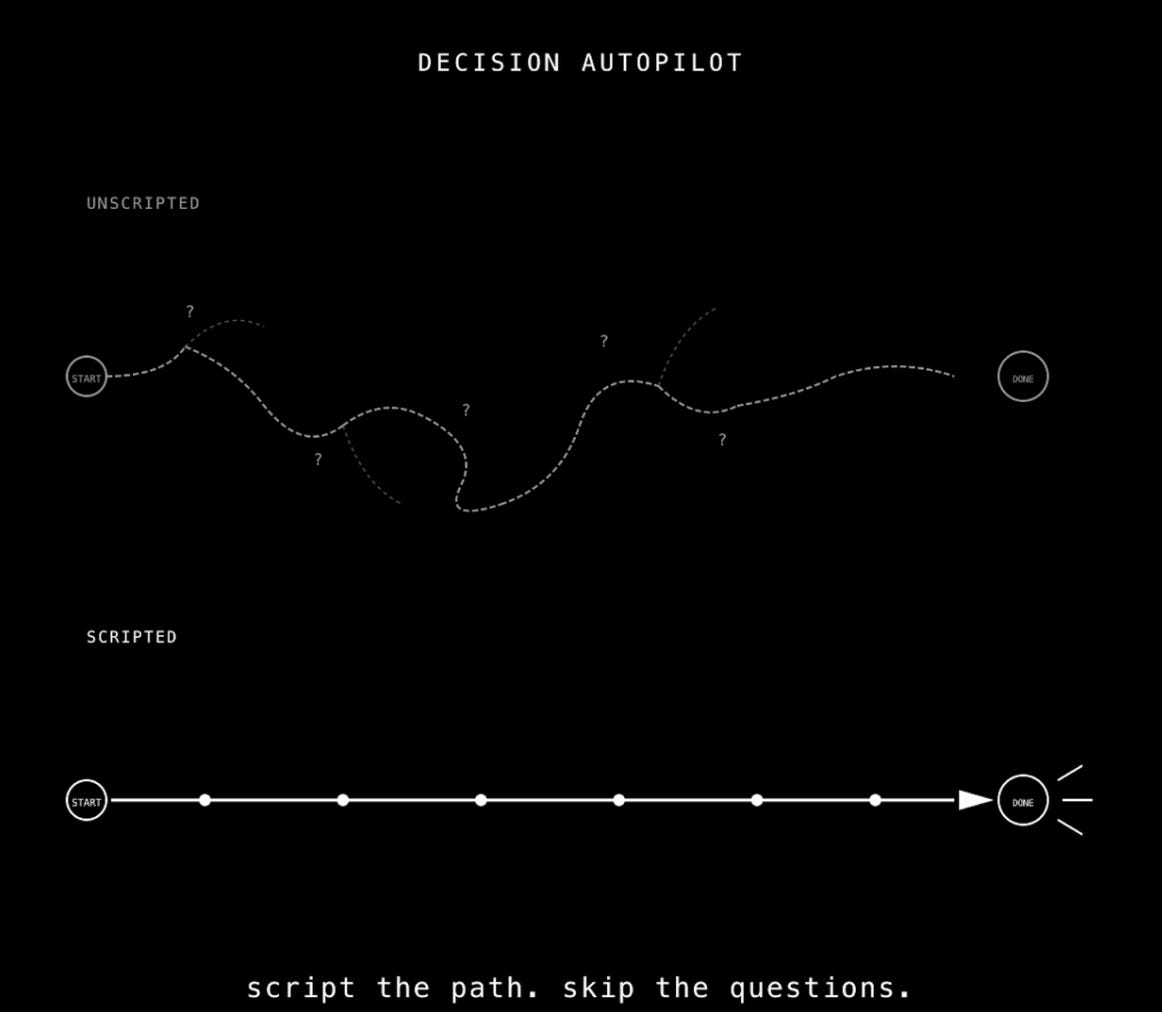
Decision autopilot is like a script you can run for your routines so that your rumination is free to diverge—never interrupted by the need to stop, converge, and devote cognitive energy to making inconsequential choices within a routine you already know you’re going to run.
Consider Immanuel Kant—responsible for creating much of Western philosophy.
He had a daily routine he stuck to religiously, with every detail dialed in.
At 5:00 AM every morning Kant’s assistant woke him.
After getting up, Kant would drink tea. Afterward — never before — he smoked one pipe of tobacco. His smoking time was “devoted to meditation.”
He then prepared lectures and worked on his books until 7:00 AM. He’d lecture until 11:00 AM. With lectures finished, he worked again on his writings until lunch. After lunch, he’d take a walk, and spend the rest of the afternoon with his friend Green.
How was Kant able to become one of the most influential thinkers of the last 2,000 years
In no small part because he devoted no time to making inconsequential, trivial decisions within his day. The details of his daily routines were explicit, running on decision autopilot.
Liberating Constraints
This may sound rigid, but it’s what’s called a liberating constraint: you bound your life in one domain to unlock increased freedom in another.
For Kant, he kept his routine dialed down to the details so he had the freedom to wrestle with civilization-shaping ideas.
Decision autopilot eliminates micro-uncertainty and those jagged, halting moments of “what’s next?”
How to set it up:
Take the routines you’re already doing and make the micro-decisions within them explicit. Start with any repeated routine—your morning ritual, your afternoon workout, your evening wind-down.
Determine the details and the sequence. Write them down. They can be changed if needed, but what you want is to remove all “should I or shouldn’t I?” from the routine.
For example, during your morning ritual:
Do you get water before meditating or after showering?
Do you have a quick snack between showering and meditating?
What order do you perform each step?
These micro-decisions add up. The amount of information processing required goes up unnecessarily. Cumulatively, they deplete cognitive energy, increase cognitive load, and block productive rumination from occurring during these time windows.
With your days’ trivialities handled, your mind is free to dream, explore, and create.
The Edges of Cognition
So these are the keys to upgrading your rumination and harnessing the power of the default mode network to amplify your output:
1. Reclaim it by focusing one primary pursuit—eliminating dispersion
2. Reboot it by externalizing cognitive clutter and reducing brooding
3. Maintain it by recycling recurring decisions and pre-scripting trivial ones
Over time, this unlocks a continuous flow of divergent cognition. Uninterrupted by the need to ping-pong and jaggedly converge on trivial decisions.
This allows your attention to expand out — like a fog across a sea — as thoughts meander to the far reaches of your consciousness.
It’s on these peripheries, the edges of cognition, where the creativity and insight that unlock your goals live.
Your next big idea is waiting for you, lingering out on the horizon of your awareness — just make sure your rumination is upgraded so you can catch it.
This article hit me when I was dangling with the question. Shall I pursue a side gig while I build my business?
Now I am clear that, i should be single focused until I have achieved my goal.
Thanks Man @Rian,
I love the graphics - they cement the theory in the brain in a clear and concise manner.
A picture paints a thousand words.