

Our ancestors had a way to reboot their focus, energy, and productivity automatically, even when utterly exhausted.
They did this by accident, out of necessity. But you can do the same thing on purpose.
By tapping into this ancient adaptation, you can get three days of work done in one.
I. The Day I Learned Sitting Isn’t Working
My friend Idahosa and I were huddled together in the office, where I was building my first startup.
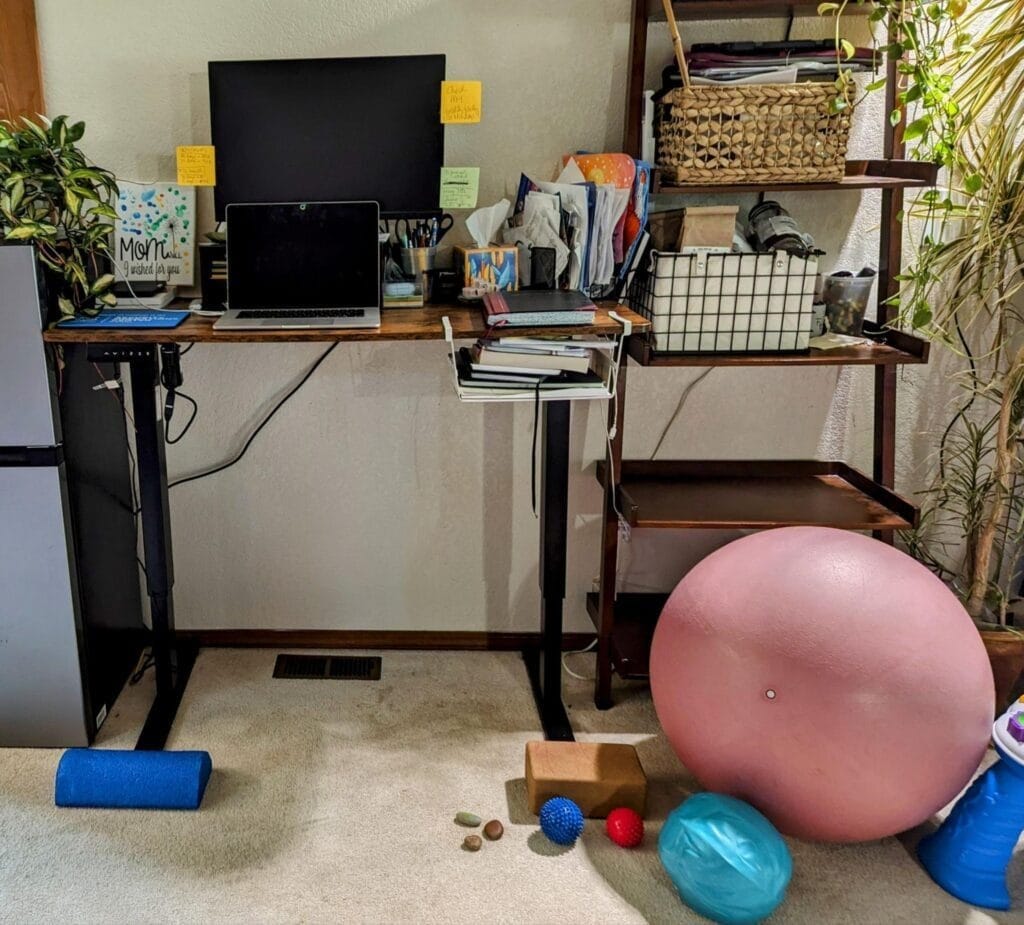
Idahosa’s desk is like a jungle gym, all decked out with foam rollers, hanging contraptions, stretching gear, and an automatic standing desk.
And me? Well, I’m the classic startup story.
Eyes married to the screen, fingers permanently contorted around a keyboard, clocking 80 hours a week.
Sitting at that damn desk.
And while my business is my baby... it’s starting to hurt me.
And I mean that literally.
Physically. I’m in more and more pain.
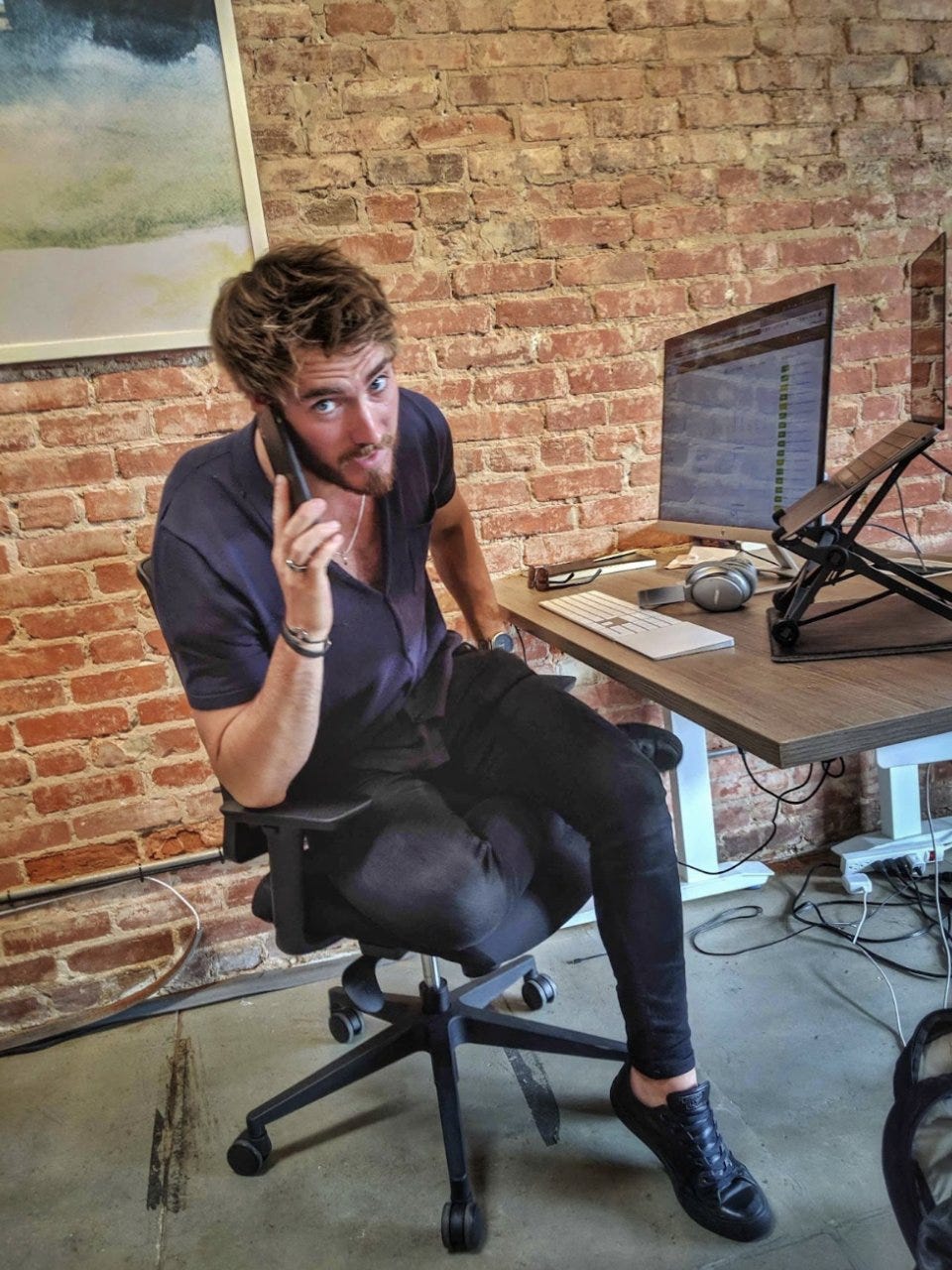
The harder I work, the more difficult it is to stand up straight. My posture’s breaking down, my lower back is cramping up, and my glutes are numb.
One day, we’re in line for coffee.
I’m caught in this weird contorted stretch. Bending over, tugging at my shoes, trying to wring out some relief from the cramp in my spine shooting down my legs.
Out of the blue, Idahosa says, “What the hell are you doing? No wonder you’re bending over, trying to get out of pain with your bashed-up back. Why are you sitting while you’re working?”
I stare at him, confused, and he says:
“Dude. Working is not synonymous with sitting.”
Idahosa wasn’t saying I was working on the wrong things.
He was saying I was working in the wrong way.
Literally, physically, the way my body was positioned in space was blocking me from peak performance and beckoning burnout.
II. The Oasis Effect: Why Your Brain Craves Novelty
Go back about 250,000 years.
Picture yourself as an early human, a nomad in a sprawling desert landscape.
You’ve been traversing the same barren, monotonous expanse for days. You’re exhausted.
Your brain, in response to the unchanging surroundings, has hunkered down into a kind of energy conservation mode.
It’s holding back resources because the sameness of the environment implies that new resources (water, food) are scarce.
Then, abruptly, you stumble upon an oasis.
Trees rise to the sky, plants crowd the ground, water gurgles from a spring.
This sudden shift in your environment triggers a chemical reaction in your brain.
The novelty signals the presence of potential resources: food, water, perhaps even a mate.
Your brain releases a surge of dopamine, a neurotransmitter closely tied to focus, reward, and motivation.
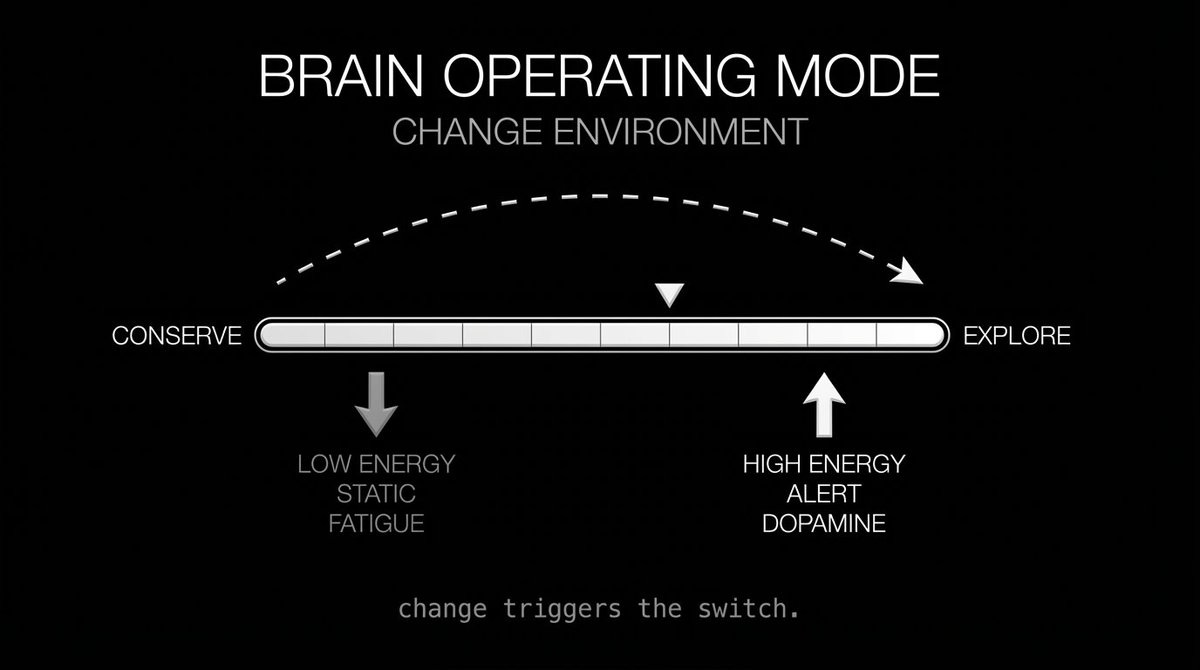
This dopamine release amplifies your energy reserves and decreases your perception of effort. You’re alert, your senses are heightened, and you’re ready to explore and exploit this new landscape. It’s as if your brain flicks a switch from “conserve” to “explore” mode.
Fast forward to today.
Your brain, though nestled in the more comfortable confines of an office or home workspace, still operates in much the same way.
When you sit in one place, static, your environment is unchanging, and your brain falls into energy conservation mode.
It perceives a “desert,” and your effort, productivity, and creative problem-solving weaken.
On the other hand, when you alter your environment (stand up, move around, change your perspective) your brain responds as if you’ve discovered a new “oasis.”
The dopamine surge heightens your alertness, increases your energy, and sharpens your problem-solving skills.
Your environment imposes a ceiling on your stamina.
III. Perceived Exertion vs. Perceived Effort
Let’s break it down a bit more.
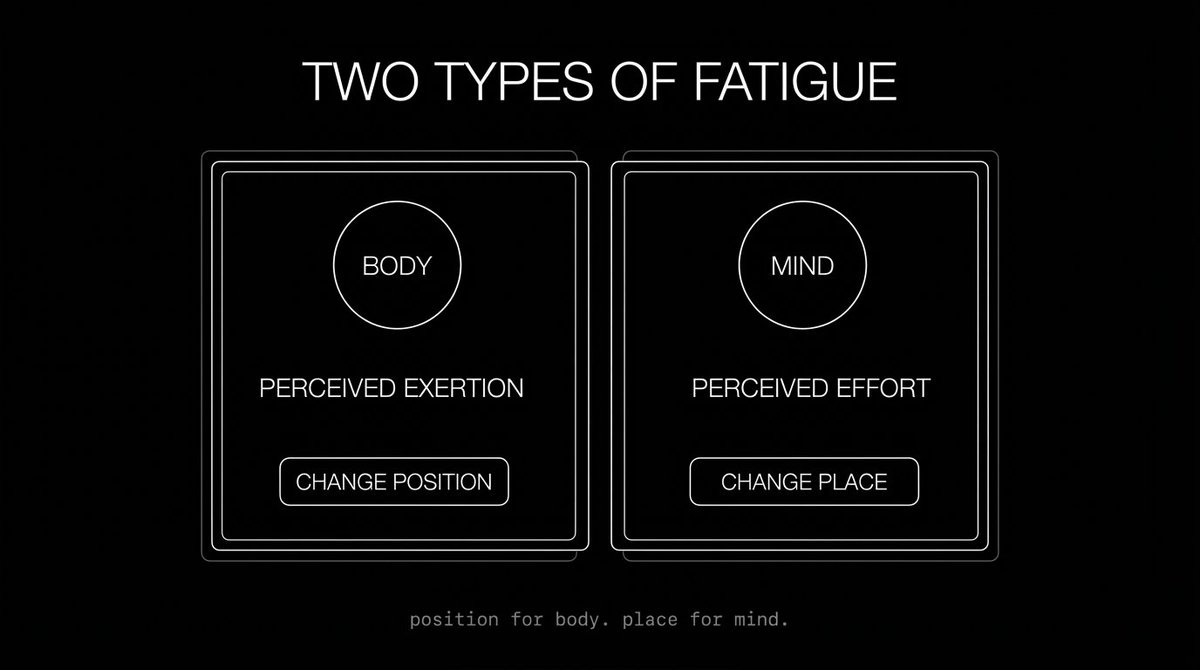
First, there’s perceived exertion (body). This measures how hard you feel like your body is working.
Then, there’s perceived effort (brain), which measures how hard you feel your brain is working.
Perceived exertion is primarily physical. Perceived effort is primarily mental.
In both cases, it’s about the subjective experience of how hard one feels they’re working to perform a task.
Here’s the rule of thumb:
To reduce perceived exertion, change positions.
To reset perceived effort, change places.
Just as changing channels on your TV offers fresh content and renews your interest, shifting your physical position and environment refreshes your brain and renews your focus.
Suppose you’ve been focusing on a task for three hours at your desk (place A). You then change your working environment, moving to your backyard (place B).
This switch in your surroundings can trick your brain into thinking that it has exerted less effort than it actually has. Suddenly, it feels as though you’ve only been working for 90 minutes.
Such a change of scene is like hitting a reset button on your brain’s fatigue levels.
With this reset, your mental stamina gets a boost, much like a computer clearing its cache to run more efficiently.
Similarly, modifying your position within your work routine, going from sitting upright to standing, walking, and then reclining, will reduce your perceived exertion, making your body feel less taxed.
The position and place you work define your sense of effort and exertion.
Change these, and you cheat fatigue.
IV. The Protocol
Step 1: Set Up Your Main Work Environment for Sitting, Standing, Walking & Reclining To Reduce Perceived Exertion
First, get a standing desk for your spine, posture, and to boost flow proneness.
Flow is a term popularized by psychologist Mihaly Csikszentmihalyi to describe a state of optimal experience and high productivity.
When standing, a mild, positive sense of urgency comes over you. Because we’re only standing temporarily, we know the task won’t last forever. So we stay focused and work faster.
The research also shows that standing while working reduces fatigue and stress.
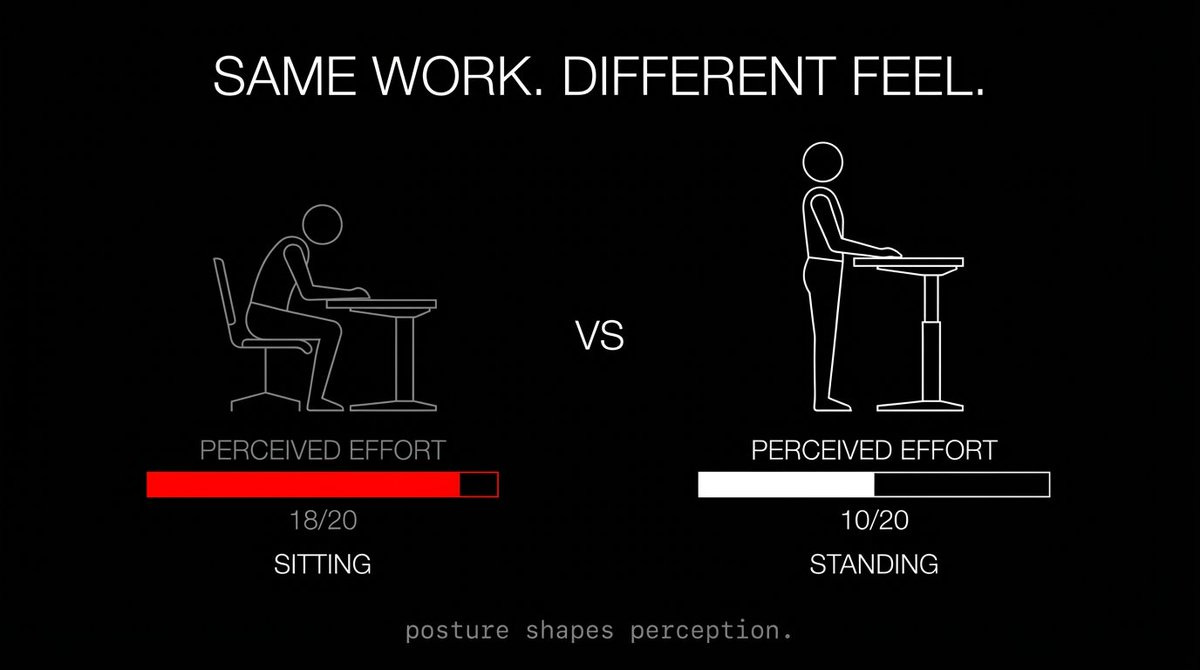
It promotes better blood circulation, which means there’s more oxygen and nutrients delivered to the brain and muscles, increasing alertness and cognitive function.
Most importantly, standing reduces perceived exertion. Your body reaches fatigue in one position, and this fatigue affects your performance. When you switch, you get a reset.
A common recommendation is to sit for no more than two hours at a time and to stand and walk for 5-10 minutes for every 30 minutes of sitting.
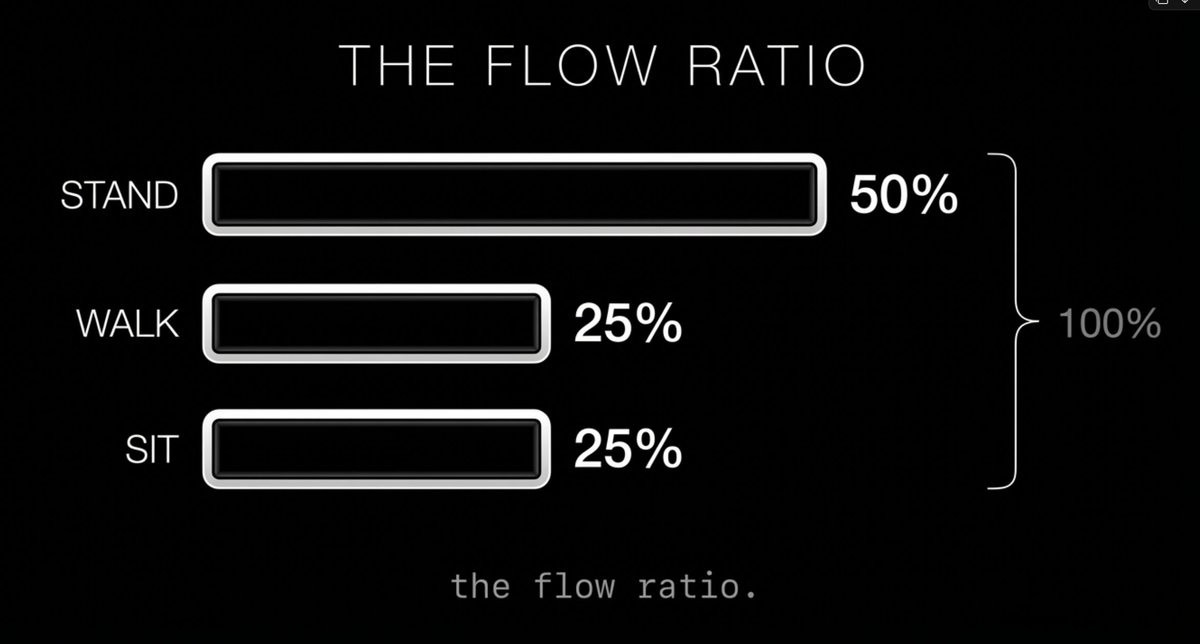
But to maximize flow, try dialing up the ratio:
Stand for 50% of the time
Walk for 25% of the time
Sit for 25% of the time
Now, standing while working will not work without one key piece of equipment: the motion board.
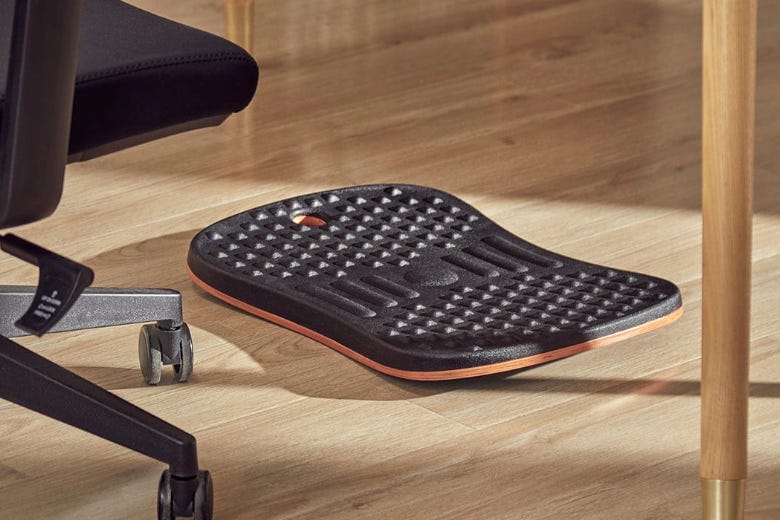
Without one, your feet and legs will cramp up, which makes standing unpleasant and unsustainable.
With one, you’re always subtly rocking from left to right, which means you’re always offsetting the pressure on each leg, which reduces perceived exertion even more and contributes to good posture.
Plus, you increase your muscular activity and activate the vestibular system (responsible for maintaining balance, spatial orientation, and coordination).
For switching positions, you can use an exercise or stability ball. Go from your chair to the ball, swapping how you sit.
For walking, consider taking walking meetings and investing in a treadmill to place under a standing desk.
Walking isn’t just for staying fit or engaged. It’s for flow.
I learned this when I first started working with Steven Kotler.
At the time, I was doing my final college exams at Trinity College Dublin. The exams were in Ballsbridge, about a mile and a half from the university.
So I’d get an Americano and walk to the exams instead of calling a taxi or driving.
Why?
Because of what’s called exercise-induced transient hypofrontality (EIT).
During EIT, your brain diverts resources from the prefrontal cortex (the area that manages complex cognitive tasks) towards the parts that control physical movements and automatic responses. This also happens in flow.
This subtle shift plays a role in the subjective experiences associated with flow, such as a reduced sense of self-consciousness, time distortion, and an increased focus on the present moment.
You can do this too.
Take your calls and meetings while walking.
As you walk, you prime yourself for flow.
And after the walk, because of the exercise-induced transient hypofrontality, you can get into flow immediately when you sit back down to work.
Step 2: Set Up Three Additional Working Environments To Reduce Perceived Effort
Ideally, you want three work environments, each with fixed variables.
Here’s why:
First, as mentioned, you reset the perceived effort of the task by resetting the environment.
But introducing novelty into your workspace isn’t just a trick for your brain. It also gives you a sense of autonomy and control, a vital component for inducing flow.
Critically, this also shortens the struggle phase.
Flow state doesn’t work like a light switch. It’s not on or off. Rather, flow is part of a cycle with four phases: struggle, release, flow, and recovery.
Imagine you’re surfing.

First, there’s the struggle to catch the wave, then the release as you ride it, followed by the exhilarating flow state as you maneuver, and finally the recovery as you prepare for the next wave
Struggle is the hardest part to get past, and it’s the phase where most professionals stay stuck, never releasing into flow.
By rotating your work environment and reducing perceived effort, you shorten the struggle phase and get more flow.
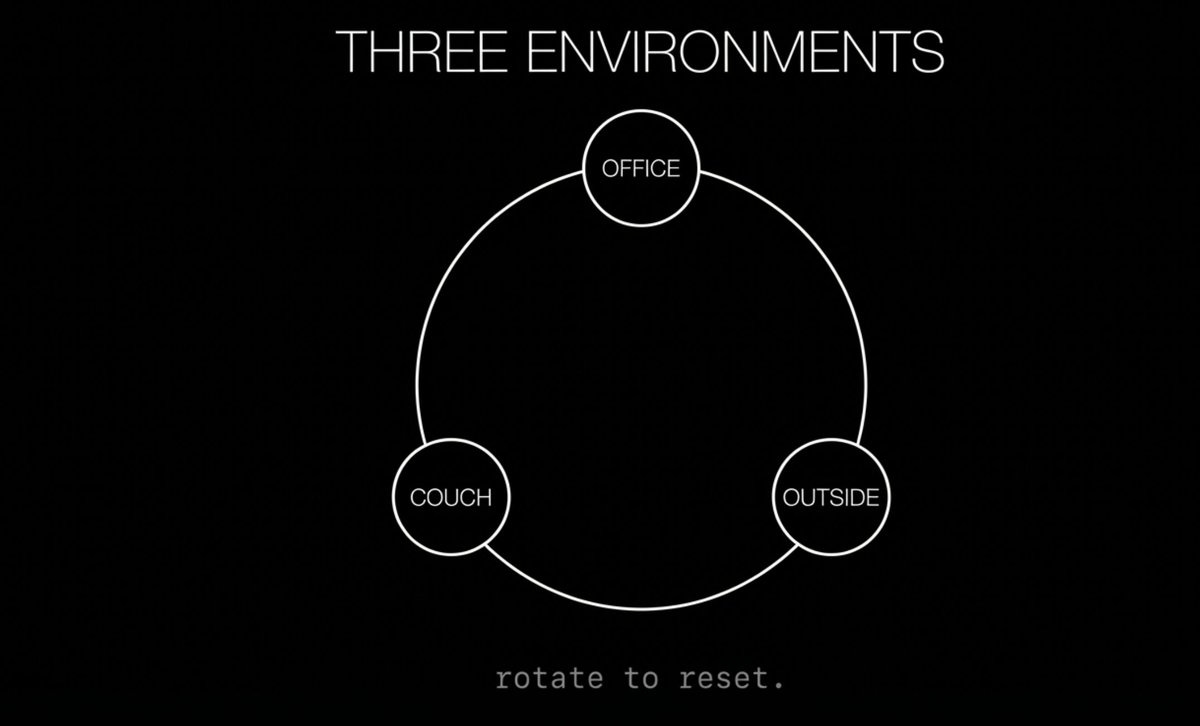
Set up three places where you can work every day, and reduce the variability within those environments.
Gate distractions, remove friction, and make it easy to slip straight into work and get into flow.
For switching places, don’t over-complicate it. You don’t have to set up a full-fledged office in multiple locations. In fact, that would actually decrease the novelty of each environment.
Use your office as the primary workplace. Use a couch (whether in the other room, the break room at your workspace, or a coffee shop with noise-canceling headphones). And go outside.
“Won’t constant environment changes disrupt my concentration?”
It’s natural to think continuity ensures focus, and it’s true but research suggests that at a certain threshold, novelty can combat fatigue.
Start with minor changes, varying your environment according to the type of work. The goal is to stimulate your mind and reduce perceived effort.
Keep in mind: what you’re doing is using each environment for a focused work block of multiple hours.
It’s not like you’re switching every ten minutes. More like two or three times per day.
V - Putting This Into Action
Set up your main workspace to accommodate sitting, standing, walking and reclining. And identify and set up three places you can work every day.
When you feel a dip in energy or the sense that work is getting hard, it’s a signal to change your position. When fatigue really starts kicking in, it’s a signal to change places.
With each swap, you give yourself another shot at getting into flow and squeezing out another burst of prime productivity.
Remember: sitting is not synonymous with working. Your environment shapes your stamina.
Change your position. Change your place. Change how hard work feels.
-Rian