

Have you ever struggled to complete a task that should’ve taken 90 minutes... yet after 8 hours, you still haven’t finished the damn thing?
There’s a neuroscientific explanation for why this happens — and a simple way to solve it.
Behind the world’s most successful people stand the four pillars of flow. These pillars allow anyone to become effortlessly productive.
To achieve Olympian-level productivity, it starts here:
Flow Blockers
Flow Proneness
Flow Triggers
The Flow Cycle
These are the pillars that power the brains of the most productive. We’ll cover each in detail.
But first — what is flow, and why does it matter so much?

What Is Flow?
Remember the last time you were hyper-productive and totally absorbed in what you were doing?
That was flow.
Flow is a state of consciousness that makes work feel effortless. You’ve experienced it — perhaps when riding a bike, reading a book, or working on a big project.
In the 1960s, psychologist Mihaly Csikszentmihalyi conducted one of the largest psychological surveys of his time, interviewing thousands of individuals — from Navajo sheep herders to factory workers, musicians to athletes, surgeons to assembly-line workers.
What he discovered was a common thread.
Whenever people described a state where they felt at their best and performed at their best, one phrase stood out: a sense of things “flowing” naturally.
Csikszentmihalyi termed this state flow. He described it as:
“Being completely involved in an activity for its own sake. Every action, movement, and thought follows inevitably from the previous one. Your whole being is involved, and you’re using your skills to the utmost.”
Here are the core characteristics of flow:
Complete concentration on the task
Clarity of goals and immediate feedback
Transformation of time (speeding up or slowing down)
The experience is intrinsically rewarding
Effortlessness and ease
A balance between challenge and skills
Actions and awareness merge, losing self-conscious rumination
A feeling of control over the task
Many of humanity’s greatest accomplishments happened in flow:
Mozart said his music “arrived fully formed” — composing entire symphonies in unbroken absorption.
Jordan reported time dilation and automatic decision-making during games.
Jobs spoke of time collapsing during his greatest creative stints.
From sports to art, technological breakthroughs to medical advances—flow is at the center of humanity’s greatest accomplishments.
The Neuroscience of Flow
Flow isn’t just a metaphor. Over 3,000 research papers on flow have found that specific neurophysiological shifts occur when you enter this state.
In flow, the brain is hit with a potent cocktail of neurochemicals:
Dopamine sharpens focus and accelerates pattern recognition. You see connections others miss. Solutions appear obvious.
Norepinephrine locks your attention while filtering out noise, making every moment feel vital and important.
Endorphins kill pain and amplify pleasure, letting you push through barriers that normally stop you cold.
Anandamide — known as the bliss molecule — enables lateral thinking and suppresses fear, so you make bold decisions at high speed without second-guessing.
Serotonin provides the afterglow, the satisfaction and meaning that makes you crave the experience again.
Brain wave patterns shift as well. Normal waking consciousness produces beta waves. In flow, the brain settles at the borderline between alpha and theta waves — the signature of creativity and insight.
And then there’s transient hypofrontality.
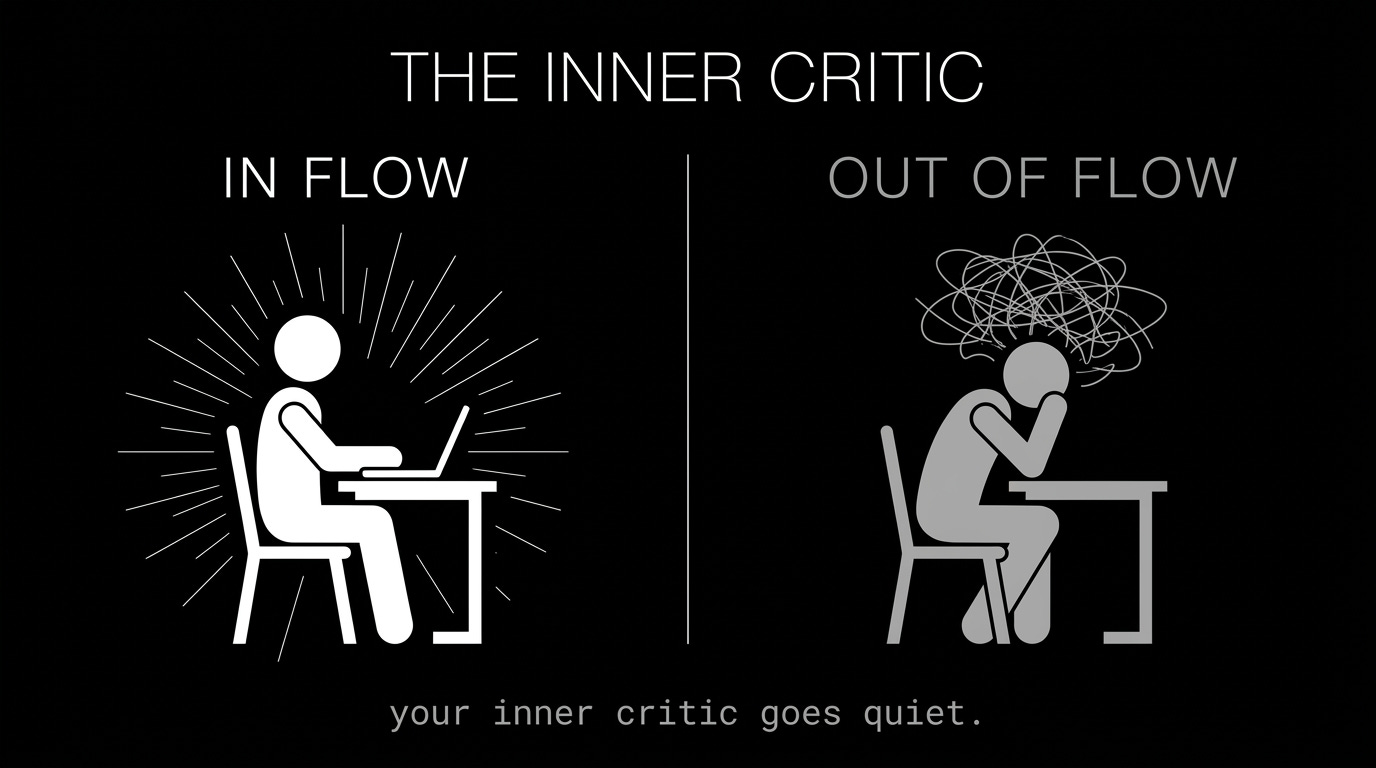
During flow, specific regions of the prefrontal cortex temporarily down-regulate. The voice that says “you can’t,” “you shouldn’t,” “what if you fail” — goes quiet.
Your inner critic falls silent. Self-doubt evaporates. Overthinking stops.
Your sense of self dissolves. There’s no “you” anymore. Just the work. Just the moment. Pure presence. Pure performance.
This neurochemical cocktail explains why flow boosts productivity, creativity, and learning — and why it’s also one of the most enjoyable experiences humans can have.
The Performance Data
The performance data on flow is staggering.
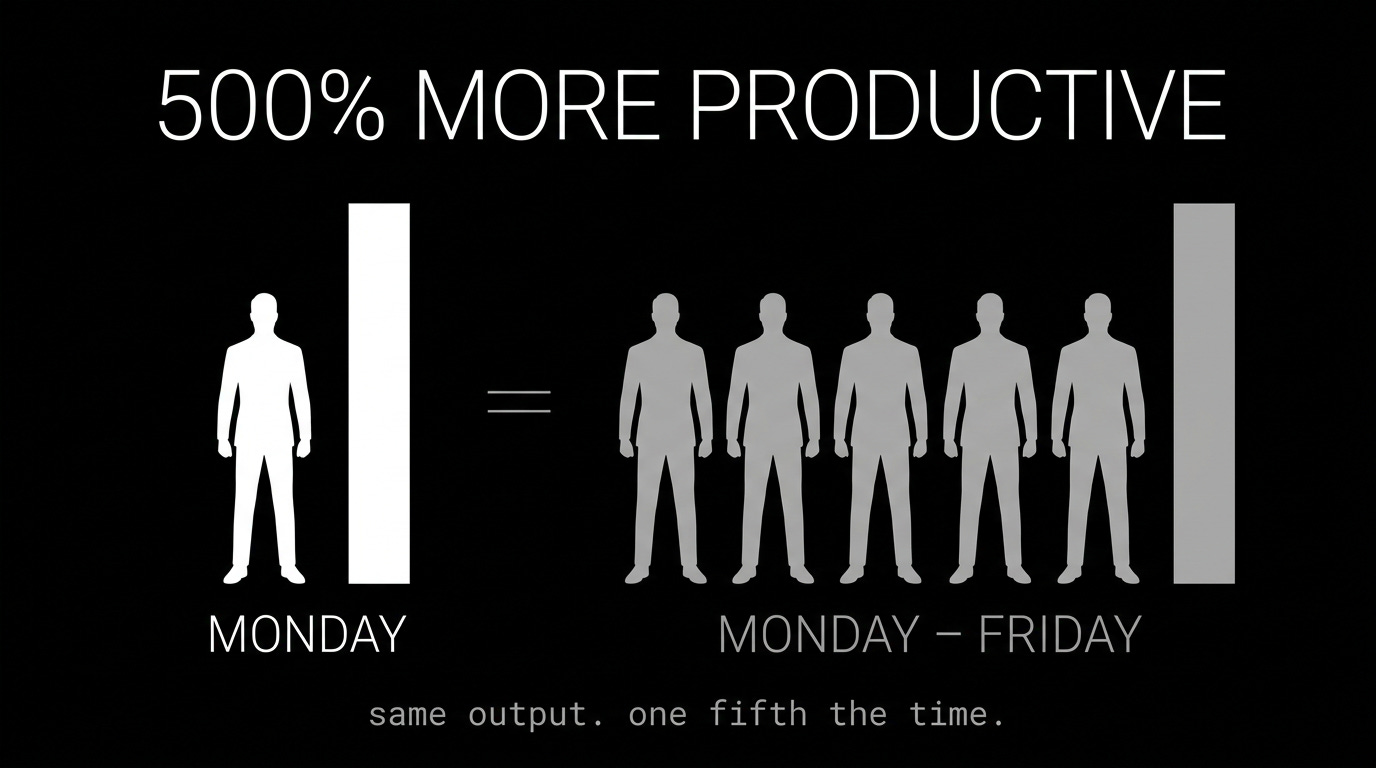
McKinsey spent about ten years talking to top executives, asking them how much more productive they felt in flow. They found the average was 500 percent more productive.
To put that in context: you could go to work on Monday, spend Monday in a flow state, take Tuesday through Friday off, and get as much done as your peers who worked all five days in their normal state.
DARPA and the Department of Defense wanted harder data. Working with Advanced Brain Monitoring, they found that when you take soldiers and induce flow states, they learn skills like target acquisition 230 percent faster than normal.
They repeated that study with non-soldiers—absolute novice shooters—using handguns, rifles, and bows and arrows. They took beginners, dropped them into flow, and found they could train them up to expert level in 50 percent less time.
The University of Sydney tested creative problem-solving with the nine-dot problem — connecting nine dots with four lines without lifting your pencil. Under normal conditions, less than 5 percent of people solve it. In their study group of 43 people, none got it right in the first round.
After inducing flow states, 50 percent of the study group solved the problem in record time.
Research from the Karolinska Institute in Sweden found that flow-prone individuals have greater D2 dopamine receptor availability in their striatal regions—the brain’s reward centers.
Flow amplifies everything that matters for peak performance:
Motivation surges because the state is intrinsically rewarding
Learning accelerates because neurochemistry cements experience into long-term memory
Creativity multiplies through richer pattern recognition and bolder insights
Productivity increases by up to 500 percent
Meaning deepens because flow is one of the most enjoyable experiences humans can have
Why We’re Wired for Flow
Many flow researchers, including Csikszentmihalyi himself, have argued that flow must have played a role in the evolution of our species.
Picture our ancestors in a complex and unpredictable world. Flow states, with their intense focus and fading self-consciousness, would block out distractions, allowing for laser-sharp attention to critical tasks like hunting or escaping danger.
This heightened perception and action likely translated into greater success— and therefore, better survival odds.
The deep satisfaction and enjoyment of flow acts as an internal reward system. This makes us more likely to seek out the same activities again. Since those activities demand focused skill use, repeated flow states encourage skill development and mastery — essential for navigating an ever-changing environment.
This is the key insight: We are evolutionarily wired for flow.
Our physiology wants us to drop into the zone when conditions allow. Flow isn’t some rare experience reserved for artists and athletes. It’s a fundamental part of being human.
The people with the most flow in their lives score highest on every measure of life satisfaction.
Flow sounds like a panacea that’ll solve all our productivity problems.
And it would be — if you could access it on demand.
But most of us can’t. Until you train yourself in the four pillars of flow, flow will remain elusive.
And nowhere is less conducive to flow than the 21st-century workplace—where distractions are rampant, procrastination plagues us, and chronic stress is the norm.
That horrible feeling of being over-caffeinated, riddled with guilt from delaying what you know you should be doing, hitting lunchtime with barely any work done...
If this has ever happened to you, it’s due to the Flow Blockers.
I – Flow Blockers
If your goal were to run a marathon, you’d first ensure you don’t have an injury or health condition that blocks you from doing it.
It’s similar with flow.
Research shows we’re evolutionarily wired for flow—our physiology wants us to drop into the zone when conditions necessitate it.
Picture this: It’s the middle of the night, and an AMBER alert hits your phone about a child abduction in Tennessee.
At that moment, we were training Facebook’s team to unblock flow so they could make better decisions under high-pressure situations.
Problem was—they were laboring under one of flow’s biggest blockers: burnout. They barely had a minute to breathe.
But in emergencies like this, flow isn’t just nice to have. It’s non-negotiable.
Sure enough, Facebook caught the AMBER alert, broadcasted it across all regional profiles, and saved the child within 3 hours.
By unblocking flow, they operated like Navy SEALs: Calm and composed amid an unending deluge of change.
How can you do the same?
First, be aware that most of the time, our 21st-century work style blocks flow at every turn.
Think about it: When you get up in the morning, what’s the first thing you look at?
If you’re like 80% of people, you check it within 15 minutes of waking up. And it’s packed with or exacerbates myriad flow blockers:
Distraction
Cognitive Load
Task Persistence Deficit
Attention Deficit Trait
This one thing is the source of over a dozen other blockers — like a dam blocking a river.
You guessed it — this one thing is your phone.
So what’s one tool to remove the most common source of flow blockers?
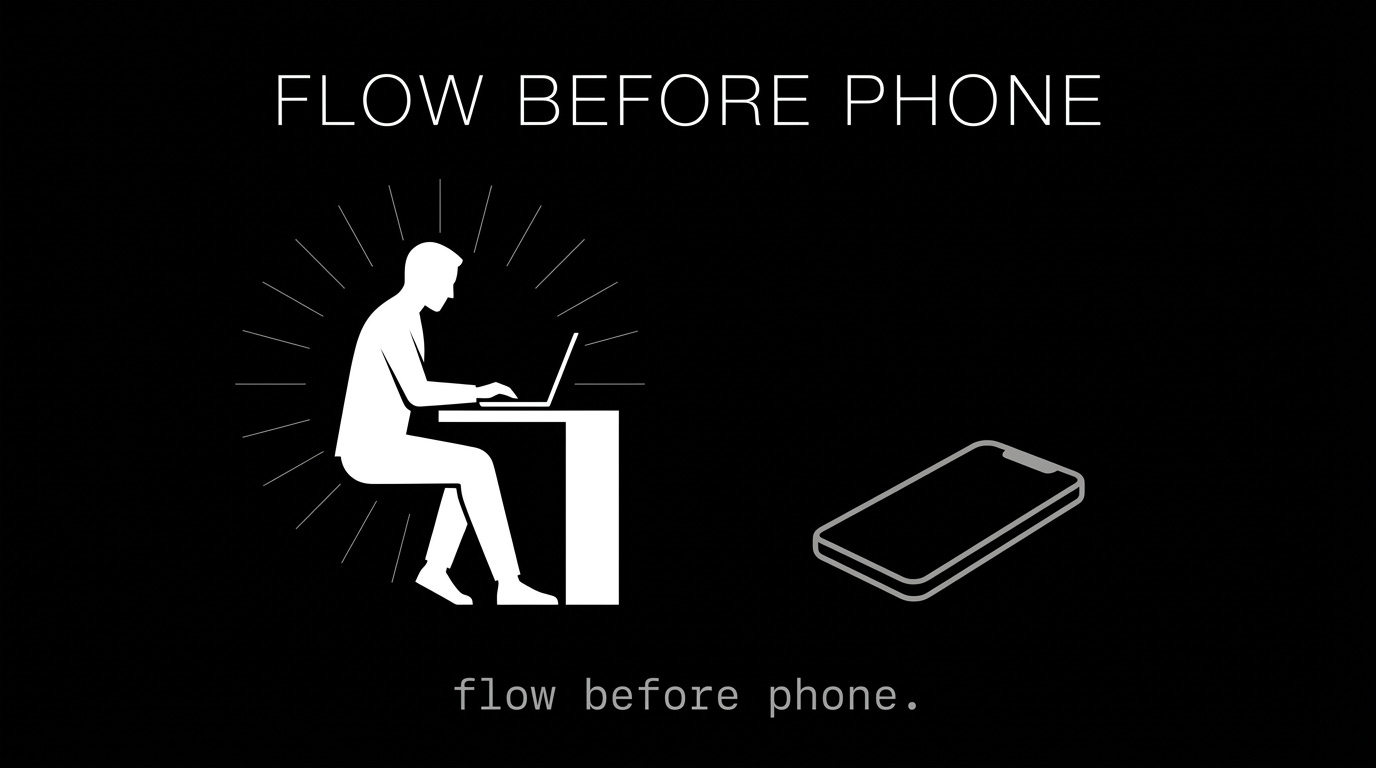
We call it Flow Before Phone.
The golden rule: Get 2-3 hours of productive flow on your highest priority work before you turn on — or ideally even touch — your phone.
Yes, this is easier said than done. It’s hard to change ingrained habits, especially when the habit is linked to a device designed to be addictive.
But once you try this and experience how much more productive you are, over time, flow can overrule that addiction.
II – Flow Proneness
Let’s say you remove all the blockers and still can’t get into flow.
This happens to lots of people. It’s because they missed the second pillar: flow proneness.
Using the marathon analogy, consider this your overall fitness level for running a marathon.
Flow proneness is your tendency to access flow—your likelihood of getting into flow at any given moment.
Some of this is dispositional. Research from the Karolinska Institute found a genetic polymorphism that impacts D2 dopamine receptor availability, making some people more naturally prone to work-related flow.
But flow proneness isn’t fixed. It can be trained.
We need to make our physiology, psychology, and environment conducive to flow proneness to maximize our likelihood of accessing the state.
The easiest way to do this?
Wake up and get to work within 90 seconds of opening your eyes.
This may seem like a workaholic thing to do, but it’s actually the opposite: by getting your most important work done within the first 2-3 hours of the day in a flow state, you can relax much more the rest of the day.
The neuroscientific reason to do this is that your flow proneness is highest first thing in the morning.
This works for a few reasons:
The brain waves of sleep — theta or delta — are similar to the alpha/theta brain waves of flow
The first 90 seconds of the morning are before the rest of the world can impose its will on you
Your cognitive load is at zero — you haven’t yet loaded anything into working memory
Cortisol levels are naturally elevated, providing alertness without artificial stimulation
When flow proneness is high, even mundane tasks become absorbing. When it’s low, even activities you love feel like a grind.
III – Flow Triggers
Okay, so you’ve removed the main source of flow blockers and increased your flow proneness.
Now, how do you actually get into flow?
Enter the Flow Triggers.
These are preconditions that drive us immediately into flow.
Researchers have identified at least 22 different triggers. They all share one thing in common: flow follows focus. The state can only arise when all of your attention is directed at the present moment.
The triggers work by either:
Pushing dopamine and norepinephrine into your system—the brain’s main focusing chemicals
Lowering cognitive load so attention can narrow
Csikszentmihalyi discovered three foundational triggers:
Clear Goals
Immediate Feedback
The Challenge/Skill Balance
Here’s how these show up in surfing:
You spot the wave. Catch it. Ride it. (These are clear goals.)
You feel the balance on the board and the wave’s power, adjusting your position accordingly. (This is immediate feedback.)
As you continue surfing, you ride waves of varying size and difficulty, matching your skill level to stay engaged. (This is the challenge/skill balance.)
Certain activities are naturally rich in flow triggers — surfing, playing music, video gaming, rock climbing.
The trick is to take these triggers out of activities where they naturally occur and embed them into activities where they don’t—like running a business.
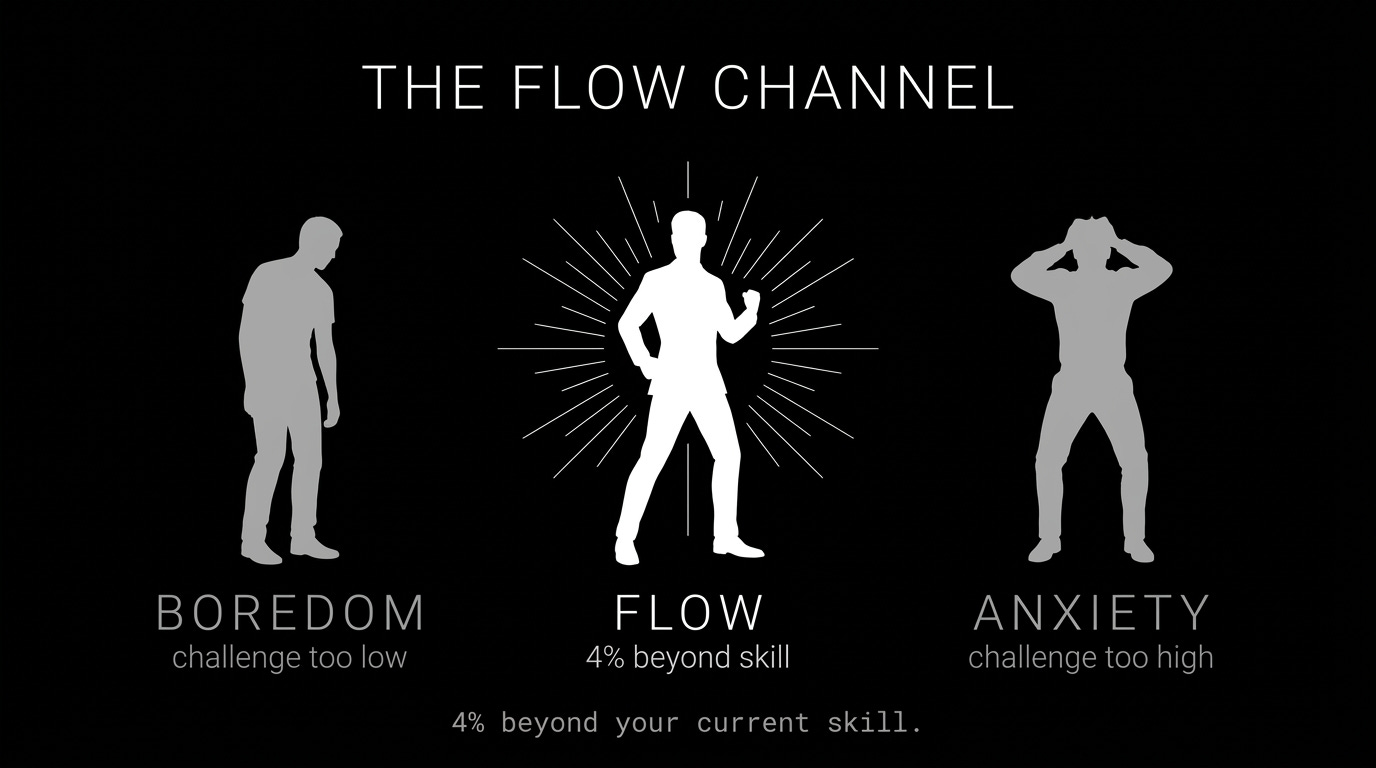
To apply this right away, tune the challenge/skill balance: engage in tasks that are 4% beyond your current skill level.
Our constant goal, as Csikszentmihalyi’s book title suggests, is to move beyond the under-stimulation of boredom and the overstimulation of anxiety.
This is the sweet spot that leads to flow.
So think about the most important tasks you face in a day and ask:
Is the challenge too great? Does thinking about it cause anxiety? If so, chunk it into smaller tasks and lighten that load.
Is the challenge under-stimulating? If you find it boring, demand more from yourself.
If you’re a writer, shrink the amount of time you give yourself to knock out a piece. Or boost your daily word count from 500 to 750.
If you’re a salesperson, set a record for how many cold calls you do in a day. Then try to beat that number the next day.
Tweak every task so that it lands inside the challenge-skills sweet spot.
Bottom line: To trigger flow, go further than you normally go.
IV – The Flow Cycle
You know those days when you’re completely in the zone and breeze through your to-do list?
Those are the days you’re in flow.
The problem is—those days are sporadic.
The fourth pillar of flow is seldom discussed, but it’s the reason behind how the world’s most productive people operate.
It’s called The Flow Cycle.
Herb Benson, a Harvard cardiologist, wrote about this for the first time in his book The Breakout Principle. Steven Kotler mapped it further in his book The Rise of Superman.
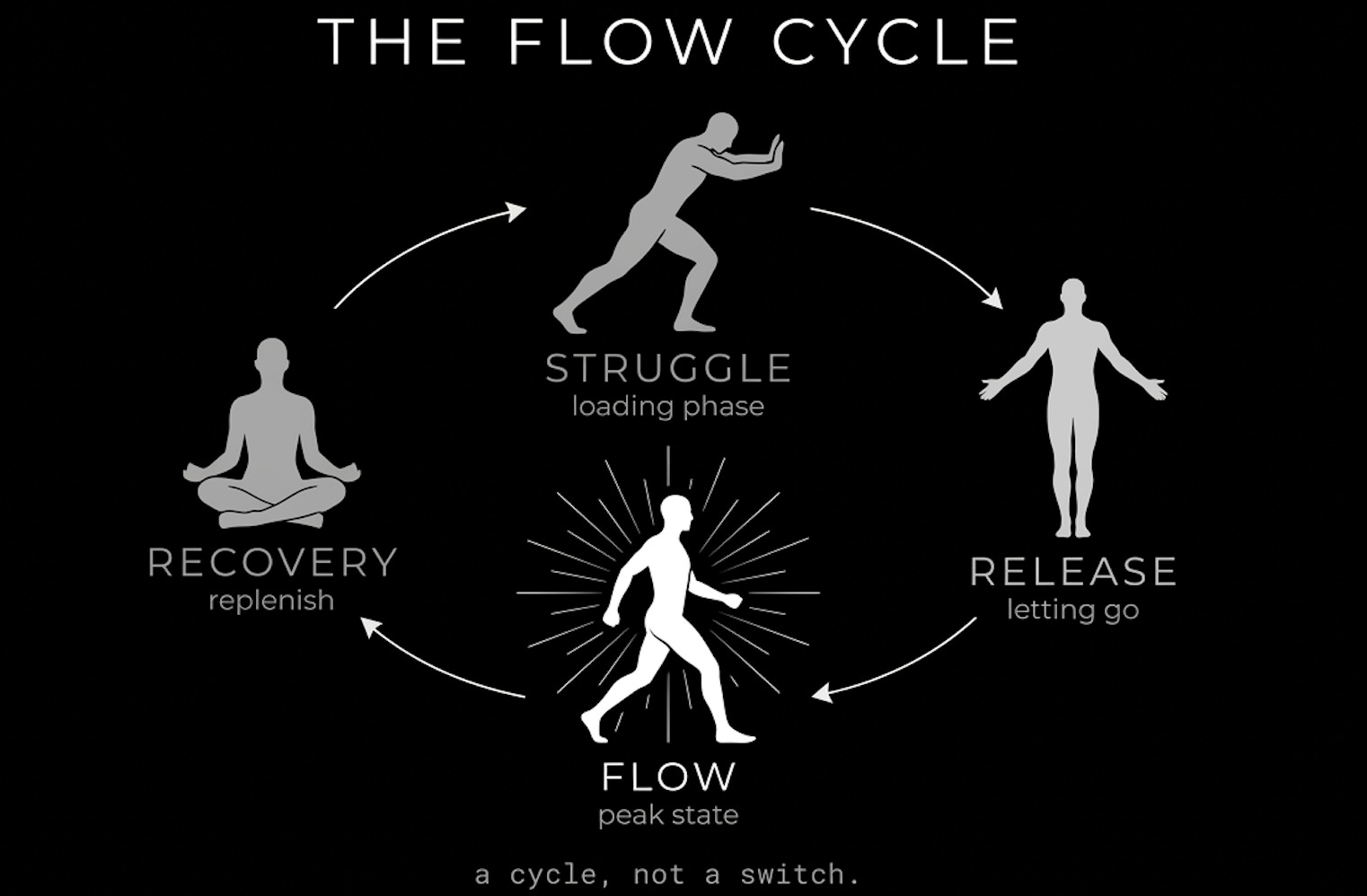
The flow cycle tells us that flow states are more like dimmer switches than light switches.
It’s not like flicking flow on or off. Rather, flow occurs as one stage in a four-part cycle:
1. Struggle
This is a loading phase. It’s when you first start a task.
The neurochemistry involved—cortisol and norepinephrine—makes you squirm. This discomfort causes us to want to avoid the task and distract ourselves.
This is where most people quit.
2. Release
This happens once you reach the edge of wrestling with the task through sustained focus.
As you persist, your brain releases dopamine, enhancing focus and motivation, finally popping into the flow state itself.
3. Flow
A state of heightened creativity.
The prefrontal cortex deactivates to allow efficient, instinctive, rapid decision-making. The neurochemical cocktail floods your system. Time dilates. Self-consciousness disappears.
It’s one of the most enjoyable states humans can experience.
4. Recovery
This happens on the backside of flow: replenishing the expensive neurochemistry involved in flow, recuperating after expending so much energy, and integrating the knowledge and skills acquired during the flow state.
As the Navy SEALs say: If you get good at crawling (struggle), soon you’ll be walking (release) and then running (flow). And after all of that running, you have to recover.
The key insight:
When it comes to accessing flow with more frequency, people think it’s all about the flow state itself.
But actually, it’s about the speed with which you can oscillate and move through this entire cycle.
That’s how you make it consistent. That’s how you become insanely productive.
The Sad Truth
Most people spend their entire careers dipping in and out of the first few minutes of the Struggle phase.
They never persist long enough to get into flow.
An inch deep into work, forever.
So start by getting great at persisting through the Struggle phase.
This comes down to Task Persistence.
You can build this with Attention Span Stretching.
Here’s how:
If you hang from a bar for as long as possible every day, you can gain an inch in height.
Similarly, if you stretch your attention, your attention span becomes longer. (And the cool thing is, you can stretch your attention span much farther than you can stretch your height.)
Ever won a staring contest?
It’s like that. Treat any task you want to persist with as a kid’s game—like trying to stare without blinking.
Examples:
Read a book all the way through, even if it’s uncomfortable. Even if you retain less, you gain more sustained attention.
Do a long meditation, adding another minute, then another.
Same with focused work. Add a minute, then another. Treat it like a muscle—max out the reps.
As you stretch your attention span, you’ll be able to persist through the struggle phase at the beginning of activity so you can transition through release and pop into flow.
The key is to incrementally sustain your attention longer than you normally would, one activity at a time.
Keep going despite the desire to stop. Go for as long as you can possibly stand it. And then do that again. And again.
Just one minute more.
Just one minute more.
If you keep going just a bit longer, you’ll gain longer and better future attention. Like working out a muscle, all the growth is caused by those last few reps when your muscles almost give out.
You’ll be shocked by how much you can stretch your attention span by constantly training it in small ways. Over time, it compounds. And your brain changes.
First, your brain releases and becomes more sensitive to attention-regulating neurotransmitters like dopamine, norepinephrine, and acetylcholine. Plus, your alpha and theta brainwaves get more stable, which boosts focus.
If you can choose between idle entertainment or a grit-fueled stretching of your attention span—the choice of a peak performer is obvious.
Because the more you stretch your attention span, the easier it is to persist past the struggle phase and into flow.
The Flow Afterglow
As you do this, you’ll feel satisfying attentional fatigue known as the Flow Afterglow.
It’s that deeply satisfying, emptied-out feeling of accomplishment that only comes after riding the wave of flow for an extended period.
In the brain, the dopamine, norepinephrine, and serotonin of flow subsides, and you’re rewarded with relaxing and rewarding neurochemicals like endorphins and endocannabinoids.
As you learn to recognize and relish the Flow Afterglow, it becomes a self-reinforcing cycle.
The more you experience it, the more you want it, and the more you push yourself to reach new heights.
That makes it a target to shoot for—which boosts performance and achievement because you can only experience it by getting into flow and sustaining it for a long time.
The Four Pillars: Summary
1. Flow Blockers prevent flow from occurring.
Start by removing distractions like your phone
Remember: Flow Before Phone
Get 2-3 hours of productive flow before you touch your phone
2. Flow Proneness refers to your tendency and likelihood to access flow.
Maximize your flow potential by starting work within 90 seconds of waking up
Your flow proneness is highest in the morning
3. Flow Triggers are the preconditions that lead to more flow.
Apply clear goals, immediate feedback, and challenge/skills balance to your work
To trigger flow, go further than you normally go
4. The Flow Cycle is the four-phase process of entering, experiencing, exiting, and reentering flow consistently.
Practice persisting through the Struggle phase
Stretch your attention span
Learn to recognize and chase the Flow Afterglow
By understanding and applying these four pillars of flow, you can become consistently productive and achieve incredible results.
The most important one.
I've been struggling to understand one specific point in your otherwise perfectly insightful piece. I'm confused, though, as to which of the two pieces of advice I should follow: should I persist in focusing my attention and try to stretch it incrementally while fighting the urge to stop, or should I aim to increase the challenge level of the task to maintain a good challenge/skill ratio as you point out earlier in the post? In my mind, each of the two frameworks makes sense separately but at the same time I find them contradicting when I combine them together. I'd be so grateful if you answered this.
Again, this is perfectly insightful and it's actively helping me start my own business!