

Dopamine.
The neurochemical that causes you to self-distract, overeat, and waste hours scrolling through your phone.
But what if you could leverage your dopaminergic system to propel you forward — making it your #1 tool for focus?
Here’s how.
The Zen Retreat Revelation
I’ll never forget it.
I was nine days into a silent Zen retreat.
Sixteen hours of meditation a day — no talking, reading, or writing.
Eating only bland, tasteless food.
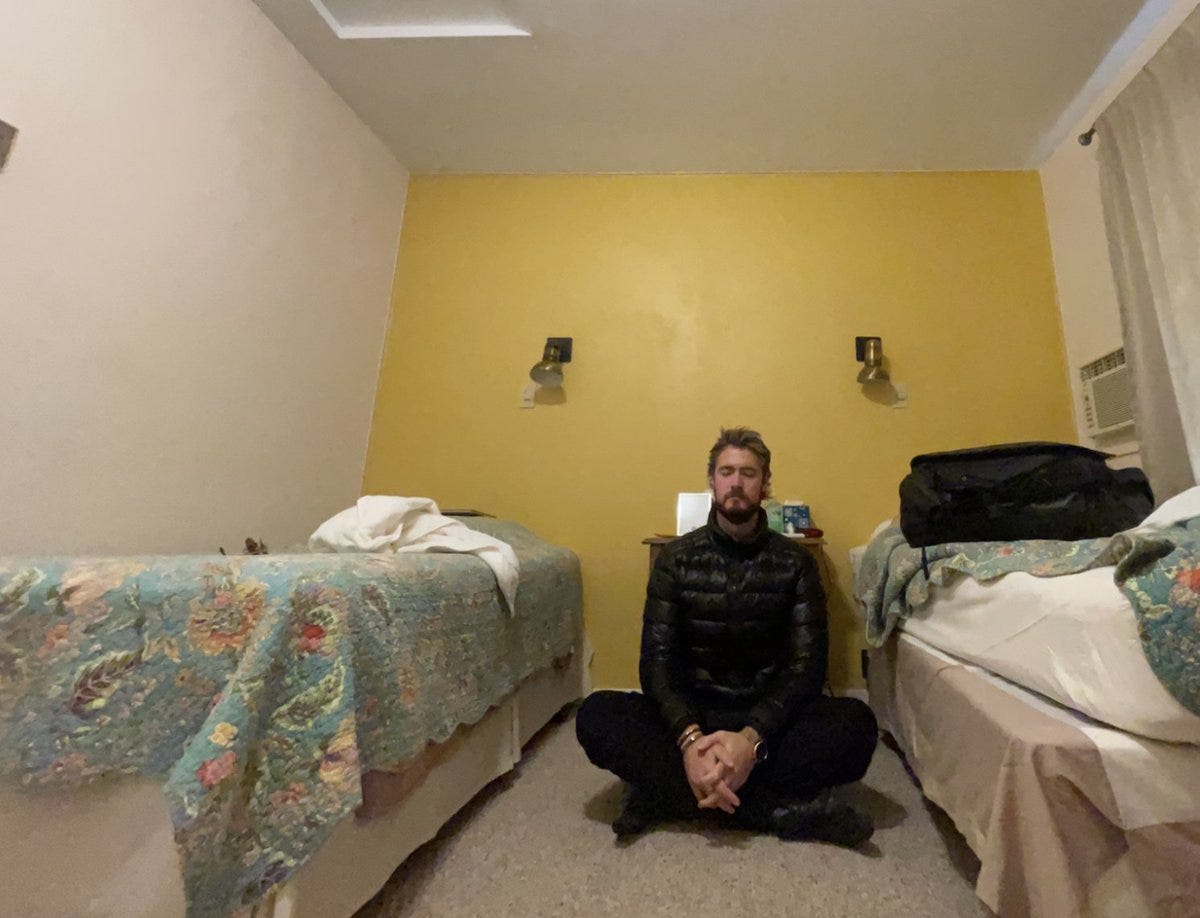
(A final meditation on the last day in the humble retreat accommodations…)
After the retreat, I caught a cab. Sitting in the backseat, my fingers hovered over my phone screen. I was about to fire it up for the first time in weeks.
The anticipation was part excitement, part anxiety.
Messages flooded in. The dopamine reward I got from the simple act of checking each one was intoxicating.
The next day, still in this heavily meditated state, I rediscovered mundane aspects of life with fresh curiosity.
I started working on a big, laborious, boring task I’d been delaying for months.
To my surprise, my attention was sucked into the present moment.
I got into a flow state almost immediately – an optimal state of effortless absorption and heightened productivity.
The once-dreaded task hooked me. Hours melted away.
Any impulse I had to do anything else was overruled by the thrill of discovery and problem-solving that had once seemed dull.
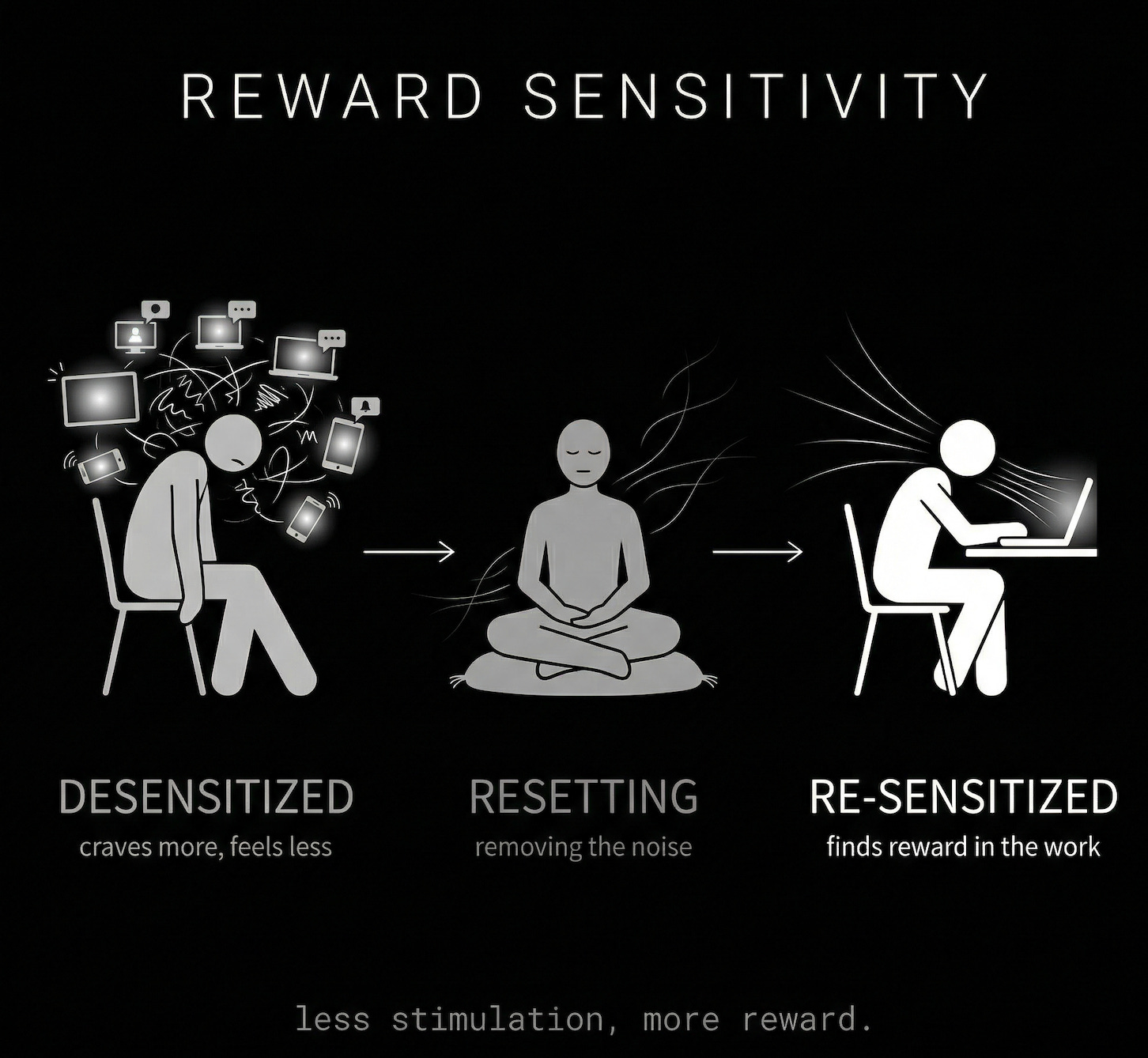
My brain had been re-sensitized to find the work rewarding.
I had no desire to do anything else.
What Was Once Boring Had Become Infinitely Rewarding
How did this happen?
It boils down to a neurotransmitter called dopamine.
Dopamine has been called the “molecule of more.” It’s the reason cocaine feels so good and social media is so addictive. It’s also responsible for the high we get from accomplishment.
It makes us want more of whatever we’ve done to produce dopamine in the first place.
That brings us to the problem of “dopamine detoxing.”
Here’s the thing: neuroscientifically, you can’t really detox dopamine.
It’s a neurochemical. We can’t function without it.
Dopamine plays many roles, but one of its key roles is that of a focusing mechanism.
Stimuli are paid attention to because of the dopamine it produces. Dopamine is the reward we get for engaging in certain activities.
This is key: It’s not stimulation that you want. It’s the dopamine that the stimulation squirts.
However, through overstimulation, we become desensitized to the effects of dopamine. When this happens, dopamine is still signaling, but fewer receptors receive the signal.
So rather than “detoxing” dopamine (which is neurologically impossible), we want to re-sensitize ourselves to it.
The ROI on Dopamine
Low sensitivity to reward means you require a significant amount of stimulation to capture your attention (through dopamine). High sensitivity to reward means you need less stimulation to get your attention (through dopamine).
Think of this as your ROI on dopamine. How much stimulation do you need to feel rewarded by dopamine? The less, the better.
Low sensitivity to reward = You need massive stimulation to capture your attention.
High sensitivity to reward = You need minimal stimulation to feel rewarded.
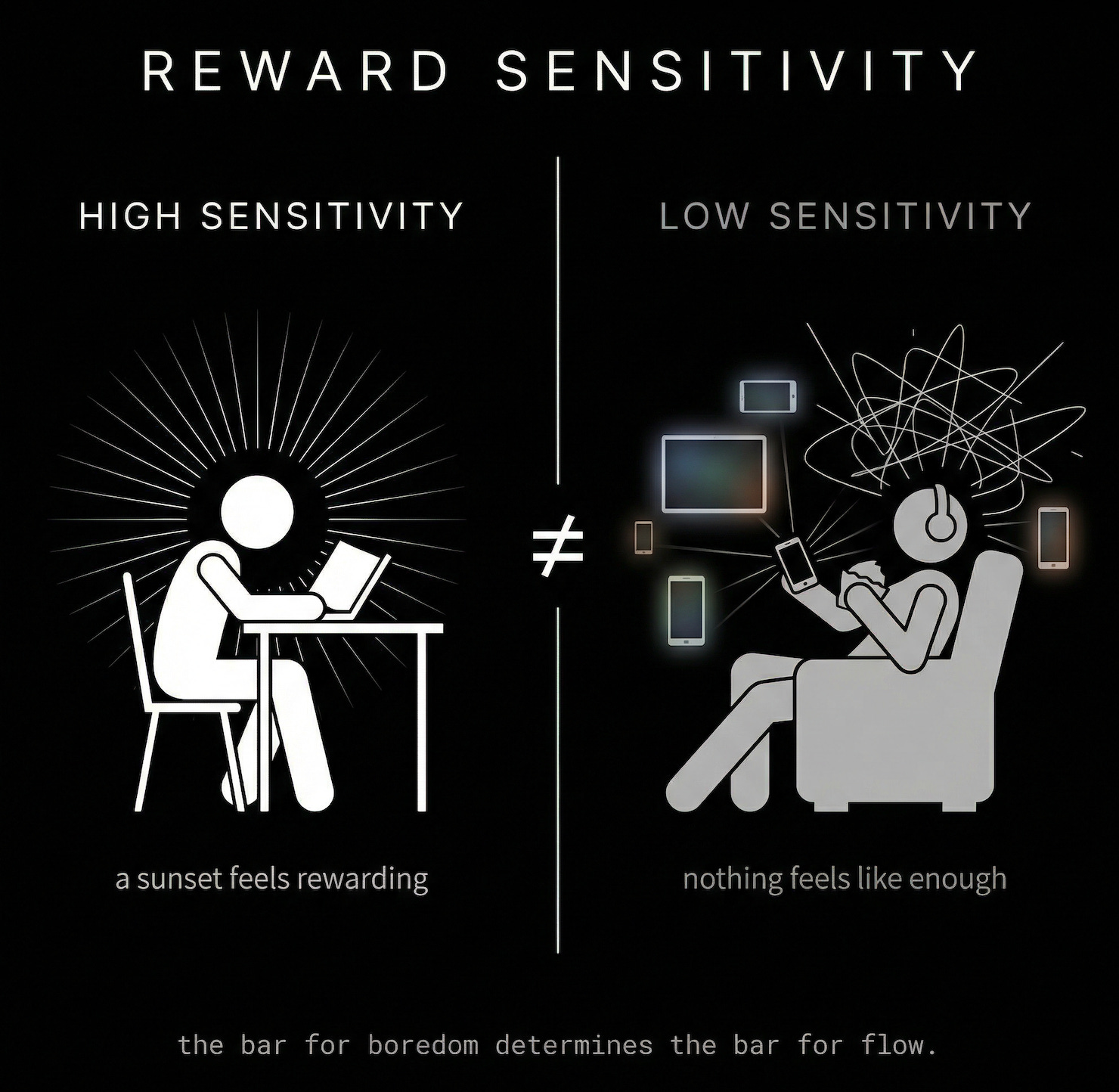
Consider: Do you get a hit of dopamine while listening to a nice song or watching a beautiful sunset?
Or do you need to play a video game and scroll TikTok while simultaneously gobbling down ice cream?
I used to fall in the latter camp. I needed a lot of stimulation for my brain to get enough dopamine for the activity to be rewarding.
Now, while I reset my reward sensitivity by sitting on a mat with my eyes closed for sixteen hours a day, you can do the same with a less extreme approach.
You can reset your sensitivity in minutes, not days.
The Payoff
Through re-sensitizing ourselves, we boost our impulse control, which means we can delay gratification.
This means we stop constantly reaching for dopamine hits — like a caged rat— through phone checking, snacking, or scrolling.
Just imagine what would happen to your productivity if you were as mentally enthralled by doing your work — writing a book, creating a product, building a business — as you are with scrolling TikTok or checking your bank account after payday.
This is what’s possible when you recalibrate your sensitivity to reward.
So how do we get these benefits and heighten reward sensitivity?
Step 1: The Art Of Making The Boring, Rewarding
To master your dopaminergic system means to master the art of making the boring, rewarding.
The first way to do this is to modify how we take breaks when we work.
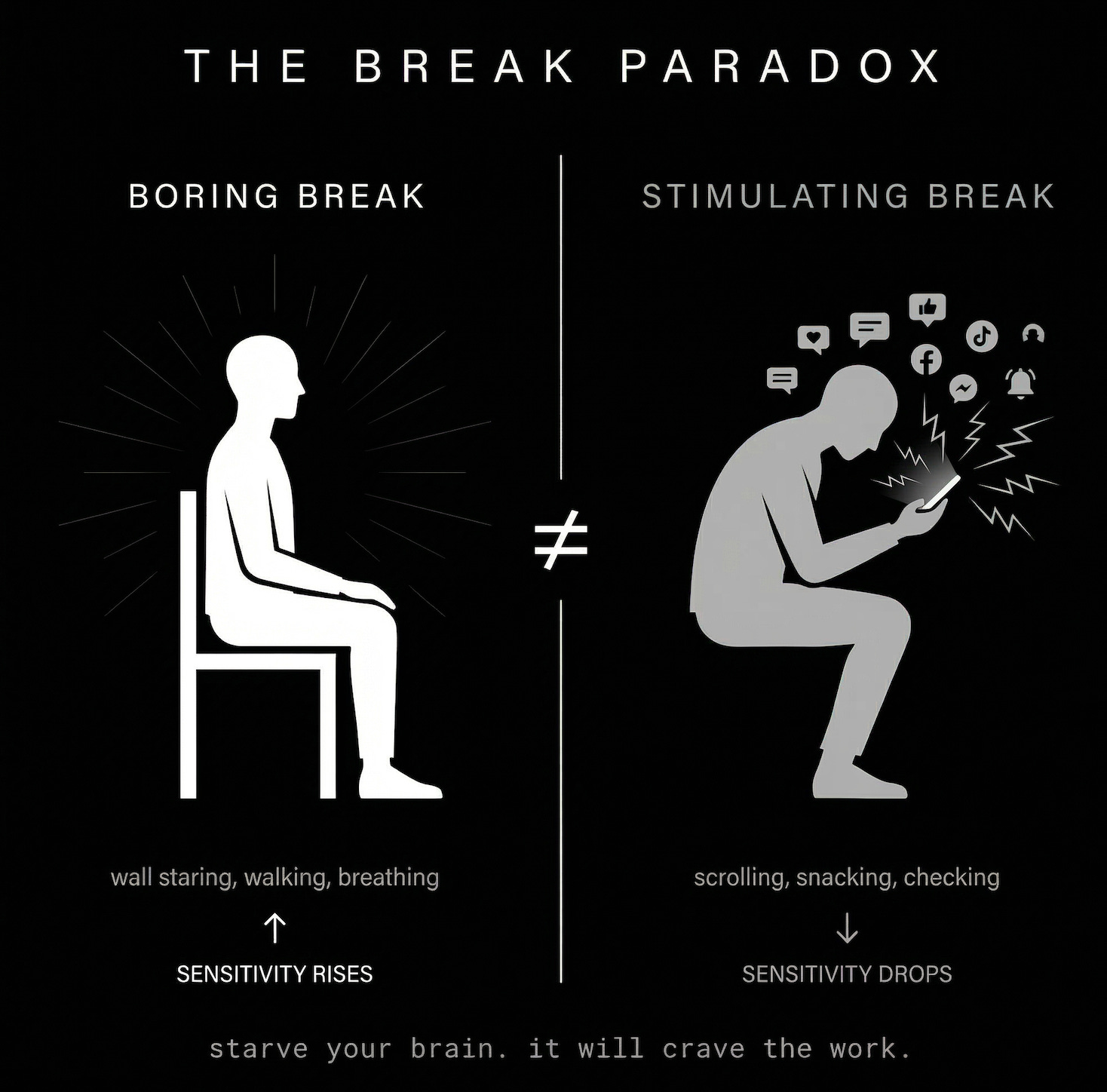
Most people take dopamine-fueled breaks: scrolling social media, checking news, reading emails.
The critical mistake when taking breaks is doing something that’s more stimulating than the work you’re breaking from.
Imagine trying to read a research paper after swiping through social media for an hour. Against instant and infinite novelty, research is dull.
Now the inverse: Stare at a wall for twenty minutes and do nothing. Don’t even meditate.
Suddenly, the research paper is irresistible.
Take boring breaks that reset dopamine and heighten reward sensitivity.
Make whatever you do before and between work as boring as possible.
We want our work to feel as easy as scrolling through social media. We do that by dropping the bar for boredom to the floor.
Good boring breaks:
• A twenty-minute nap
• Walking without a podcast
• Stretching
• Mindfulness
• Breathwork
• Foam rolling
• Light exercise
• Wall staring
Wall staring is a favorite. I’ll stop working and stare at a blank wall for five or ten minutes, letting things simmer.
When on a break, starve your brain of dopamine so it craves getting back to work.
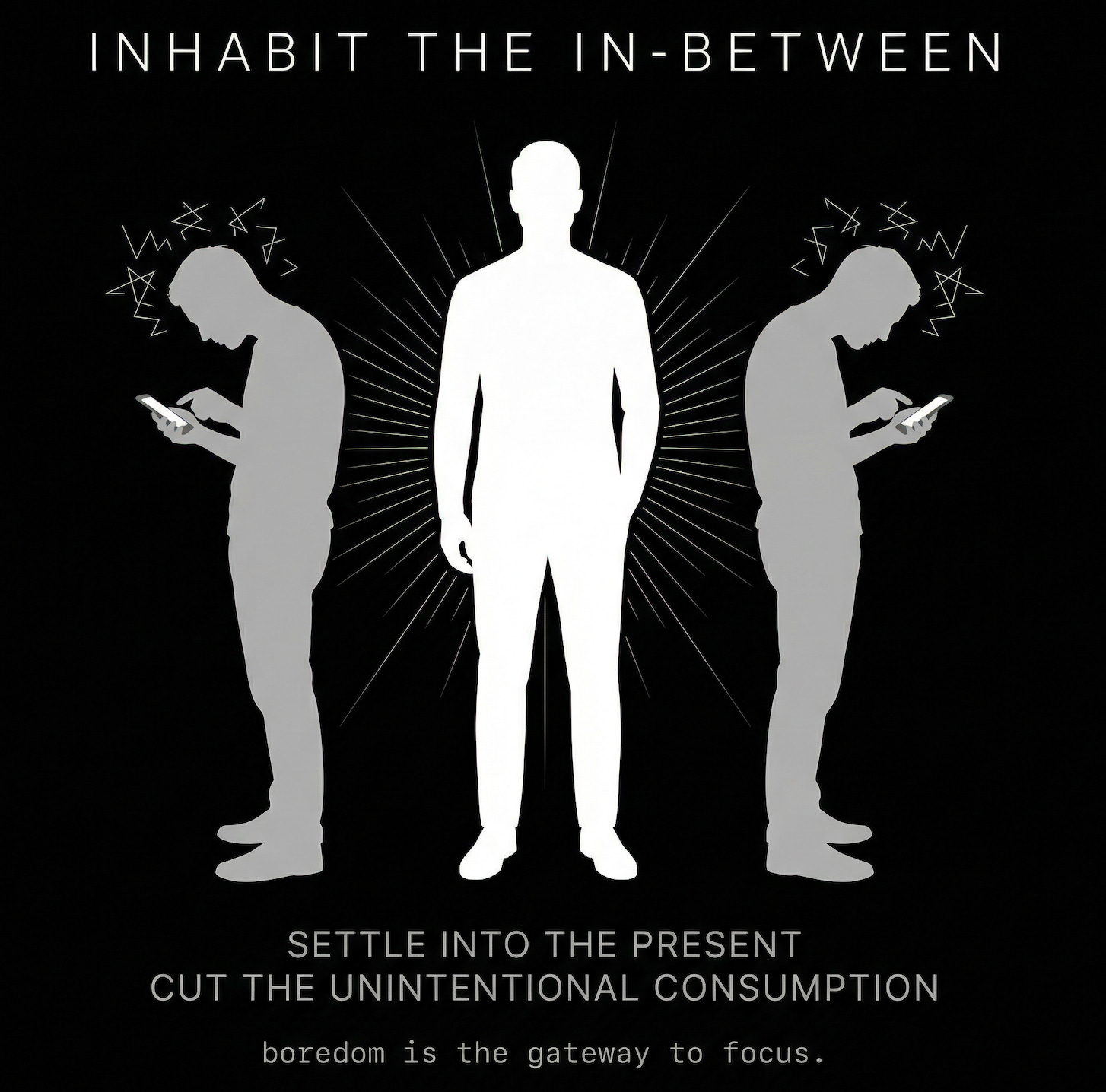
Step 2: Inhabit the In-Between
The second strategy is to inhabit the in-between moments.
Think about what you did the last time you were waiting in a line, or sitting alone at lunch while your friend ran to the bathroom.
You probably reached for your phone.
This is not ideal.
We all have these in-between moments every day, but we’re so accustomed to reaching for our phones for that quick hit of dopamine that it’s almost subconscious.
Inhabiting the in-between means leveraging these moments by allowing yourself to simply settle and return to the present.
In these moments, we cut out the unintentional information consumption that fractures our attention and further desensitizes our dopamine receptors.
How do you inhabit the in-between?
• When you arrive early to a meeting, sit quietly without your phone
• When waiting in line, pay attention to your breath
• When commuting to work, drive or walk in silence
You’ll be forced to be present and tolerate moments without stimulation.
This will make you more sensitive to reward over time.
Your baseline for what’s boring shifts, and you’ll cultivate a monk-like quality of mind
that’s conducive to deep focus and flow.
Step 3: Do Everything One Thing at a Time
The third strategy: Do everything one thing at a time.
As I’ve improved my focus and access to flow, I’ve become worse at multitasking. Much worse. It’s embarrassing. My team even laughs at me for stopping mid-sentence and mid-walk to send a text.
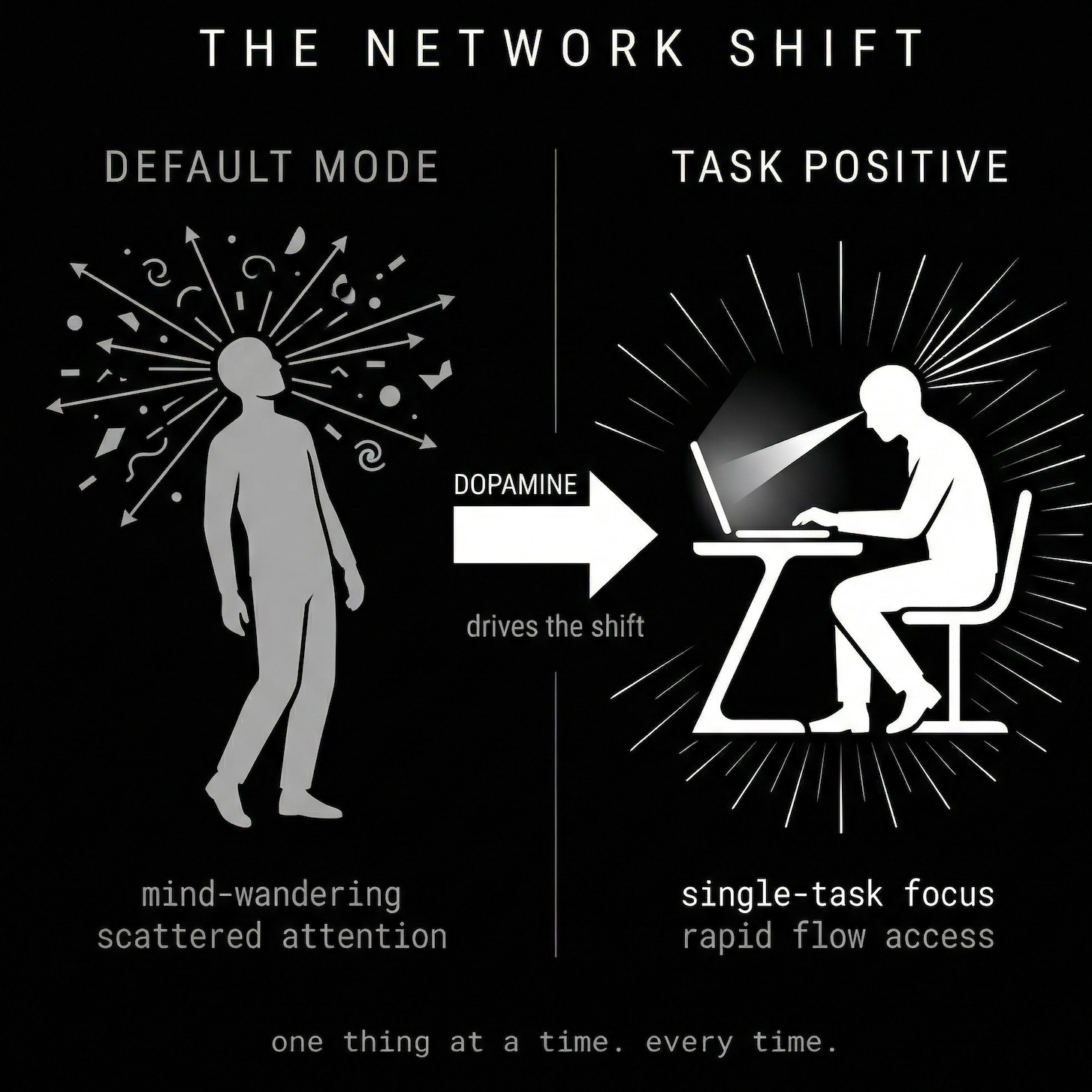
This is due to the interplay between the Default Mode Network (DMN) and the Task Positive Network (TPN) in the brain.
When not engaged in a task, the DMN is active. When focused, the TPN takes over.
In my texting example, I’m rapidly shifting from DMN to TPN, creating a tunnel of attention that makes me oblivious to my surroundings.
While this shift is a burden for texting, it’s a superpower for flow.
The faster you can shift from the Default Mode Network to the Task Positive Network, the faster you can unlock deep focus.
The higher your reward sensitivity, the easier this shift is—because you get more focusing neurochemistry funneled into the system in the form of dopamine.
To train this ability, focus on one thing at a time.
• When eating, just eat
• When working, just work
• When walking, just walk
Embrace life as a series of singular activities rather than scattered efforts to secrete dopamine.
The Compound Effect
When you master your dopaminergic system through:
1. Boring breaks — reset your reward sensitivity between work sessions
2. Inhabiting the in-between — prevents passive desensitization throughout the day
3. Single-tasking — trains rapid DMN-to-TPN transitions for faster flow access
The compound effect is profound…
What was once boring becomes rewarding. What once required willpower becomes effortless. What once felt like grinding becomes play.
Your work transforms from something you have to do into something you get to do.
And the best part?
Flow state — that optimal state of effortless absorption and heightened productivity — becomes the default, not the exception.
-Rian Doris, CEO & Founder of FlowState.com
Very powerful article.
After glancing at email and opening this article up my intuition told me that there's something powerful in here.
However, I didn't sit down to read this article till very late in the evening.
Solid. And confirms what I already intuitively knew. 🐝🙏💝
This was a great read.
I especially loved how you raised the importance of the interplay between the TPN and the DMN.
When you experience that "aha" moment during a period of learning, it's almost always after a pause in attention (and perhaps a far off stare). This is the moment you switched from TPN to DMN, and it handed you the insight on a golden platter.
Now armed with the new insight, you can dive back into the beautiful fray of the TPN.
It's such an elegant learning system (and ironically fueled by cortical dopamine).
One point I also wanted to add: there are ways to adapt the act of scrolling through social media so that the limbic dopamine "load" isn't harmful, and therefore not causing (significant) sensitisation. If you can cognitively engage those TPN areas of your brain while scrolling, top-down control then actually keeps limbic dopamine in check.
Again, absolutely fantastic article. You have done dopamine justice.