

Science shows there’s a source of motivation more powerful than money, praise, or fame, one that practically forces your brain to crave doing the hard work you keep putting off.
I. THE INVISIBLE FORCE
Picture this: You’ve set your alarm early, determined to start the day right. But when it rings, you hit snooze. Repeatedly. Last night’s enthusiasm has evaporated. The blanket weighs you down like a concrete slab, and the day ahead feels like an enemy to avoid instead of a challenge to conquer.
At your desk, the cursor blinks, and your to-do list stares back at you. But an invisible force keeps you frozen in place.
You know you should work, but something inside won’t cooperate. There’s a profound disconnect between what you want to do and what you can bring yourself to do.
Lunch comes and goes. You tell yourself you’ll start soon, but the afternoon finds you lost in distractions, chasing trivial tasks while the important ones loom large and untouched.
The day ends, and the weight of what you didn’t accomplish settles in. You long for the passion and focus you once had. As you put your head on the pillow, you feel the sting of disappointment, having fallen short of the potential you know you’re capable of, day after day.
If you’ve ever experienced this depleted drive, know this:
You’re not lazy. Procrastination isn’t the problem. And there’s nothing abnormal about you.
The issue is more specific than a mere lack of motivation.
It’s that you lack a specific type of motivation.
II. THE TWO TYPES OF FUEL
There are really two types of motivational fuel. One far outperforms the other. The trouble is, most of us are stuck relying on the weaker of the two.
Extrinsic motivation comes from the outside: money, status, praise. If your fuel is extrinsic, you act for the sake of a reward.
Extrinsic fuel works, but wanes. For the brain, anticipation is more rewarding than attainment. Dopamine surges as we anticipate something and plummets after we attain it.
Extrinsic rewards are like fossil fuels: they come from the outside, and eventually, they run out.
Intrinsic motivation comes from the inside: curiosity, purpose, mastery. If your fuel is intrinsic, you act for its own sake and win with or without a reward.
You listen to the song to enjoy it, not to finish listening to it.
Intrinsic fuel works better than extrinsic, and it compounds. It makes hard work easy, leading to an upward spiral of skill development and access to flow state, an optimal state of consciousness where we perform at our very best.
Extrinsic motivation can get you started. But it’s intrinsic motivation that keeps you going.
Think of it like this: A rocket needs an extra booster engine to launch. But once it hits escape velocity, the booster falls off, and it can cruise on its remaining engines.

So how do you upgrade your fuel source? It starts by focusing on the five intrinsic motivators: Curiosity, Mastery, Autotelicity, Purpose, and Autonomy.

III. THE ACADEMIA TRAP
I first felt the deep pain of lacking intrinsic motivation in my early 20s.
Back in Ireland, I was on the academic path, wanting to pursue a PhD in neuroscience, researching optimal states of consciousness. In my first few years on this path, I had enormous drive.
But as time went on, something began to shift.
My drive started to fluctuate wildly. Some days I was pumped to go hard. Others felt like an endless grind.
I scratched my head: “What was going on here?”
One day, while doing some research with Steven Kotler (who would later become my business partner), he sent me a breakdown of the five intrinsic motivators. I read through each one, scoring myself against it. The picture that emerged explained everything.
Curiosity is the insatiable itch to learn everything you can about your work. Without it, work ends when you leave the office. With it, work is like reading a book you can’t put down.
On the academic path, my curiosity was really high. It was all I could think about: I was gobbling up podcasts on peak states of consciousness, I couldn’t stop reading about it, couldn’t stop talking to my friends about it.
So when I read about this intrinsic motivator in Steven’s breakdown, I was confused about why my drive was so low.
Purpose was the next intrinsic motivator I read about. Without purpose, you’re in the proverbial rat race, trading your life for a paycheck in some faceless company that exists just to make money. When purpose is present, you’re willing to make sacrifices because the work is a cause you care about.
This resonated with me too. On the academic path, my purpose felt really high. I was so passionate about what I was researching, knowing that if we could figure out more about consciousness itself, we could improve the quality of the human experience for so many people on Earth.
But I kept reading about the other intrinsic motivators.
Mastery is the pursuit of excellence and continuous improvement. Without this drive, you do just enough to get the job done. With it, you’re like a musician who keeps practicing even after the concert’s over.
And here I realized: “Wait a second, my mastery is really low.”
I couldn’t endlessly improve my ability to do the activities within my academic work. Imagine you’re really good at making PowerPoint slides. You’ve mastered how to make information pop. But then your boss says, “Great, now do the exact same slide, over and over, every day.”
That was me with study design. As I read about the mastery motivator, I thought, “Hm, maybe this is why my drive is low.”
Autotelicity is love for the activities you do at work. With it, you’re like one of those programmers who just can’t stop programming because they love the activity in and of itself. Without it, you’re like an attorney who can’t stand the activity at the core of their work.
You know those tasks at work you secretly love? Like crafting a pitch deck you’re proud of, or writing copy where every word lands? Imagine if those were replaced with activities you loathe.
That was me with academia. I didn’t like designing studies. I didn’t like crunching spreadsheets.
I realized that even though I loved the topic I was studying (my curiosity drive was high) and I found plenty of purpose in it... the actual activities that I do day-to-day, hour to hour, I hated.
It’s one thing to love the idea of a field. It’s another to love the daily work it involves. So my autotelicity was low too.
Autonomy is feeling in control of the when, how, and what of your work. Without it, you feel trapped, like someone else is pulling the strings. With it, you choose what project to work on, how to work on it, and what time of day you do the work.
In academia, autonomy was at a zero for me. The academic walls were closing in, putting a straightjacket on my autonomy. Imagine having a killer project idea but being told you can only work on it on Fridays from 2 to 3 PM, and only if you fill out a form and get it approved by the board of directors first.
That was my experience on the academic path.
I was stuck on the academic hamster wheel, chasing the extrinsic outcome, a PhD. I was doing it for the title, not the game.
Three out of my five intrinsic motivators had flatlined, and the other two (curiosity and purpose) were confined by the lack of autonomy.
IV. THE CAREER SHIFT
Realizing this was incredibly useful because I could then look for a different pursuit that had just as high a level of curiosity and purpose... but also had autonomy, mastery, and autotelicity.
So I used this framework to identify a critical career shift: moving from academia to business.
I co-founded a neuroscience-based research and training business with Steven Kotler, where my curiosity and purpose were still just as high, with the study of consciousness and flow state at the core of what we do.
But mastery, autotelicity, and autonomy went through the roof too.
In terms of Mastery: I was reading books, learning how to use financial spreadsheets, and figuring out how to recruit people. The skill development and mastery possibilities had no cap, where improvement had real, immediate effects.
I loved the startup hustle, the creativity it permitted, and the clear results of the work I put in, which supercharged the Autotelicity intrinsic motivator.
And finally, I was in charge of when I worked, what I worked on, and how I approached it. I had no rules other than the legalities of business. There were no academic guardrails to constrain me, no specific length a study had to be. I had full Autonomy.
With the Flow Research Collective, my love for researching optimal states of consciousness found a new expression, one where my curiosity, mastery, autotelicity, purpose, and autonomy were finally aligned.
V. THE SOUND HEALER
This shift (where intrinsic motivators go through the roof and drive goes through the roof as a result) is seen all the time.
A friend of mine is a sound healer. She would use crystal bowls to run sound meditations for people.
When we met, she had high levels of autotelicity: she loved the sound meditations, the actual act of creating beautiful music. She also had a deep sense of purpose: she saw just how impactful the sound healing was for people who listened to the music she made. And she had a high level of autonomy: she worked for herself, could take the jobs she wanted to take, and ran the sound meditations however she wanted.
But mastery was low. She suggested you can only get so good at rubbing a baton over a crystal bowl.
Curiosity was lacking too, because there wasn’t depth to the topic that could keep her endlessly intellectually stimulated.
So she made a career shift: Psychotherapy.
This had just as high a level of purpose: she still got to help people heal, with some therapeutic relationships stretching over years. She had a similarly high level of autonomy: she could work for herself and conduct her practice how she saw fit. She had an even higher level of autotelicity, because she enjoyed using various therapeutic modalities in her practice.
And because the world of psychotherapy is inexhaustible in its depth, the profession demands continuous learning (curiosity) and improvement (mastery).
Her intrinsic motivation stack went from 3/5 to 5/5, and her drive became unshakeable.
VI. THE FIVE INTRINSIC MOTIVATORS (HOW TO DIAL EACH UP TO A 10)
Let’s untangle each of these five intrinsic motivators in a way that allows you to dial each up to a 10.
Curiosity (What You Explore)
You know when you keep wondering about a specific topic with a craving to fully clear the fog and understand it in depth? When you scour through a book, underlining passages as if they’re gold?
That’s curiosity at work.
As Mihaly Csikszentmihalyi, the godfather of flow, put it: “The flow concept itself was developed as a result of sheer curiosity. It was the fruit of ‘pure’ research, motivated only by the desire to solve an intriguing puzzle in the mechanism of human behavior.”
Curiosity is not just wanting to know. It’s needing to know.
From a neurological perspective, curiosity activates the brain’s reward system, releasing dopamine, which increases attention and pleasure in learning.
How to boost curiosity:
You need two things:
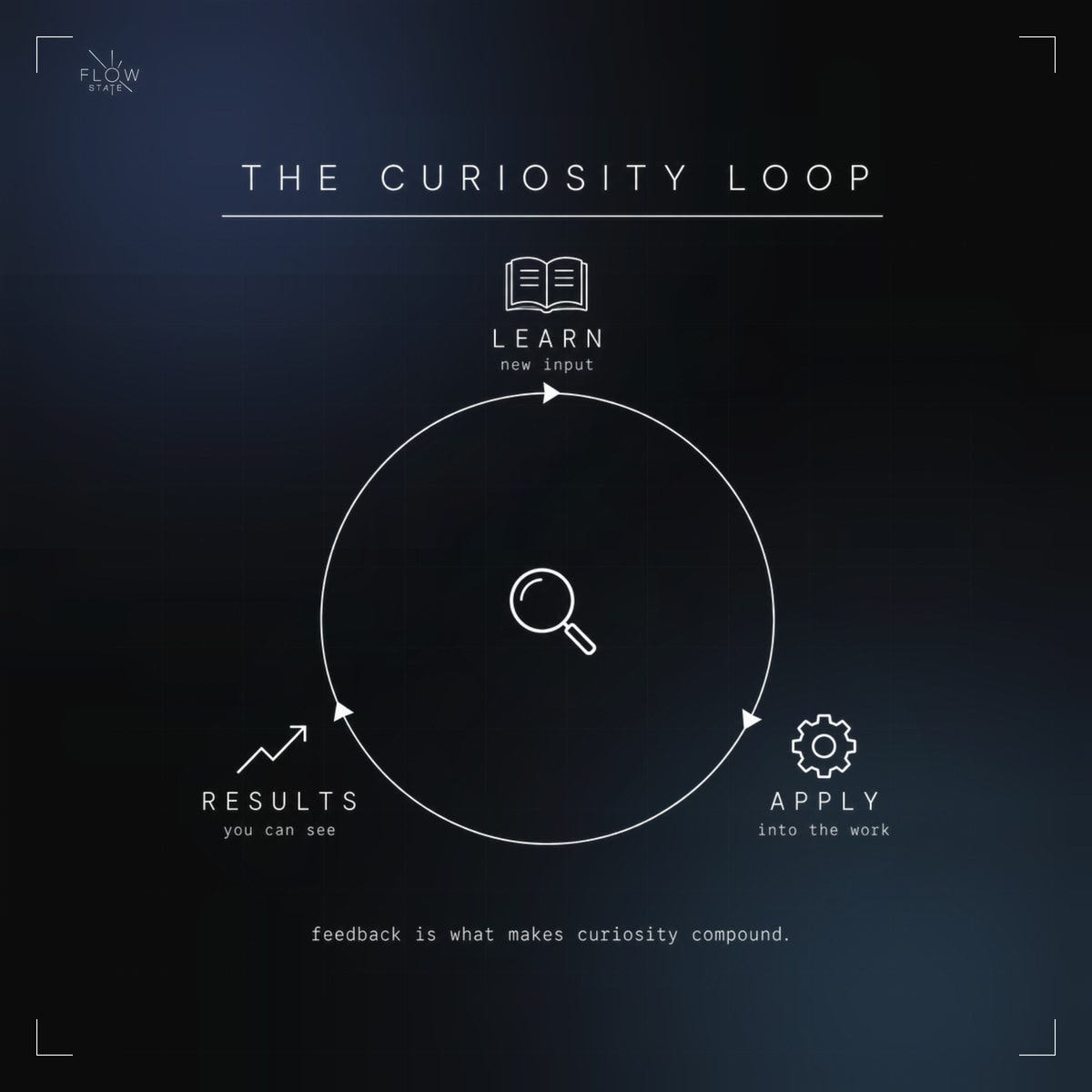
Leverage from learning: The knowledge you gain must have a direct, positive impact on your work. You learn something new, implement it, see tangible results.
Immediate feedback from learning: See the direct consequences of your applied learning, ideally in real time.
Back when I was in academia, I didn’t read about study design because if I had, it wouldn’t have made a difference. I wouldn’t have gotten any better, and it wouldn’t have sped up my progress.
When I switched to business, I consumed five business books a week. Everything I learned and every single model or insight resulted in tangible breakthroughs in the business, which further compounded the curiosity motivator.
The more you learn, the more things happen.
Mastery (What You Improve)
This is the ability to endlessly improve at what you do. If you’ve ever gotten really into a sport, one of the things that wrapped you up in it was the thirst to be better today than yesterday.
It’s like pushing for a new high score in a video game long after beating the main storyline.
Ever rewatch that killer presentation you absolutely crushed, just to analyze your work? Or spend an evening journaling, breaking down a recent project’s successes and failures? You don’t just want to relive the win. You want to understand how to make the next game even better.
Mastery releases dopamine and endorphins, the biochemical markers of progression. As skills improve, we seek out greater challenges, leading to an upward spiral of growth and engagement.
How to boost mastery:
Identify all the skills and subskills that will advance your long-term goals at work as a result of mastering them.
Then, learn and practice those skills explicitly with deliberate practice, as if you’re a professional athlete or musician. Practice the skill on the edge of your comfort zone and correct your mistakes continuously until you habituate new behavior.
This is what my sound healer friend lacked: she had already mastered making her sound bowls sing, and there were very few subskills to develop.
If you can’t actually get better at the skills involved in your work, you need to make a career shift. Choose something that has unlimited possibilities for mastery baked in.
Autotelicity (What You Love)
Imagine falling in love, but with an idea, a project, or activities at work. You know the feeling of working late, not because you have to but because you want to?
That’s autotelicity. The line between work and play blurs.
“Autotelicity” is derived from Greek words meaning “self-purpose.” Activities that are rewarding in themselves, done for their own sake rather than for external reward.
As Csikszentmihalyi observed in the flow state subjects he studied, with high autotelicity, you behave as if what you’re doing is “the most important thing in the world.”
How to boost autotelicity:
Don’t focus solely on what you like to do in and of itself.
Instead, consider a simpler question: “What am I good at?”
You’re naturally way better at some things than others. You have innate strengths that make certain tasks feel less like work and more like play.
It’s easier to build a career around things you are good at than things you happen to love doing right now. If all you like doing is playing video games, it will be tough to make it a viable career.
The key is to trust that if you do things you’re good at, over time, you will forge autotelicity within those activities. The research shows that strengths are a trigger for flow, and the more time you spend in an activity while in flow, the more you come to love that activity.
I felt strongly about the neuroscience of consciousness, but the activities I had to do within academia felt like using a fork to eat cereal. It just wasn’t the right tool for me. Business, on the other hand, was like my spoon. It just fit because I was naturally good at it, and high autotelicity was the result.
Purpose (What You Impact)
Purpose applies autotelicity to a bigger cause or mission. It’s the belief that what you do affects something bigger than you.
Autotelicity is for you. Purpose is for others.
You’ve probably had jobs that you were good at, maybe even passionate about, but something felt missing. You find yourself in a role where you question if any of it matters. Without a sense of purpose, your job is just a collection of tasks.
The meaning found in purpose leads to greater persistence despite challenges. It makes your job not just a paycheck but a mission. Purpose ramps up levels of oxytocin and serotonin, key players in social bonding, mood stability, and long-term well-being.
How to boost purpose:
First, a gut check: “At a basic level, does the organization I work within or the work I do have an obvious purpose attached to it at all? And is that a purpose I can get behind?”
If not, you need to switch careers entirely.
However, if there’s even a glimmer of purpose you can connect with in your current work, here’s how to amplify it:
Positive psychology research shows that a well-articulated purpose and a clear correlation between that purpose and your work drive up both motivation and job satisfaction.
Distill your life’s mission into one laser-focused sentence. For instance, “Advance technological innovation for global good.” Then, every day, next to each work task, identify how it links to your purpose.
Autonomy (What You Choose)
Ever felt trapped in someone else’s plans? Autonomy is the exact opposite. It’s that feeling of ownership, that sense of “this is mine.”
Remember the freedom of tackling a project your way without someone micromanaging every step? Think about that side project at your job where there were no strict guidelines, just an objective. You could design it, delegate, decide the approach, and suddenly, work felt like play.
Autonomy is steering your ship, free to pursue what you want and operate as you see fit. Our brains flourish when we have a say in our actions.
How to boost autonomy:
There are two ways. One perceptual, one literal.
First, zoom out and swap the current context of your work into a context that you own. Make the shitty, low-autonomy job you have right now a key step within your chosen life trajectory.
Even if what you’re doing right now is low autonomy, by embedding it within a bigger journey that you shape and control, you boost your autonomy in the present.
This makes a low-autonomy role like being a junior sales rep autonomous at the macro level because all of a sudden, you’re learning the skills you need to start your first business in three years’ time.
Second, cultivate “eff you autonomy.” You’ve heard of “eff you money.” Same principle here. Gain “eff you skills,” an “eff you network,” and “eff you knowledge.” This is the backdrop of choice you have to pursue other options at any given moment.
And here’s the best part: You don’t need that much autonomy to boost this intrinsic motivator.
At work, most of your work doesn’t require autonomy. But you need a high degree of autonomy within a narrow part of it. Focus on the smallest part of your work life that you can control without question.
Outside of work, spend an afternoon per week on something you fully own. That’s really all the autonomy you need.
Most of the time, we just don’t make use of the autonomy we already have. If we maximize whatever little autonomy we have, that’s often enough.
VII. THE DIAGNOSTIC
Identify where you currently stand with the intrinsic motivators.
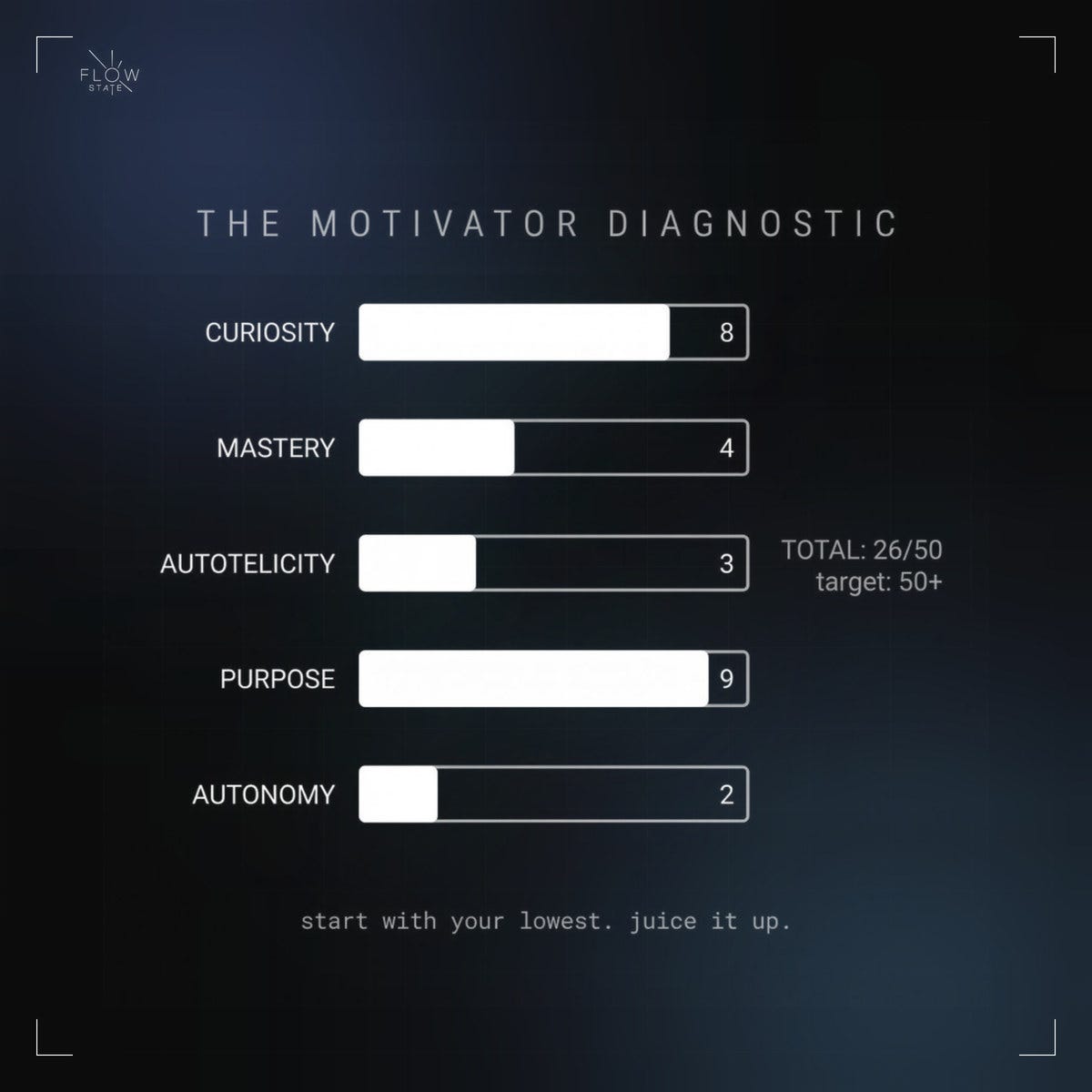
With your work in mind, rate each motivator from 1-10:
Curiosity: How many times over the last 30 days did you have the desire to read, watch, or listen to content related to your work outside of your work hours?
Mastery: Looking back at the past month, to what degree do you feel the desire to endlessly improve at the skillset required for your work?
Autotelicity: In the last 30 days, how often did you spontaneously dive into one of your core work activities without any obligation?
Purpose: What would you be willing to sacrifice to have the outcome of your purpose realized in the world?
Autonomy: Over the last 30 days, to what extent has the how, what, why, or when related to your work felt in your control?
Your goal: boost each intrinsic motivator by 5 points per year until you hit 60 (maxed out). Then sustain that 60.
Start with whichever intrinsic motivator is lowest, and juice it up. Raising one motivator can give you the energy required to raise the rest.
Know that these won’t always remain in balance. You’ll always be upgrading your motivational stack based on what your work requires.
If I ever find myself lounging in bed in the morning for multiple days in a row, I know it’s because something is off with my intrinsic motivational stack. Because even through illness, grief, and life’s natural turbulence, when my motivations are aligned, I’m eager to engage every day.
Eventually, you’ll be able to check in to each of these as easily as you check your heartbeat. And course-correct as needed.
VIII. THE VIRTUOUS CYCLE
Why are these intrinsic motivators so effective?
High levels in each release performance-enhancing neurochemicals like norepinephrine, dopamine, and acetylcholine while also lowering cognitive load. Both mechanisms enhance focus and drive flow state.
Within flow, you get an additional cascade of neurochemistry: endorphins, serotonin, anandamide, and oxytocin (in group flow).
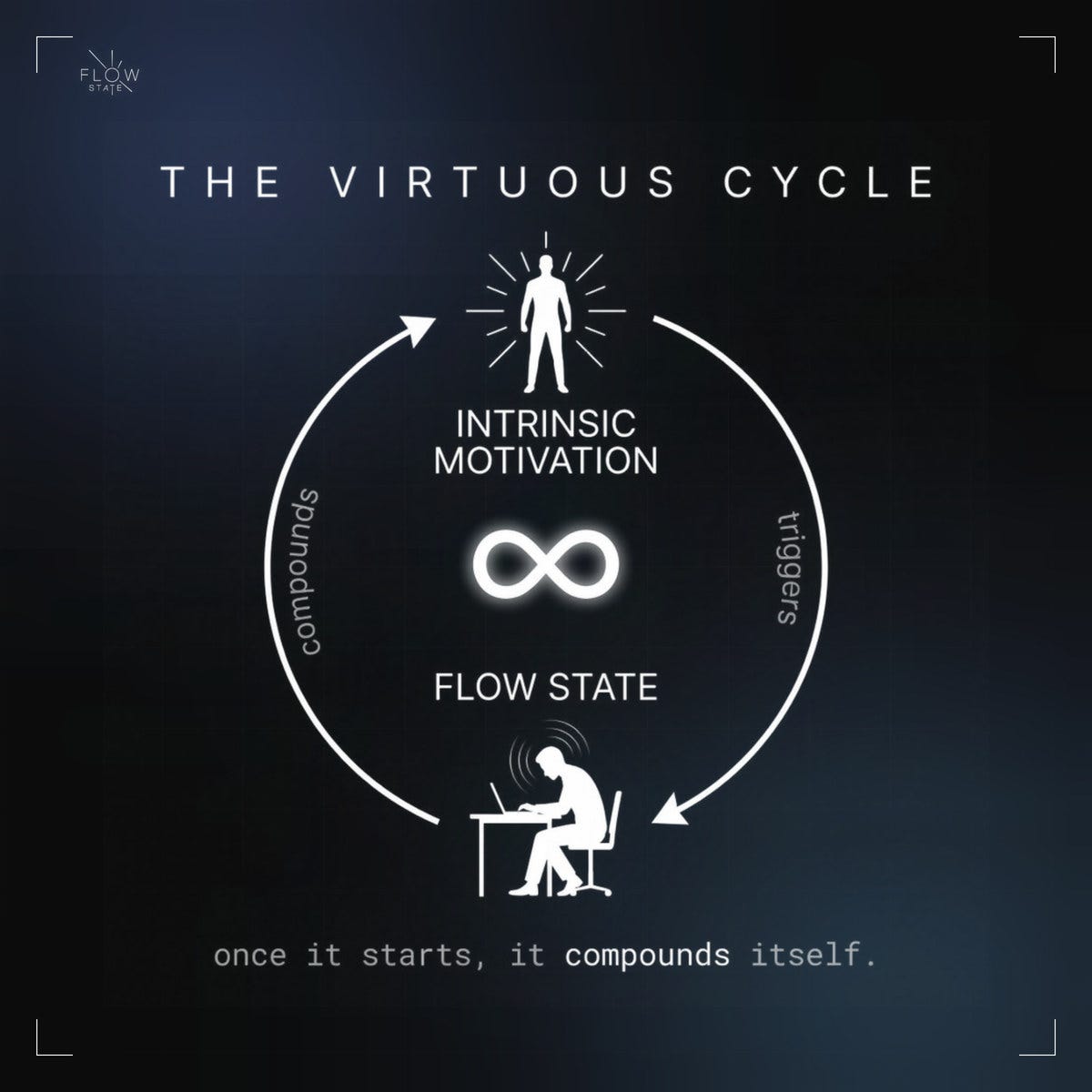
The intrinsic motivators get you into flow. But flow compounds your intrinsic motivation.
A virtuous cycle begins where the more motivated you become, the more flow you get. And since flow is the epicenter of intrinsic motivation, it compounds your motivation even further, leading to more flow, and on the cycle goes.
Once you get in the grip of this cycle (intrinsic motivation feeding flow, flow feeding intrinsic motivation) the compounding becomes relentless.
This is why people like Einstein, Marie Curie, Michael Jordan, and Serena Williams could sustain extreme motivation for multiple decades straight. Einstein’s lifelong curiosity led to relativity. Curie’s curiosity and purpose led to pioneering radioactivity research and two Nobel Prizes. Jordan and Williams, driven by mastery and autonomy, earned six NBA championships and 23 Grand Slam titles respectively.
What do all peak performers have in common? Their intrinsic motivators are locked in and maxed out consistently.
With intrinsic motivation feeding flow and flow feeding intrinsic motivation, the cycle compounds itself decade after decade.
IX. WHAT CHANGES NOW
When you upgrade your fuel source, you go to bed so excited to wake up in the morning that you feel like a kid on Christmas Eve.
And working “hard” becomes irresistibly easy. Like a video gamer, you can solve complex problems for hours on end, yet be so hooked you feel no exertion.
As intrinsic motivation increases, extrinsic motivation actually dissipates. And that’s when everything shifts.
Extrinsic motivation can make you a slave to arbitrary success metrics, external rewards, and the fear of failure. You fall prey to feeling like you never have enough. Every achievement becomes a short-lived high, quickly replaced by a new craving or worry.
But once intrinsic motivation takes over, you’re untouchable.
The need for external sources of pleasure and happiness melts away. You don’t need anything outside of the activity you’re engaging in. This makes you less likely to be manipulated by external rewards or to behave and make decisions influenced by money, status, or punishment.
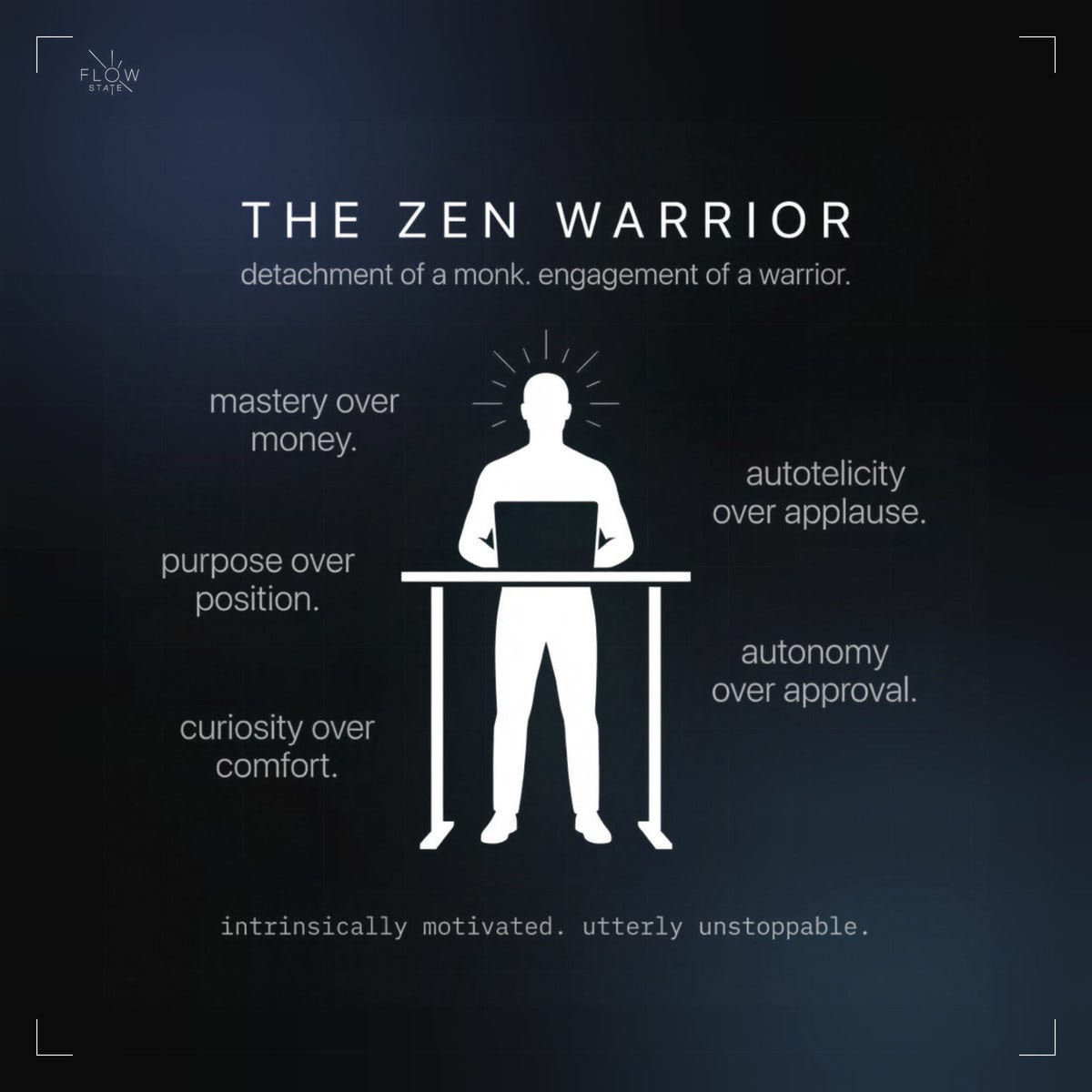
Think of it as becoming a “Zen Warrior”: the detachment of a monk with the engagement of a warrior.
You’re detached from the trappings of the external world (money, status, fame) but obsessed and engaged with the work itself. You’re in it for the pure joy it brings you, without being swayed by what others think or expect.
This sublime, imperturbable mode of autotelic consciousness makes you increasingly immune to the types of suffering that derail so many lives.
The intrinsically motivated chase:
Mastery over money
Purpose over position
Autotelicity over applause
Curiosity over comfort
Autonomy over approval
If you understood just how good being intrinsically motivated can be, you’d understand that no amount of extrinsic rewards can compete or compare.
It takes time to get there. But once the virtuous cycle locks in, you’ll look back and realize it was the most important shift you ever made.
Ten years of intrinsic motivation turns ordinary talent into something no one can compete with. Ten years of extrinsic motivation turns extraordinary talent into a long list of achievements that never felt like enough.
-Rian
I believe laziness is a habit as much as discipline.
Make sure hard give hard pleasure.