

“Consistency is key.”
You’ve heard it a thousand times. But by Friday, you’ve stayed up too late, skipped the workout, and the routine you swore was non-negotiable has become a once-in-a-while thing.
You’d assume the problem is willpower. That you need to force yourself harder. But willpower is effortful and inconsistent. Every morning you “make yourself” do something, your prefrontal cortex has to fight for it all over again.
The fix is to anchor each habit to a specific time, and let an alarm do the deciding. When it fires, you move.
I call those alarms hinges.
I. THE COFFEE SHOP
A few years back, I was chatting with my writing partner Joshua at a coffee shop. I’d just gotten better from a brutal multi-month bout of long COVID. For close to a year, it had taken me hours to get out of bed in the morning. I couldn’t exercise. I could barely work. My peak performance habits got completely derailed.
And at the same time, I’d just acquired a new company AND started a full-time PhD. On top of already running a team of sixty people.
So I had to dial in my habits as fast as possible, otherwise these projects would start to topple.
Joshua looked at me and said, “Look, dude. Let’s make this simple. What is the one daily habit that makes the rest of your behaviors naturally happen?”

I instantly answered. “Oh, that’s easy. Waking up at 5:30 AM and diving straight into flow makes my entire day infinitely more productive. From the moment I started my first business, all my success relied on that one habit.”
This is what’s called a domino habit: a habit that, if done, auto-corrects the rest of your behavior.
A domino habit can be anything, elaborate or simple. Watching the sunrise. Taking a cold shower. Going to bed at a certain time. What makes it a domino habit is that completing it boosts the likelihood that the rest of your positive habits will occur.
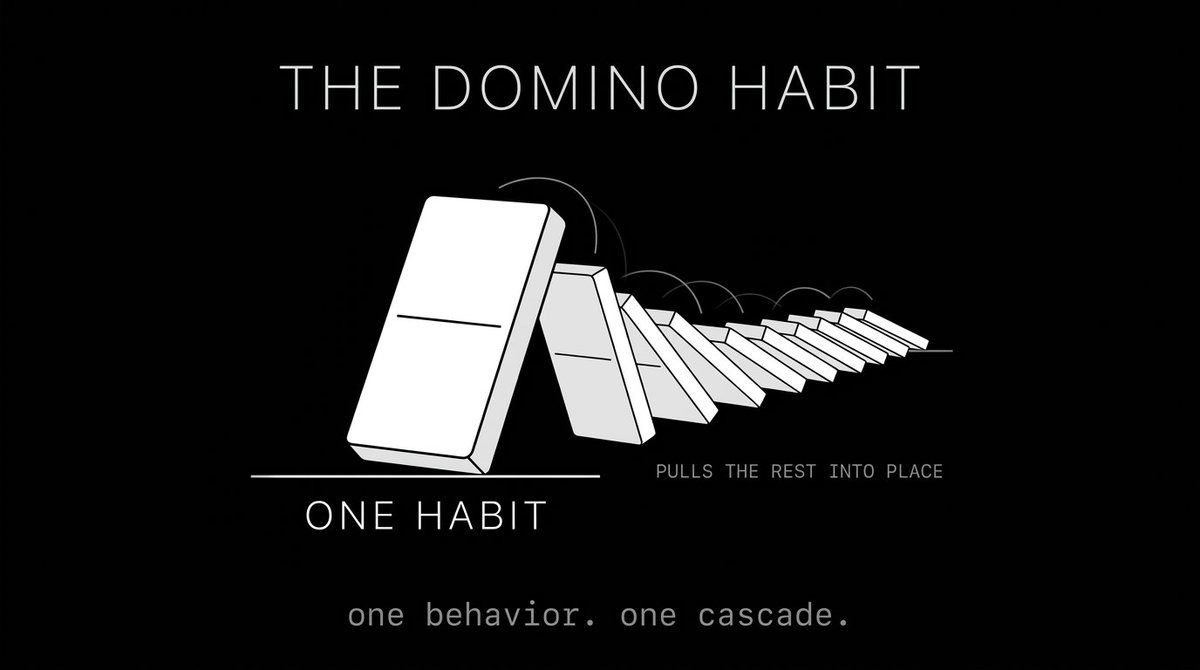
The problem was, even after recovering from long COVID, I was still having trouble getting consistent with that domino habit. Staying up too late. Snoozing the alarm. Getting sucked into my phone. You know how it goes.
So I asked Joshua, “How do I ensure I actually DO the domino habit and stick to it relentlessly?”
Joshua thought about it for a second, and then reminded me of the research on temporal landmarks.
(I post daily about flow state, the state of peak performance where you feel and perform your best. Subscribe if you want to see more content)
II. TEMPORAL LANDMARKS
Research from the University of Pennsylvania, led by Hengchen Dai, Katy Milkman, and Jason Riis at the Wharton School, describes temporal landmarks as dates of significance that are distinct from “ordinary” days. Dates that draw a boundary between one era in our lives and another.
This is often the start of a New Year, Mondays, or birthdays.
These landmarks serve as markers in time that can help separate our past selves (who are anchored to suboptimal behaviors) from our future selves (who have the potential to act differently).
Temporal landmarks produce what they call a “fresh start effect.” Making people feel more motivated to pursue their goals in anticipation of and right after the landmark.
But there’s no inherent reason to wait so long between temporal landmarks.
There are also intra-day temporal landmarks that occur within a 24-hour cycle.
These are the milestones of your day:
The moment you start work
The moment you have lunch
The moment you go to the gym
The moment you finish eating
The moment you get ready for bed
The moment you wake up
By building your habits around these temporal landmarks that occur within your days, as opposed to across weeks or months, you can get a regular fresh start effect which you can leverage to become more consistent.
III. THE HINGE DISCOVERY
Joshua asked, “Have you tried mapping out the temporal landmarks within the 24-hour period BEFORE the domino habit and seeing if observing those temporal landmarks results in you consistently hitting your domino habit?”
I looked at him, thinking he might be onto something.
He asked, “What has to happen within every 24-hour period, and by when, to make sure that no matter what, you hit that domino habit?”
So he starts firing questions:
“First, what time do you have to be asleep to hit that 5:30 AM wake-up?”
“Well, 9:00 PM,” I told him.
“And to drift off by 9, when do you need to be in bed?”
“Well, 8:30 PM.”
“And to hit the sack by 8:30, what time should you finish dinner?”
I thought about it for a second and mapped it out. “5:00 PM.”
We continued the line of questioning until I had identified all of the temporal landmarks within my day.
Then we set alarms on my phone for each. To alert me that a temporal landmark had occurred.
The alarm would act as a trigger, to ensure that I shifted my behavior accordingly. To honor the temporal landmark and move into the next phase of the day. Which keeps me on track to hit the domino habit the next time it rolls around.
Here’s what it looked like when we mapped it out:
5:30 AM: Wake up + flow
8:00 AM: Reboot routine
5:00 PM: Finish work
6:00 PM: Finish eating
8:30 PM: Wind down
9:00 PM: Lights out
It was like setting up dominoes, and the first one was set to fall at 5:30 AM.
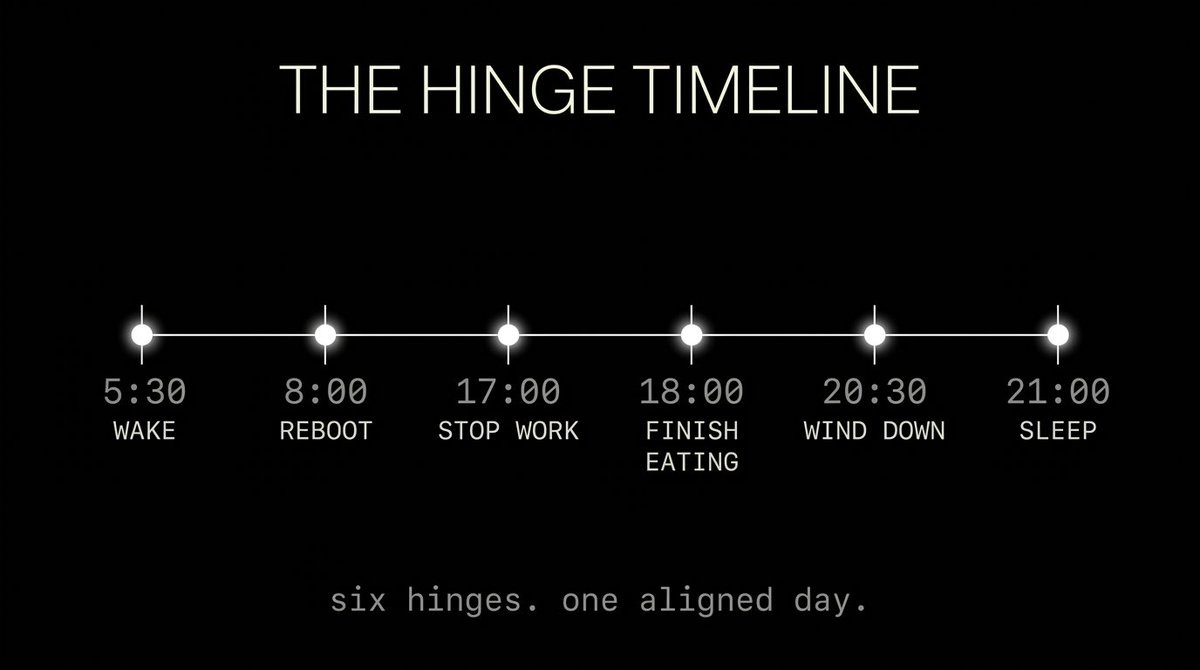
In between each of these alarms are other activities, of course. But those alarms are anchored to the key temporal landmarks that, if hit, ensure the domino habit occurs. For me, waking up at 5:30 AM.
That’s when Joshua said, “You wanna stay consistent? Just don’t get unhinged.”
“What do you mean?” I asked.
“Your day hinges upon your domino habit. Your domino habit hinges upon the temporal landmarks. And each alarm acts as a hinge. Just as a door swings from closed to open on its hinges, each alarm is a turning point in your day. A moment when you pivot from one activity to another that keeps you on track to hit your domino habit.”
Here’s the sequence:
Alarm → Temporal Landmark → Start Next Phase Of Day → Hit Domino Habit → Rest Of Behavior Autocorrects
Ever since I put these hinges in place, I haven’t missed a single 5:30 AM wake-up.
And it’s no surprise this works so well. As research from BJ Fogg at Stanford and Benjamin Gardner at University College London shows, similar to how behavior keys off environmental cues, behavior also keys off temporal cues.
Using time to drive behavior is one of the most underestimated levers on habit formation.
The goal is simple: Never get unhinged.
IV. WHY THIS WORKS
You might wonder: Surely the solution to consistently nailing your high-performance habits each day can’t come down to something as trivial as setting a few alarms on your phone. Right?
Let’s look at the science.
The alarms you set (the hinges) decrease your cognitive load. The amount of information you’re trying to hold in working memory at any given time.
They do this by:
1. Slicing your day into manageable segments. This reduces the strain on your working memory and improves efficiency.
2. Simplifying decision-making. Once you know exactly when to START an activity and when to STOP, it reduces your decision load.
3. Outsourcing time management. They shift time management from an active, conscious process into a passive, unconscious process that automatically occurs.
And the benefits of lowering cognitive load are threefold.
First, when you have a lower cognitive load, you’re more present. And this matters because flow state can only occur when you’re present and fully focused.
Second, when you reduce cognitive load by setting hinges, you end up with higher flow proneness. You’re more susceptible to dropping into flow at any given time.
Third, you free up working memory for the actual work that matters.
Picture it like using a GPS for a road trip. Instead of having to remember every turn, the GPS remembers everything and guides you, letting you focus on driving.
The end destination is your domino habit. The temporal landmarks are every turn that you have to take. And the hinge is the voice on the GPS that tells you WHEN to make each turn to ensure you reach your destination.
(I also put together a 30-day email sequence breaking down the science of peak performance and flow state in more detail. Access it through the link in my bio.)
V. THE THREE-STEP PROTOCOL
So how do you set this up? Three simple steps.
STEP 1: IDENTIFY YOUR DOMINO HABIT
Identify the one habit that auto-corrects the rest of your day. The one lead domino you want to flick.
Sometimes this domino habit is obvious. It may be morning exercise, meditation, or a focused work ritual. It’s different for everyone.
But other times, identifying your domino habit can be tricky or counterintuitive. Maybe you’ve found that it’s something unexpected. Like if you read 90 minutes of inspiring literature, for whatever reason, the rest of your day auto-corrects.
Take some time to think about it. Look back on the periods when you’ve been most happy, most fulfilled, most productive, and when you’ve accessed flow state most consistently within your life.
What is the one habit during that time that you rarely or never skipped that caused the rest of your habits to click effortlessly?
Is it a workout? Time with friends? A nap in the middle of the day? Getting up at a certain time? A ritual in nature?
The key is that you find that one habit that you know, when done, makes everything else fall into place.
STEP 2: REVERSE ENGINEER THE TEMPORAL LANDMARKS
Ask: what is every essential action or transition (temporal landmark) that must happen before and after my domino habit to ensure it happens without fail?
These temporal landmarks might be as simple as “stop working” or “eat dinner.”
Sometimes you’ll have to stop doing something productive to adhere to your temporal landmark so you can be set up to hit your domino habit for the following day.
For example, sometimes I’m doing something productive at 8:30 PM, and an alarm goes off. Time to get ready for bed.
On aggregate, over a 24-hour period, and then over a week and a month, I’m better off staying on track with the domino habit by adhering to the temporal landmark than ignoring it so I can continue doing something else that’s productive.
It’s about prioritizing the productivity of your week over your day.
STEP 3: SET YOUR HINGES (THE ALARMS)
Since you might have alarms for other things, such as meeting reminders, make sure your hinges are distinct. Perhaps using a different sound.
These hinges specifically alert you to the fact that you’ve reached a temporal landmark. Time to phase shift to stay on track for your domino habit.
Your goal is to turn with each hinge. It’s like a spinning top that keeps on spinning.
Aim to establish hinges for:
When you wake up
When you go to bed
When you wrap up work
Recurring activities like exercise, eating, or breaking a fast
Important: Don’t have more than six hinges.
Anything more than six is too complex and disrupts the natural flexibility in your day, or causes you to not adhere to them. You just need the key hinges to keep the day moving and set you up to hit your domino habit again within that 24-hour cycle.
VI. SIX CHANCES TO WIN
What if you miss your domino habit or a hinge?
Simple: just hit your next hinge. You’ll be on track for the next 24-hour cycle.
With hinges, you’re removing the onus of consistency from the domino habit, and instead transferring it to every milestone that you know leads to the domino habit being hit per 24-hour cycle.
That’s the beauty of it:
Rather than having one chance to win in a 24-hour period by hitting your domino habit (which you sometimes miss), you now have six chances to win.
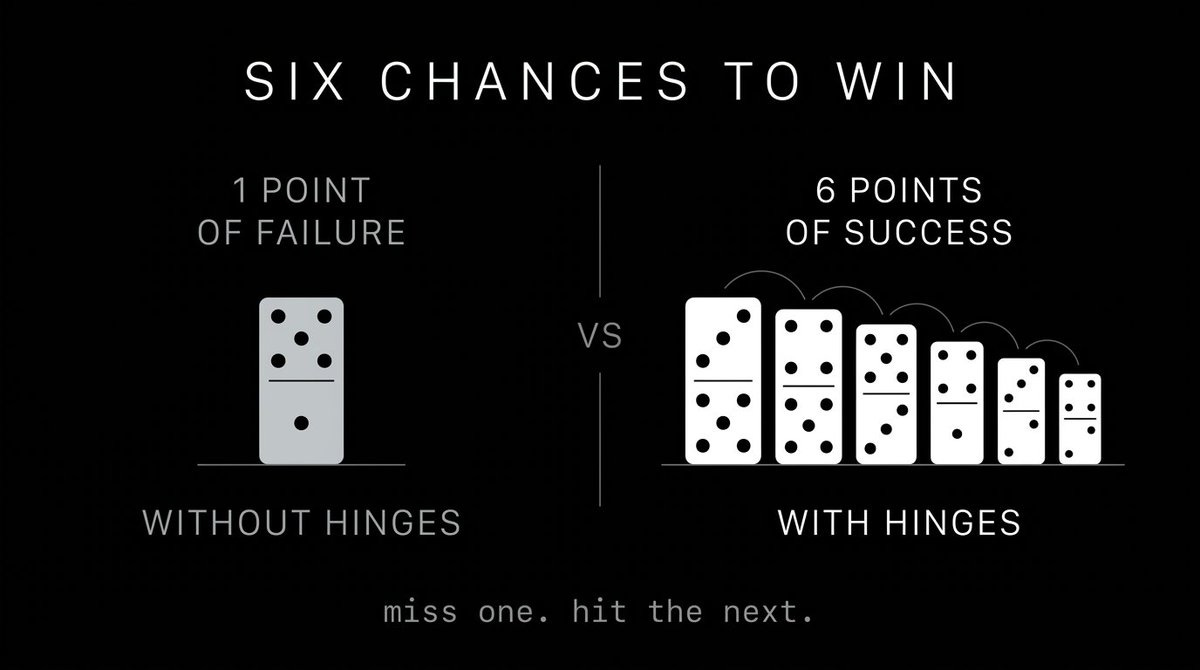
Each hinge is a win. These wins build up to the ultimate win of the domino habit, which results in you nailing your day.
This lowers the stakes, takes the pressure off, and gives you more wins.
NEVER GET UNHINGED
That’s it. No overcomplicated to-do lists. No need to make the habits obvious, attractive, or easy. Just a simple mechanism of using time itself to keep you on track for peak performance every 24 hours.
Your domino habit will become more consistent than ever. You’ll be more productive. And you’ll get way more access to flow state.
The satisfaction from flow will reinforce the positive feedback loop so strongly that you’ll never want to miss a temporal landmark again.
Willpower breaks. Hinges hold.
Just don’t get unhinged.
What’s your domino habit? The one thing that, when you do it, makes the rest of your day click?
Reply and tell me. I read every response.
Thanks for reading, and I appreciate your time.
If you enjoyed this read, the best compliment I could receive would be if you shared it.
-Rian
Thanks for the insights Rian. A very convincing and meaningful read on managing time through these hinges. Often you miss the domino habit and it destroys the day making you feel lost and unproductive. With your method neither the mood nor time is lost. We recalibrate and keep going. Thanks once again.
One impediment is other people's schedule. Their karma can run over your dogma! E.g., meetings scheduled by colleagues in Europe, Asia, etc.