

Could you lift a car if your child was pinned beneath it?
You’d say no. The physics don’t work. A human body can’t produce that kind of force.
But the science says otherwise. And what it reveals about your untapped capacity will change how you think about what you’re capable of.
I - My Flow Channel Explosion at 22
I first experienced a flow channel explosion in college.
By accident, I discovered you can take on far more than you think.
I was 22 when I got the biggest break of my life: co-founding a neuroscience-based peak performance training institute with Steven Kotler, whom I’d been a die-hard fan of for years.

In 18 months, I went from being a student in Ireland, sweating bullets about a pointless exam, to leading a team of nearly fifty people - most of them twice my age - carrying roughly half a million dollars in monthly salaries on my back.
If you’d told my 22-year-old self this would happen, I would have freaked out.
Just months before, I was nervous walking into a 30-minute meeting with my thesis supervisor.
The thought of revising a philosophy paper within a week felt tough.
But once I was forced into it, I was hosting weekly all-hands with forty people in attendance - psychologists and neuroscientists, all more qualified than me.
And counterintuitively, my opportunities for flow state increased with the greater responsibility load.
What happened was that the top of my flow channel - the upper ceiling where I’d normally tilt into anxiety - had elevated.
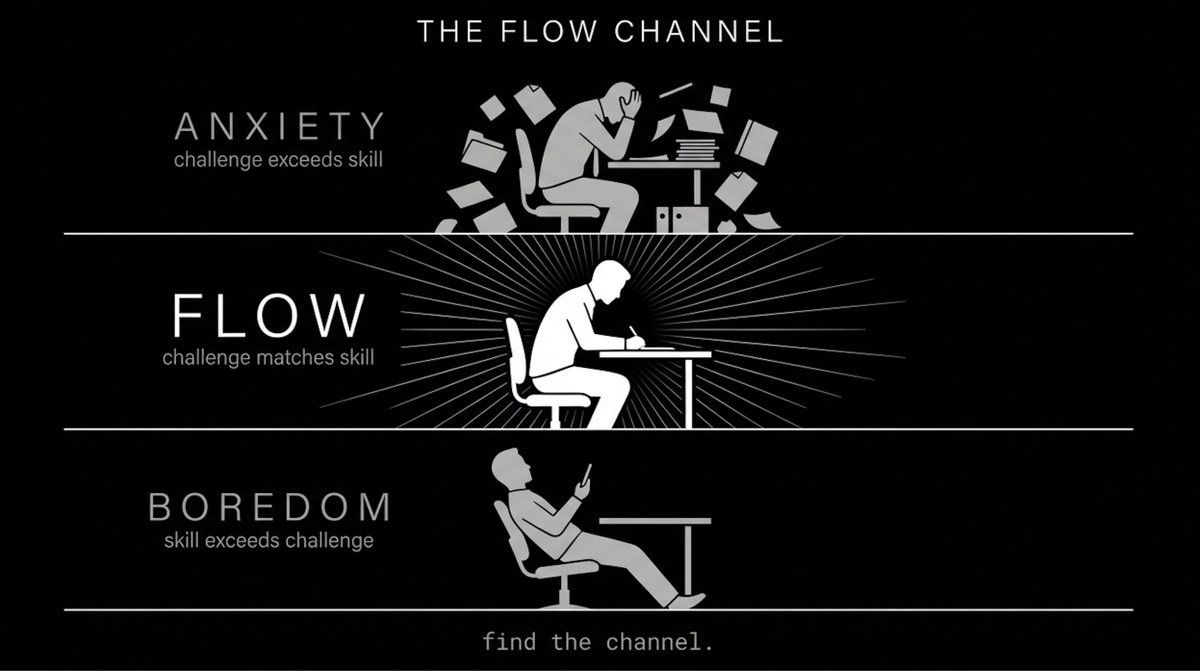
The range of experiences that used to overwhelm me now intensified my focus and performance.
I could suddenly do the professional equivalent of handling the steep, rocky hill on the bike and the double black diamond ski runs.
My biology was confronted with a circumstance that required me to explode my flow channel.
Hungarian psychologist Mihaly Csikszentmihalyi discovered the flow channel in the 1970s.
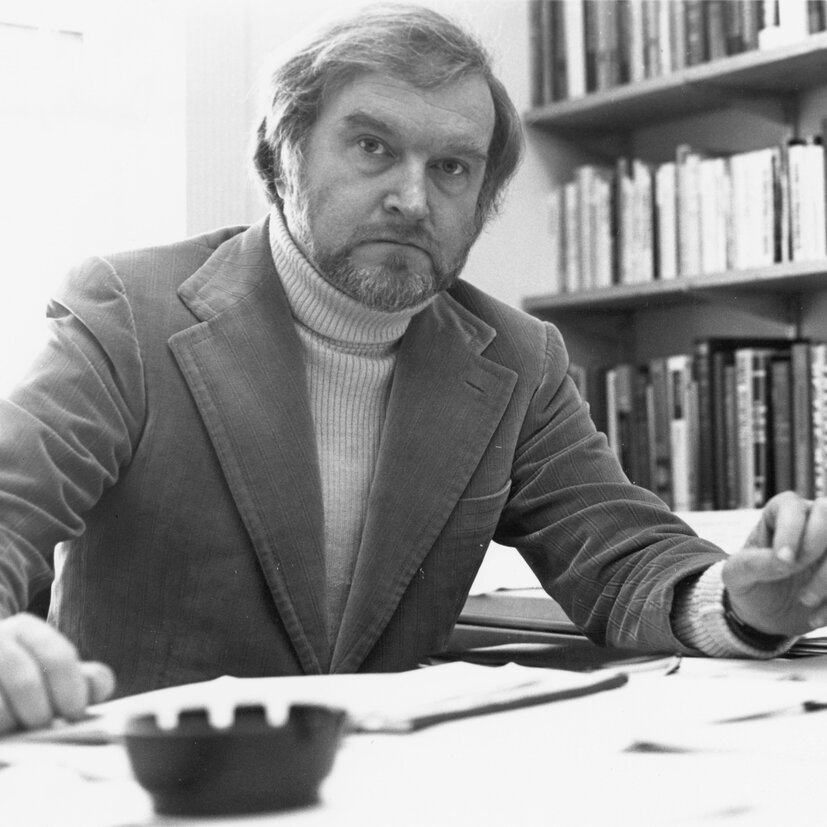
When in the flow channel, people lose track of time and become completely absorbed in what they’re doing. Outside the channel lie two states:
Boredom — when the challenge is too low for your skill level.
Anxiety — when the challenge is too high.
The flow channel is the balance between them.
And here’s the key: the wider your flow channel, the more opportunities you have to get into flow.
You can perform at a high level in more situations, including under conditions that would previously overwhelm you.
With a narrow flow channel, you can only access flow under ideal conditions - the flat road on a bike, the one beginner run at the ski resort. Life feels stressful at a level below where it could.
The beauty of widening the flow channel is that the whole mountain opens up. You can ski greens, blues, blacks, or doubles, with the possibility of flow across all of them.
You can widen the flow channel in two ways:
By lowering your baseline for boredom
By increasing your capacity to handle challenges
The optimal blend is when you are hard to bore and hard to make anxious.
Exploding the flow channel means rapidly expanding that capacity so you can thrive under extreme conditions that previously would have overwhelmed you.
I saw a vivid example of this on a childhood trip to Croatia.

In Ireland, kids took six months of swimming lessons before the armbands came off.
In Croatia, parents tossed their children off piers into the Adriatic.
I watched a father carry his 5-year-old out onto a barnacle-covered pier. The boy grasped at his dad’s hands, sensing what was coming.
In one motion, the father flung him over the edge. His shriek was engulfed by crashing waves.
After minutes of frantic splashing, the child began paddling in circles - coughing up seawater but staying afloat.
Above on the pier, the father laughed and clapped.
That’s what it’s like to explode the flow channel.
You force yourself to learn to swim so you don’t drown.
The risk is real - you might drown. But the upside is learning to swim in minutes rather than months.
II - The Three-Step Process: Overload, Adapt, De-load
So how do we actually do this?
It sounds good in theory, but what are the practical steps to pull this off, to crack open our resilience reservoirs, explode the flow channel, and expand our capacity?
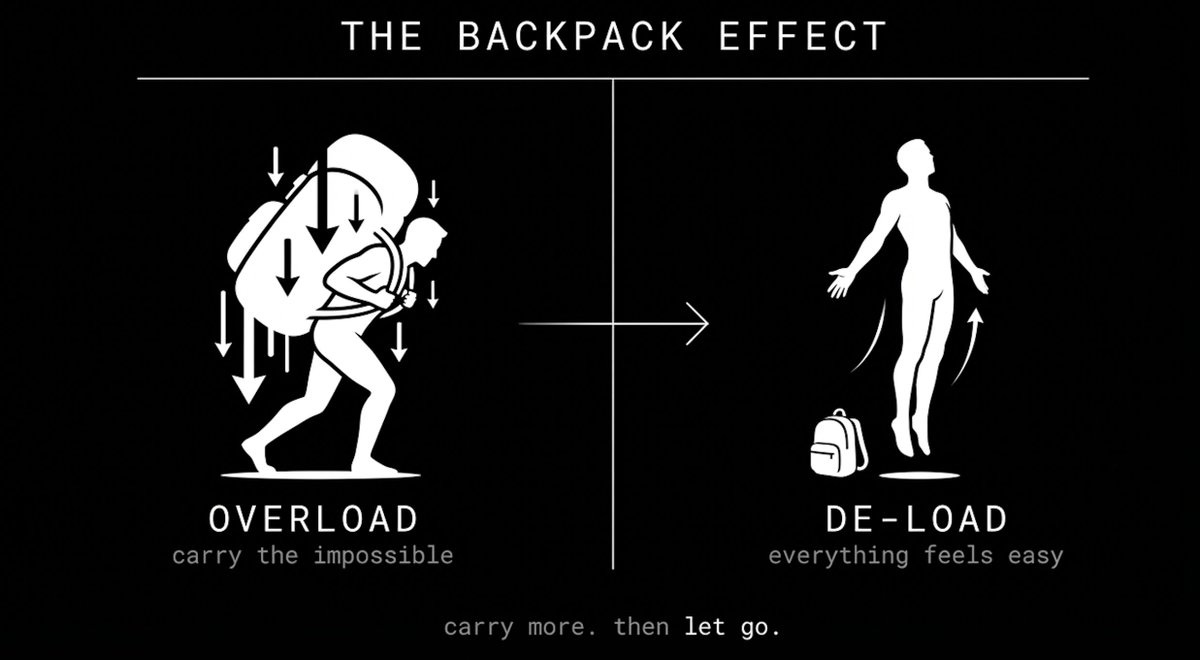
Think back to a time when you had a heavy bag on your back for a while.
Remember how, after you take it off, it suddenly feels like you can jump twice as high?
That’s what we’re going for.
To tap into your dormant resilience and expand your capacity, there are three steps:
1. Overload
2. Adapt
3. De-load
Step 1: Overload
Take on an inconceivable amount more than you’re handling now.
More responsibility, more work, more challenge.
This intense overloading forces an explosion of your flow channel.
When overloading, go through a discrete phase where you 10-100x the load you are carrying, to a degree that feels unfathomable and even insane.
Similar to the woman who lifted the car or the woman who fought off the polar bear. What’s your version of the car or polar bear?
It should feel like it might take you years to be ready to pull off the overload phase.
Otherwise, you likely haven’t overloaded enough.
Remember, the load refers to responsibility and high consequences: both things that will increase your biology’s ability to respond and thus tap into resilience reservoirs by necessity.
For example, just saying to yourself that you’ll work harder doesn’t increase the responsibility load.
At most, the only consequence is internal: breaking the word to yourself. This matters, but it’s nowhere near the external high consequences of saving a child’s life, for example.
So first, get clear on your most important professional goal right now.
Really crystallize it.
This is your own version of Hell Week, your polar bear to fight, your car to lift.
Now, with a huge professional goal in mind - the car you want to lift - ask yourself:
How could I realistically achieve this goal in 1/10th of the time? What would that require?
The goal is not simply increasing your output, but fundamentally upgrading the capacity of your mind and nervous system by exploding the flow channel.
Overloading in this manner forces your brain to rapidly develop new neural pathways, abilities, and cognitive faculties to handle the intensity. An exponential jump in responsibility leads to exponential growth in mental capacity.
And it leads to exponential accomplishment.
Overload Rules
A few important distinctions to keep in mind:
The overload needs to be focused on your core professional domain.
Don’t spread yourself thin trying to overload in all areas of life at once. Stack responsibility and activity within your central field.
For example, if you’re a software engineer, take sole ownership of a massive new feature instead of overloading with different, unrelated coding projects.
Overloading by taking on disparate new projects will dilute the effect. You want one unbelievably heavy backpack, not ten average-weight backpacks. Use overload to go deeper in your profession, not wider.
Avoid setting arbitrary goals without activity attached.
Don’t just affirm bigger outcomes - drastically amp up relevant action toward them.
Overload is about doing, not just thinking bigger. Match bold goals with equally bold day-to-day efforts.
You have to fully immerse yourself.
Cancel all non-essential meetings and obligations. Rearrange your life to fully focus on this one make-or-break goal for a short sprint.
For example, when working on a book with my writing partner, it typically takes us a couple of weeks to get a solid draft of a chapter.
So, we both canceled all of our meetings, booked an expensive hotel in West Hollywood, and spent a week getting ten chapters written.
We didn’t just set a goal to write faster - we drastically rearranged our lives to make hitting that exponentially increased goal a make-or-break priority.
The high consequences for failing to deliver those 10 chapters in a week would have been enormous in terms of wasted time, money, and momentum. And we’d fail to hit the publisher’s timeline.
Overloading yourself requires an exponential, not incremental, approach.
Don’t gradually add to your workload, like lifting slightly heavier weights at the gym.
That elicits incremental growth at best. Instead, blast past your perceived limits entirely. Take on a burden so heavy and unrealistic that it seems absurd to even try.
The last rule when considering what to overload with is to ask: Where are you investing the stress you’re inevitably going to feel?
Every project comes with stress and preoccupation, so you may as well pick big, meaningful projects to allocate the inevitable stress to.
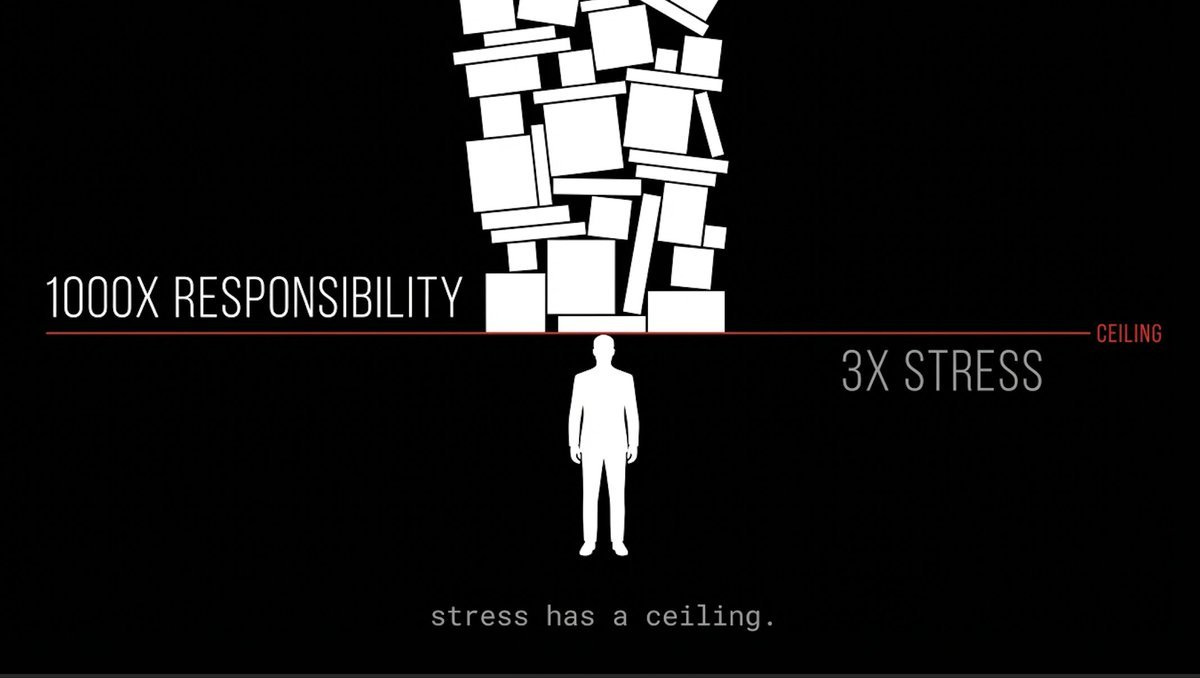
Because, as mentioned, you’re going to hit a stress ceiling either way.
An enormous project doesn’t have an equivalently large increase in stress associated with it. You can only have so much cortisol in your system, and that cortisol can always be systematically cleared through active recovery.
This overload phase will feel scary - like the Croatian kids being plunged into the ocean without knowing how to swim. But only by entering these unknown waters will you learn to swim them.
And by persisting through the uncertainty and stress, you’ll force dormant capacities and resilience to the surface.
Step 2: Adapt
Deploy every resource and skill you’ve got to handle the overload phase.
It will be brutal but liberating. Discomfort, yes, but not despair.
As you adapt to the overload, this is the moment you explode the flow channel - by making the ceiling for anxiety way higher, which means you can get into flow with much more on your plate.
Step 3: De-load
Finally, it’s time to de-load.
Return to your previous load, and it will feel like smooth sailing. Your capacity is now expanded, and with it, your flow channel is wider.
And then, after this period of taking on way more than you think, which forces your resilience reservoirs to the surface, something cool happens:
You stretch yourself out of shape.
Here’s how it works:
You’ve just put yourself through the intensity of the overload phase. You took on challenges and responsibilities multiple times greater than your previous norm.
It was uncomfortable. Stressful. It required deploying all of your skills in new ways and tapping into new reservoirs just to stay afloat. The human spirit kicked in, and you hit the top of your stress ceiling.
But now, after a set period of intensity - say 3-6 months - you deliberately drop back down to your original load levels.
Suddenly, everything feels easier.
Your original, pre-overload responsibilities that used to tax you now feel smooth and manageable. You can get vastly more done with less effort, and almost no stress.
It’s like trying to lift 100lbs for an hour, and then suddenly trying to lift 10lbs.
The 10lbs feel as light as a feather.
III - The Rubber Band Effect
What happened?
You’ve experienced cognitive elasticity, also known as the rubber band effect.
You had to rapidly expand to handle the overload phase. Just as muscles grow in size and strength when lifting heavy weights, your mental capacities grow when heavy cognitive loads are placed on them.
Your brain evolved new connections and pathways. Attention centers became more robust. You developed greater emotional resilience and more complex thinking patterns.
All of this was necessary just to survive the exponential increase in load and responsibility. You adapted.
But here’s the key: once grown, your brain doesn’t relinquish these new capacities when you return to lower load levels.
It’s permanently stretched, like a rubber band. Your fitness for tolerating professional responsibility has permanently increased.
The bottom line: If you take on an insane amount of responsibility periodically, afterward, work feels easy, and you can get into flow with a higher workload that previously would have overwhelmed you.
Here’s a helpful analogy to tie all of this together:
Imagine loading a heavy backpack onto your shoulders. At first, it feels crushingly heavy. Your muscles ache as you struggle under the weight.
But if you keep walking despite the strain, your muscles and mind adapt. Step by step, the burden lightens. Your legs strengthen; your resolve hardens.
Soon, you’re trekking smoothly with a pack that initially seemed unbearable. Your capacity expands to accommodate more.
Then, you de-load. Shed the recently added responsibility and drop back to normal levels.
Suddenly, your original workload feels smooth and easy. Your enhanced abilities and freshly widened flow channel make what once felt taxing now seem simple.
But it goes even deeper. It’s not just that doing what you were doing feels easy; it’s that doing double what you were doing feels easy now.
For example, a 1000% increase in workload may cause 300% more stress (due to the stress ceiling). Adapt and de-load, and that 300% stress drops down to nothing. From there, it requires a 2000% increase in workload to feel stress again.
Overload, adapt, de-load. By training this way, you gain strength, resilience, and skills you never knew you had. And you explode your flow channel.
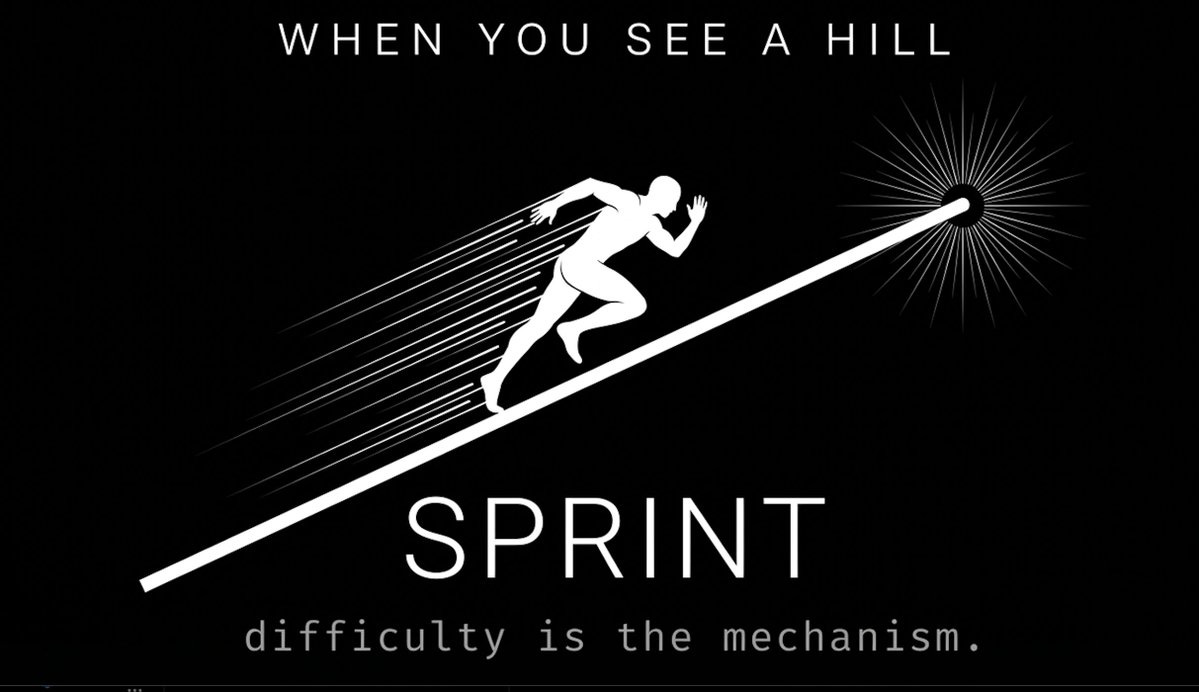
One way to remember this: “When you see a hill, sprint.”
You may not be able to handle what’s currently on your plate, but you may be able to handle far more than what’s currently on your plate.
A certain amount of pressure is required for antifragility to form.
An overload of additional requirements is often easier to handle than partial additional requirements as it summons more out of you.
IV - Putting It All Together
Your biology has resilience reservoirs waiting to be cracked open.
You have a stress ceiling that prevents you from feeling proportional stress no matter how much responsibility you take on.
And you can permanently expand your flow channel through deliberate overload.
The three steps:
1. Overload — Take on 10-100x your current responsibility in your core domain. Make it a make-or-break sprint with real consequences.
2. Adapt — Deploy everything you have. Your resilience reservoirs will crack open. What would have shattered you becomes your new normal.
3. De-load — Return to your previous load. Everything feels easy. Your capacity is permanently expanded.
When you see a hill, sprint.
You may not be able to handle what’s currently on your plate.
But you can almost certainly handle far more.
That analogy of taking the heavy backpack off your shoulders makes so much sense - it is so true isn't it, you do feel like you could jump so much higher!
Never considered that you could (and should) apply it to professional life.